Discovering and exploring mathematics in every story

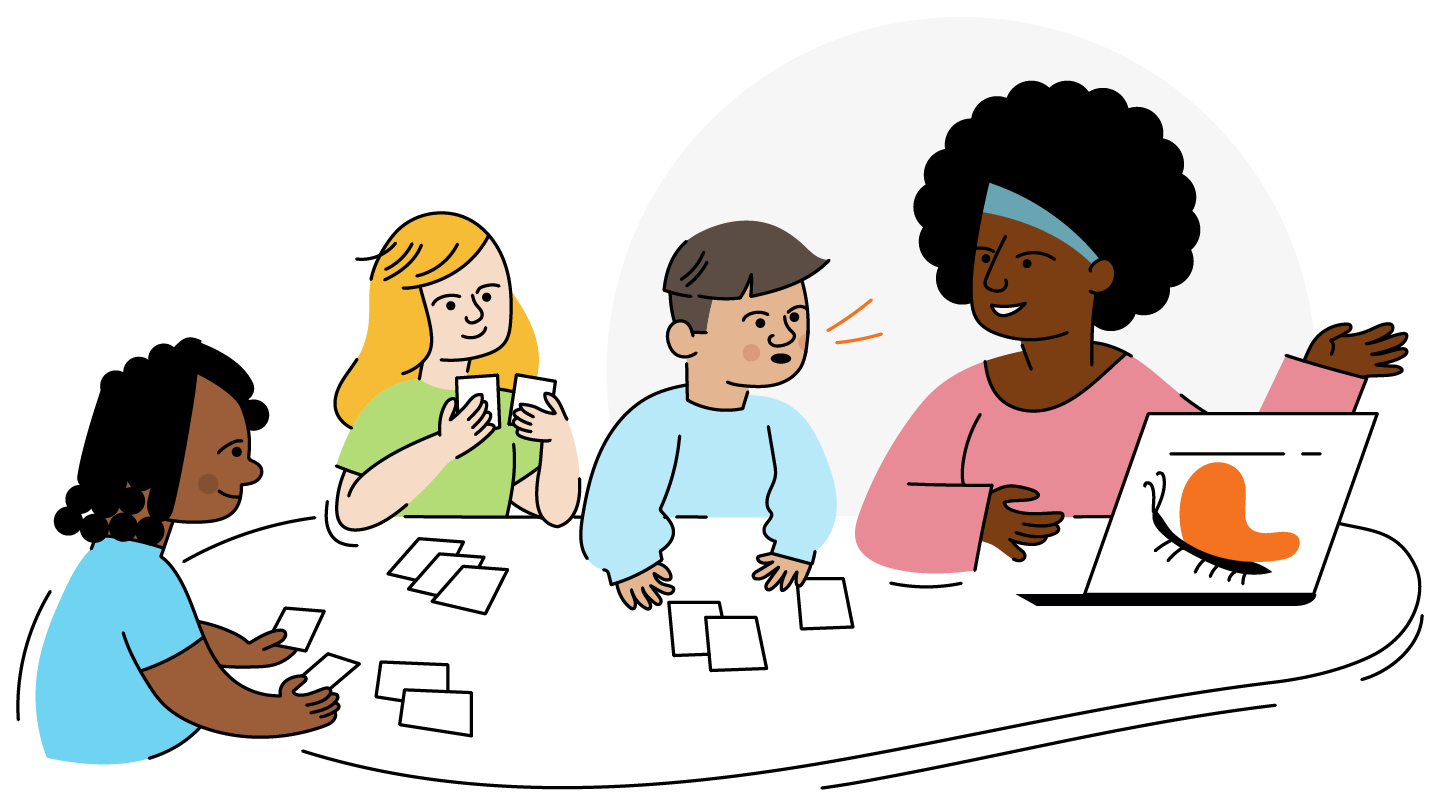
Smiling young boy sits at a classroom desk holding an open book, developing reading comprehension, while two other children are seen in the background engaged in activities.

Every picture book on your classroom shelf holds mathematical treasures waiting to be discovered! What if every read-aloud could go beyond a literacy moment to become a catalyst for mathematical sense-making? This question lies at the heart of Allison Hintz and Antony T. Smith’s delightful and informative book, Mathematizing Children’s Literature: Sparking Connections, Joy, and Wonder Through Read-Alouds and Discussion.

Many teachers have used traditional counting books and shape-focused stories to support students in connecting mathematics to literature. According to Hintz and Smith, you can challenge readers to extend and expand upon these experiences in ways that provide more space for them to make sense of stories; ask their own questions; see mathematics authentically in the world; and make connections between the stories, the math, and their lives. That’s the promise of mathematizing—approaching any story with a mathematical lens.

The concept of “mathematizing” goes beyond simply finding numbers in a story. Children are naturally curious and construct meaning by noticing, exploring, explaining, and modeling. The story context becomes a place to play and practice seeing math everywhere in our world. As we read a story aloud and pause to ask, “What do you notice? What do you wonder?,” students are able to surface structure, compare quantities, model situations, and justify their ideas, all while staying rooted in characters, plot, setting, and theme. The result is a classroom where math feels joyful, meaningful, connected, and accessible.

In this post, we’ll explore simple moves to mathematize your next read-aloud, sample prompts to elevate discussion, and follow-up activities to turn your library into a launchpad for mathematical thinking!

Mathematizing process and structure

While there’s no one way to facilitate a mathematical read-aloud, the following steps can help you get started:

  1. Explore books in your current library. There are no hard and fast rules for choosing the right book to mathematize, because a book can spark mathematical ideas in many ways. Look for books that a) are overtly ‘mathy’ where the math is central to the story’s plot, b) have illustrations that provide opportunities to explore the math in them, and/or c) have a story that inspires mathematical thinking, even if the math isn’t central to the story’s plot.
  2. Read the book aloud for the first time. The first read is a wonderful opportunity for students to hear and enjoy the story itself.
  3. Ask students what they noticed and wondered. As students share their responses, record them on a piece of chart paper to revisit later. If no responses pertain to the math in the story, you can follow up with the question, “Where did you see math in the story?”
  4. Reread the book a second time or revisit a specific page in the book. At this point, you want to start to focus on the math the students will explore in the book. You can either reread the entire story and pause on strategic pages that center on the mathematical ideas, or revisit specific pages in the story. (If the story is longer,it will probably be easiest to just flip back to specific pages.)
  5. Elicit student thinking. Ask students what math questions they could ask based on the pages they revisited.
  6. Give students a follow-up math activity. This could be based on a question the students mentioned earlier in this process, or one the teacher has planned.

Mathematizing examples

To save you time finding a book to use, we’ve outlined a plan based on some of our favorite books to mathematize (listed by grade band).

Grade levelK–1
Book title and authorBear Says Thanks by Karma Wilson
Mathematical focusCounting, addition, and mathematical representations
LaunchRead the story aloud. Ask students, “What do you notice? What do you wonder?” Record their responses on a piece of chart paper. And ask students, “How many friends visited Bear? What different food items did Bear’s friends bring?”
Pages to revisitAs students describe the different foods, revisit those pages. Identify any foods the students didn’t mention. As you revisit each page, ask students, “How many of that food item did that friend bring? ”Record their responses on a piece of chart paper for each friend. 
ActivityArrange students in small groups of 3–4 and give them a piece of poster paper. Ask students to show each friend’s food items. They can represent them using pictures, counters, ten-frames, etc. After they’ve correctly represented each friend, ask them to show how many total food items Bear’s friends brought using numbers and equations. When they’ve finished, have them visit one another’s posters to see how others represented and added the food items. 
Grade level2–3
Book title and author100 Hungry Ants by Elinor J. Pinczes
Mathematical focusConnecting arrays to expressions
LaunchRead the story aloud. Ask students, “What do you notice? What do you wonder?” Record their responses on a piece of chart paper. And ask students, “How did the ants rearrange themselves throughout the book?”
Pages to revisitAs students describe the different arrangements of ants, revisit those pages so students have a visual of the array. As you revisit each page, ask students, “How many ants are in each row? Each column? What is an equation we can write to represent the array?” Record their responses on a piece of chart paper. 
ActivityArrange students in small groups of 3–4 and give them a piece of poster paper. Give each group a different number of ants. Suggested numbers are: 12, 24, 36, 20, 18. Ask students to draw all of the different ways their number of ants could rearrange themselves and record an equation to match each. If it’s helpful, you can give each group a set of cubes, counters, or beans to represent the ants so they can manipulate them. Wrap up the activity by having students visit one another’s posters and discussing the similarities and differences between them. 
Grade level4–5
Book title and authorDozens of Doughnuts by Carrie Finison
Mathematical focusMultiplication and division
LaunchRead the story aloud. Ask students, “What do you notice? What do you wonder?” Record their responses on a piece of chart paper. And ask students, “How many ways did Luanne share her doughnuts as friends arrived at her door?”
Pages to revisitAs students describe the different ways Luanne shared her doughnuts, revisit those pages. As you revisit each page, ask students, “How many doughnuts were being shared? By how many animals? ”Record their responses on a piece of chart paper. 
ActivityArrange students in small groups of 3–4 and give them each a piece of poster paper. Ask them to show all of the ways Luanne shared her doughnuts. To enable variation, refrain from specifying the representation they should use. After they’ve finished, ask them to do a Gallery Walk to each other’s posters to get ideas to add to their poster. If none of the groups have a multiplication and division equation for each way, ask students to record those as well. Ask students how Luanne could have shared a dozen doughnuts with the following number of animals showing up at her door: 5, 8, 10, 14, 16, and 18. Encourage students to show their work and record multiplication and division equations. 

And with all the upcoming holidays and opportunities to gather with friends and family, we were also inspired to use Spaghetti and Meatballs for All! by Marilyn Burns in a mathematizing read-aloud. Follow this link to find K–2 and 3–5 lesson plans for this book that you can use right away!

Getting started with Amplify Science California

Dear Elk Grove K–5 teachers,

Welcome to the Amplify Science California family! Below you’ll find everything you need to successfully kick off your science instruction this year.

– Your California team

Amplify Science - Student reading a book remote & hybrid

Program introduction

Onboarding videos

To start using Amplify Science California quickly in your classroom, check out the following onboarding videos. They cover what you need to know to get started fast, from unpacking materials to quickly start using Amplify Science in your classroom and navigating the digital Teacher’s Reference Guide.

Program pacing

Hands-on materials kit

The following videos give you a quick look into our Amplify Science California classroom kits. For each grade level, you’ll find a “How to unpack your kit” video for the first unit of the program.

Teacher digital resources

Watch this video to understand the basic organization of the digital teacher experience and how to navigate the platform.

Want some practice? Download this exploration guide to practice toggling between teacher view, presentation view, and student view.

Our new digital experience also makes it easy to assign work through our LMS integrations.

Our new digital experience also makes it easy to view student work in real time.

Student digital resources

Watch this video to take a peek at the various student digital resources available to your class.

Use this Student Login Click Path document to support students and families logging in from home.

Essential resources

Your Teacher’s Reference Guide is a tremendously rich resource. It’s also packed! That’s why teachers getting started with Amplify Science love our condensed Unit Guides, lesson planners, and device calendars.

Unit Guides

These short and sweet guides provide a big picture overview of each unit’s phenomenon and storyline, the key questions that guide learning, and how the storyline develops from chapter to chapter. We even spoil the big reveal at the end by pointing out ahead of time what students figure out throughout the unit.

A laptop displays an educational website titled "The Earth System" with lesson modules; a printed Teacher’s Guide with a similar cover design is shown beside it.

Kindergarten

Grade 1

Grade 2

Grade 3

Grade 4

Grade 5

Lesson planners

Our lesson planners give you easy access to direct links to key resources within the program.

Kindergarten

Grade 1

Grade 2

Grade 3

Grade 4

Grade 5

Teacher-provided materials

Your Amplify Science classroom kit includes a wide variety of consumable and non-consumable items. In fact, each kit contains enough non-consumables to support a class of 36 students working in small groups, and enough consumables to support 72 student uses.

In addition to these provided items, there are some teacher-provided items required in each unit. For a consolidated list of teacher-provided items per unit, download the appropriate PDF below.

Device calendars

Our at-a-glance device calendars make device management and sharing between grade-level colleagues a breeze. With one calendar per unit (beginning in grade 2), you can easily see which lessons utilize devices.

Approach to assessment

The Amplify Science California assessment system is grounded in the principle that students benefit from regular and varied opportunities to demonstrate understanding through performance. In practice this means that conceptual understanding is revealed through engagement in the science and engineering practices.

Assessment types at a glance

In your classroom, you’ll be utilizing a variety of formative (F) and summative (S) assessments:

  • End-of-Unit Assessment (S): Assessments toward the end of each unit feature a combination of targeted discussions, student-generated models, and written explanations to gauge students’ knowledge and growth.
  • Pre-Unit Assessments (F): Discussion, modeling, and written explanations to gauge students’ knowledge.
  • On-the-Fly Assessments (OtFA) (F): Multi-dimensional tasks integrated regularly throughout the lessons. OtFA opportunities were designed to help teachers make sense of student activity during a learning experience (e.g., student-to-student talk, writing, and model construction) and to provide evidence of how a student is coming to understand core concepts and developing dexterity with SEPs and CCCs. Three-dimensional assessment opportunities make measuring progress toward NGSS learning goals possible.
  • Self-assessments (F): One per chapter; brief opportunities for students to reflect on their own learning, ask questions, and reveal ongoing wonderings about unit content.
  • Critical Juncture Assessments (F): Variety of multidimensional performance tasks intended to assess student progress, occurring at the end of each chapter. Examples include writing scientific explanations, engaging in argumentation, developing and using models, and designing engineering solutions. Based on student performance on the assessment, teachers have access to recommendations for targeted student interventions, suggested follow-ups, or differentiating classroom instruction.
  • End-of-Unit Assessment (S): Assessments toward the end of each unit feature a combination of targeted discussions, student-generated models, and written explanations to gauge students’ knowledge and growth.

Pre-Unit Assessments

Most Pre-Unit assessments are embedded within an activity of the first lesson of a unit. In kindergarten and grade 1, the Pre-Unit assessment (as well as the End-of-Unit assessment) is oral. In grades 2–5 they are typically written. Refer to the Digital Resources area of the Lesson Brief for materials needed for the assessment activity, such as the Clipboard Assessment Tool (K–1 only), copymasters (grades 2–5 only), and an Assessment Guide that will help you interpret and leverage students’ responses.

If you and your students have Interactive Classroom licenses, students can complete their assessment digitally instead of using the copymaster.

When students complete the assessment pages digitally, you’ll be able to review their work on the View Work page.

Critical Juncture Assessments

Critical Juncture assessments typically occur towards the end of each chapter. The Materials and Preparation section will indicate when there is a Critical Juncture to prepare for, but you can also tell when an activity is designed to be a Critical Juncture assessment by the hummingbird icon that will appear within it. Selecting the hummingbird icon will tell you how to assess students’ understanding with the activity, and how to tailor instruction based on what you find. If you need guidance on the “answers” to the assessment activity, refer to the “Possible Responses” tab.

If you are using Classroom Slides or Interactive Classroom, you’ll see a hummingbird or “Critical Juncture” label in the bottom right corner of one of the slides of the activity.

The notes about assessing understanding and tailoring instruction are located in the notes of that slide (on the right-hand side of the Teacher’s Guide tab in the Interactive Classroom experience; underneath the slide in Classroom Slides).

End-of-Unit Assessments

End-of-Unit assessments are typically the last lesson of a unit. In some units, these are two-part assessments that take place over two lessons. The easiest way to find the End-of-Unit assessment is to skim through the lesson titles. Lessons containing End-of-Unit assessments will always have that noted in the title.

Like the Pre-unit assessment, you can find materials for the End-of-unit assessments in the Digital Resources area of the Lesson Brief.

On-the-Fly Assessments

These embedded assessments leverage the formative opportunities in the learning experience students are already engaged in, such as creating models, analyzing data, actively reading, conducting investigations, and more. Refer to the Critical Juncture section above for guidance on finding information about using them.

Unit-level assessment information

You can find overall information about an individual unit’s assessments in the “Assessment System” resource, which is located within the Teacher References section on the Unit Overview page.

The Assessment System resource contains a comprehensive list of all of the assessment opportunities in the unit, including the assessment’s location, a brief indication of what students are doing in that particular activity, what type of assessment it is, which Disciplinary Core Ideas, science and engineering practices, and cross-cutting concepts it specifically addresses, and the kind of evaluation guidance you can expect for it. If you are in a kindergarten or first grade unit, you will also find information on the Clipboard Assessment Tool (used for supporting oral assessment) in this section.

If you’re interested in focusing on information related to the unit’s Critical Juncture and On-the-Fly assessments in particular, check out the “Embedded Formative Assessments” resource, also located within the Teacher References section on the Unit Overview page.

Three-dimensional assessment connections

All assessment opportunities within Amplify Science California include clear labeling around the Disciplinary Core Ideas (DCIs), Crosscutting Concepts (CCCs), and Science and Engineering Practices (SEPs) to help teachers connect formative and summative assessments to specific NGSS dimensions.

Coming soon

Unlike other publishers, we don’t make you wait until your next adoption to get the latest and greatest from Amplify. We’re always launching new and exciting features. In fact, on this page is a list of new features you can look forward to using during the 2023-2024 school year.

FAQs

Program questions

Amplify Science California is a flexible, blended K–8 science curriculum that addresses 100 percent of the Next Generation Science Standards for California and a significant number of the California English Language Development Standards and Common Core State Standards for English Language Arts, Literacy in Science and Technical Subjects, and Math. Together, the units deliver three-dimensional instruction across the following disciplines: Life Science, Earth and Space Science, Physical Science, and Engineering Design.

Amplify Science California does indeed feature some powerful and engaging digital components, which are gradually introduced beginning at grade 2. However, as a fully blended and flexible program, Amplify Science California can be (and has been) implemented in a wide variety of scenarios.

All lessons were designed with device sharing in mind, and never assume that every student has a separate device. While 1:1 scenarios are great, they aren’t required. When devices are necessary for students to fully experience a concept, teachers can opt to share devices across pairs or small groups, or simply display the Sim or Modeling Tool to the whole class and allow students to “drive” using your device.

Rather than introducing a concept on Monday, testing for mastery on Friday, and knowing students will forget everything by the next Tuesday, we set out to help students build meaningful and lasting knowledge that they can retain and transfer over the course of the entire unit. We accomplish this by giving students multiple opportunities (a.k.a. “at-bats”) to encounter, explore, and experience a concept. Said another way, Amplify Science California is actually made up of a series of multi-modal “mini-lessons.” This intentional, cyclical, and iterative design mirrors the 5Es, allows teachers the flexibility to speed up or skip ahead once students have demonstrated mastery, and empowers students to learn concepts more deeply than any other program.

Yes. Rather than separating performance expectations into physical science units, earth and space science units, and life science units, Amplify Science California units are organized around anchoring phenomena designed to give students opportunities to dive deeply into certain Disciplinary Core Ideas (DCIs) while also drawing from or applying to others. In organizing the Amplify Science California middle school units, we’ve carefully sequenced these ideas within each grade level to support the development of deep and coherent understanding.

Many real-world phenomena cross the domain boundaries of life, physical, or earth and space science (as well as engineering). Each Amplify Science California unit begins with an intriguing real-world phenomenon that poses a problem that needs to be understood and/or solved. By the end of the unit, students will have analyzed the anchor phenomenon across multiple scientific domains, possibly designed and tested an engineering solution, and applied what they’ve learned in a different context.

For example:
In the Light Waves unit, students investigate the anchoring phenomenon of why Australia has a much higher skin cancer rate than countries at similar latitudes like Brazil. The focus of this unit is on Disciplinary Core Ideas related to wave properties (PS4.A) and electromagnetic radiation (PS4.B). Students explore these physical science ideas deeply within the unit, and also draw on ideas from earth science (e.g., latitudinal variation of the sun’s energy) and life science (e.g., the effect of energy on the DNA in the nucleus of a cell) in order to explain the central phenomenon.

Absolutely. Hands-on learning is at the heart of Amplify Science California. Integrated into every unit are opportunities for students to take on the role of scientists and engineers as they gather evidence, think critically, solve problems, and develop and defend their claims.

In addition, our unique combination of focus and flex activities means teachers have more options, opportunities, and materials to make learning active. Each hands-on activity provides clear instructions for the teacher, with more complex activities supported by video demonstrations and illustrations.

What’s important to remember is that more hands-on doesn’t necessarily mean better, at least according to the California NGSS. That’s because only two of the eight Science and Engineering Practices (SEPs) are directly related to hands-on learning.

Just as scientists gather evidence from many types of sources, students in the Amplify Science California program gather evidence not just by making physical models, but also by making and interpreting digital models; reading texts; watching videos; and analyzing photographs, maps, and data sets. By doing do, students are provided with more opportunities than any other program to use all of the practices called out in the California NGSS Framework:

  • Asking questions
  • Developing and using models
  • Planning and carrying out investigations
  • Analyzing and interpreting data
  • Using mathematics and computational thinking
  • Constructing explanations
  • Engaging in arguments from evidence
  • Obtaining, evaluating, and communicating information

While all of our units engage students in gathering evidence from a rich collection of sources, the reliance on different types of evidence (and evidence sources) varies according to unit. For instance, some units lend themselves to meaningful hands-on experiences, while in other units the phenomena students are investigating are too slow, too dangerous, or too big to be observed directly. In those units, students rely more heavily on other evidence sources such a physical models or simulations.

Unit types in grades K–5

In each K–5 grade, there is one unit that emphasizes investigation, one that emphasizes modeling, and one that emphasizes design. In addition, in grades 3–5, there is also one unit that emphasizes argumentation.

Unit types in grades 6–8

Each 6–8 grade features three types of units: LaunchCore, and Engineering Internships. Each year has one Launch unit, six Core units, and two Engineering Internships.

For teachers who want to supplement the lessons with even more hands-on activities, optional “flextension” activities are included in many units.

Yes indeed. Amplify Science California integrates all four STEM disciplines—science, technology, engineering, and math, in addition to English Language Arts—throughout the curriculum. In addition, each grade level features specific units that emphasize engineering design.

Yes, the program includes multiple opportunities for summative assessments.

End-of-unit assessments: At grades K–1 these look like targeted conversations, at grades 2–5 we incorporate written responses, and at grades 6–8 we assess through a combination of auto-scored multiple-choice questions and rubric-scored written responses. These summative assessments for each unit are designed to provide valid, reliable, and fair measures of students’ progress and attainment of three-dimensional learning.

Benchmark assessments: Delivered four times per year in grades 3–5 and three times per year in grades 6–8, benchmark assessments report on students’ facilities with each of the grade appropriate DCIs, SEPs, CCCs, and performance expectations of the California NGSS.

Science Seminars and final written arguments (formative and summative components): In grades 6–8, culminating performance tasks for each core unit invite students to figure out a new real-world problem. They collect and analyze evidence, examine a number of claims, and then engage in a full-class discussion where they must state which claims are best supported by the evidence, all while making clear their reasoning that connects the evidence to the claims. After the seminar, students then individually write their final scientific argument, drawing on the DCIs, SEPs, and CCCs they have used over the course of the unit to develop a sophisticated and convincing argument that addresses the problem they’ve been investigating. Rubrics, scoring guides, and examples of student responses at each scoring level are provided to teachers to support the assessment of students’ understanding of concepts and specific practices.

Amplify Science California provides more than enough instructional content to fill 180 days of instruction. However, unlike other programs that expect you to complete 180 discrete lessons, Amplify Science California includes built-in wiggle room.

For example, the typical elementary classroom delivers science instruction only two times per week. Rather than asking teachers to wade through unnecessary content, we designed our program to address 100 percent of the California NGSS in just 66 days at grades K–2 and 88 days at grades 3–5. When it comes to middle school, we address 100 percent of the California NGSS in 146 lessons.

Some classes might last longer than one session due to a number of reasons (e.g., enthusiastic student conversations, challenging topics requiring deeper dives, more time needed to accommodate diverse learners, etc.). Also, teachers might want to supplement Amplify Science California with some of their own favorite lessons. Lastly, we’ve accounted for the inevitable assembly days, class trips, testing schedules, etc. For teachers that want to go deeper or expand upon a unit topic, we also offer a number of additional lessons that are not core to each unit.

Amplify Science California lessons are designed to be completed in the following time frames:
Lessons in grades K–1 are designed for 45 minutes of science instruction.
Lessons in grades 2–5 are designed for 60 minutes of science instruction.

That said, it’s not a problem if you can’t allocate 45 minutes of science instruction every day at K–1, or 60 minutes per day at 2–5. Since there are a total of 66 lessons to address 100 percent of California NGSS at grades K–2, and 88 lessons to address 100 percent of California NGSS at grades 3–5, you can easily teach the lessons in smaller blocks and cover all of the content over the course of the school year.

Each lesson of every Amplify Science California unit includes point-of-use differentiation strategies and embedded teacher and student supports for diverse learners, including English learners, students who need more support, and students who are ready for more challenge. These strategies and methods ensure that all students have access to the same content as their peers.

Two notable categories of suggested modifications are:

  • English-learner-specific strategies such as English/Spanish glossaries, native language supports, and provision of cognates and other content-specific language scaffolds are provided in each unit.
  • Relatively small alterations and additional scaffolds that provide students with greater access to the content.
    These types of scaffolds benefit all learners and include suggestions such as providing graphic organizers, practice with multiple-meaning words, etc.

With Amplify Science California, the use of technology is always purposeful.

For example:

  • The curriculum has a strong emphasis on literacy, with students reading and analyzing informational texts, and writing scientific explanations and arguments.
  • Digital elements are gradually introduced to students in grades 2–3, with the greatest use of digital elements taking place in grades 4–5, as the phenomena at these grades become more challenging to observe directly.
  • The curriculum’s readers and interactive notebook pages are available in both print and digital across all K–5 units.

This curriculum addresses a significant number of the standards as they pertain to science. Throughout each unit, students read science texts, engage in science talk and argumentation, and write evidence-based science explanations. The curriculum supports vocabulary, language, and reading comprehension development. Students also use measurement tools with precision, record and analyze data, make sense of scientific phenomena, and develop solutions to problems experienced in the real world.

Digital questions

Teacher Support notes including sample teacher talk, student responses, pedagogical support, and possible student responses are provided within your student-facing slides. Simply click “Teach” and reference your private Teacher Guide tab. Students will only see the lesson slides that you are presenting.

You, the teacher, must “Start class” to launch the presentation tab. (Remember, without the presentation tab, students would be able to see your teacher notes.)

Clicking “Starting class” also brings students to the correct slide, which is particularly important for young students who are learning to navigate.

Teachers can either press the “End class” button in the bottom right corner of the slide navigation, or they can simply close the presentation tab.

Clicking “End class” also enables students to navigate through the lesson on their own. That means they’ll be able to return to slides and books to review content, to the Sims and Modeling Tools to replay them, or to notebook pages to update their work.

You can click on the “Student preview” option in the bottom right corner (within the menu that opens when you click the three dots) to open a new browser tab where you can preview the student view using your teacher account.

Any work you complete in this student preview (or elsewhere in the teacher experience) will be automatically saved to your account.

Looking for help?

For login or technology issues, please submit an EGUSD Heat ticket. For curriculum and pedagogical questions, please refer to the support resources below.

Powerful (and free!) pedagogical support

Amplify provides a unique kind of support you won’t find from other publishers. We’ve developed an educational support team of former teachers and administrators who provide pedagogical support for every Amplify curriculum, assessment, and intervention program. This service is completely free for all educators who are using our programs and includes:

  • Guidance for developing lesson plans and intervention plans.
  • Information on where to locate standards and other planning materials.
  • Recommendations and tips for day-to-day teaching with Amplify programs.
  • Support with administering and interpreting assessment data and more.

To reach our pedagogical team, use our live chat within your program, call (800) 823-1969, or email edsupport@amplify.com

Timely technical and program support

Our technical and program support is included and available from 4 a.m. to 4 p.m. PT, Monday through Friday, through a variety of channels, including a live chat program that enables teachers to get immediate help in the middle of the school day.

For your most urgent questions:

  • Use our live chat within your program.
  • Call our toll-free number: (800) 823-1969.

For less urgent questions:

Connect with other teachers

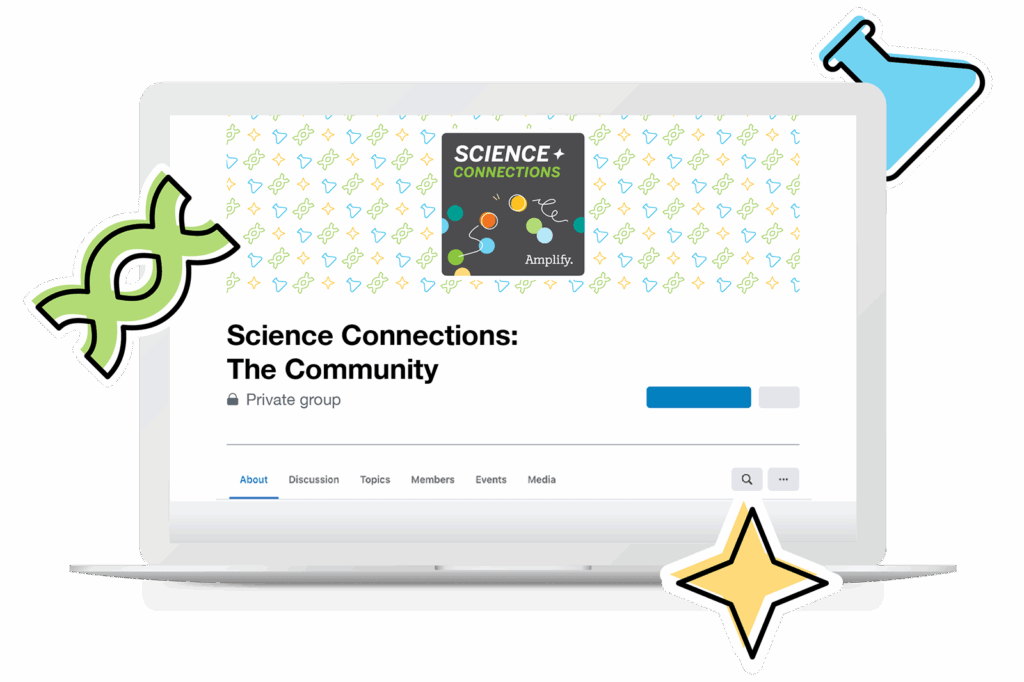
Our Amplify Science Facebook group is a community of Amplify Science educators from across the country. It’s a space to share best practices, ideas, and support on everything from implementation to instruction. Join today.

S3-05: Thinking is power

A graphic with the text "Science Connections" and "Amplify" features colorful circles and curved lines on a dark gray background.

Join us as we sit down with Melanie Trecek-King, college professor and creator of Thinking is Power, to explore how much of an asset science can truly be in developing the skills students need to navigate the real world. You’ll learn about “fooling” students and the importance of developing critical thinking, information literacy, and science literacy in the classroom. We’ll also share real strategies and lesson examples that help build these essential skills and engage students in learning.

And don’t forget to grab your Science Connections study guide to track your learning and find additional resources!

We hope you enjoy this episode and explore more from Science Connections by visiting our main page!

DOWNLOAD TRANSCRIPT

Melanie Trecek-King (00:00):

We say knowledge is power, but it’s not enough to know things. And there’s too much to know. So being able to think and not fall for someone’s bunk is my goal for my students.

Eric Cross (00:12):

Welcome to Science Connections. I’m your host, Eric Cross. On this third season, we’ve been talking about science’s underdog status. And just this past March at the NSTA conference in Atlanta, I had the chance to speak with science educators from around the country about this very topic.

Hermia Simanu (00:28):

Right now, there’s only two teachers in our high school teaching science.

Shane Dongilli (00:32):

I have 45 minutes once a week with each class. The focus is reading and math.

Alexis Tharpe (00:38):

Oftentimes science gets put by the wayside. And you know, I love math and I love my language arts, but I also think science needs to place be placed on that high pedestal as well.

Askia Little (00:46):

In fifth grade, oh, they teach science, because that’s the only grade that it’s tested.

Eric Cross (00:50):

That was Hermia Simanu from American Samoa. Her team flew for three days to make it to the conference. You also heard from Shane Dongilli from North Carolina, Alexis Tharpe from Virginia, and Askia Little from Texas. All of these teachers were excited to be at the conference and had a lot to say about the state of science education in their local schools. Throughout this season, we’ve been trying to make the case for science, showing how science can be utilized more effectively in the classroom. We’ve explored the evidence showing that science supports literacy instruction. We’ve talked about science and the responsible use of technology like AI. My hope is that all of you listeners out there can use some of this evidence to feel empowered to make the case for science in your own communities. And on this episode, we’re going to examine how science can help develop what might be the most important skill that we try to develop in our students: Good thinking. On this episode, I’m joined by a biologist who actually advocated for eliminating the Intro to Bio course at her college. Instead, Professor Trecek-King created a new course focused on critical thinking, information literacy, and science literacy skills. In this conversation, we discuss why the science classroom is such a good environment for helping students become better thinkers. Now, I don’t think that you can make a much stronger argument for science than using it to develop the skills that Melanie describes in this conversation. So, without further ado, I’m thrilled to bring you this conversation with Melanie Trecek-King, Associate Professor of Biology at Massasoit Community College, and creator of Thinking Is Power. Here’s Melanie.

Eric Cross (02:29):

Well, Melanie, thank you for joining us on the show. It’s so good to have you.

Melanie Trecek-King (02:34):

I am so happy to be here.

Eric Cross (02:35):

Now, I went to your session at NSTA in Chicago … I think it was two years ago. A couple years ago. And I was listening to your session, and as I was listening to you, I started Reverse Engineering in my mind what you were doing with your college students. I started reverse engineering the K–8. I was like, “This is amazing.” Where has what you’ve been doing been hiding? We need this not just in the college, higher ed. We need this all the way up and down. Because I hadn’t seen it before. So I think a good place for us to start is gonna be like the story of how and why you as a biologist wound up making the case to actually eliminate the Intro to Biology course at your college. So can you start off and tell us a little bit about that story?

Melanie Trecek-King (03:20):

Sure. So I started teaching at a community college in Massachusetts. And I absolutely love teaching at a community college. And I was teaching the courses that people who don’t wanna be scientists when they grow up have to take to fulfill their science requirement. And that course was Intro Bio. And I tried every way I could figure out to make that class be useful,] relevant to students. I mean, the thing is, our world is based on science and you have to understand science to be a good consumer of information, to make good decisions. And I’m a biologist, so it pains me to say this, but you know, somewhere in the middle of teaching students about the stages of mitosis and protein synthesis, I thought, “Is this really — like, if I have one semester that’s gonna be the last chance that someone’s gonna get a science education, is this really what they need?” And I just decided, “No.” So, to my college’s credit, they were very supportive. I went to them and said, “You know, I think we should assess the non-majors courses. Like, why do we teach non-majors science?” And we all agreed, well, it was for science literacy. OK, great. Do our existing non-majors courses do that? And so we evaluated each of the courses. I made a case that Intro Bio was not doing it. And so we actually replaced it with a course that I call Science for Life. And the whole course is designed to teach science literacy, critical thinking, and information literacy skills.

Eric Cross (04:48):

And so you did this while you were looking at mitosis. And you’re looking at students who may or may not be science majors. And then kind of asking that question. I know every educator asks this, and whether or not it’s welcomed or supported is a different question: “Is what I’m teaching actually gonna be relevant and useful later on down the road for this group of students?” And you actually got to run with it and then create this course, this new course. So, what were the skills that you were hoping to achieve with the new course you developed, and and why were those skills so important?

Melanie Trecek-King (05:21):

Well, if I just go back for a second to what you said, ’cause it, really hit me: I remember the actual moment — it had been building up to that point, but the actual moment that it hit me — I was teaching students the stages of mitosis. And I was applying it to cancer, because the thought is that if we use issues that are relevant to students to teach concepts, that it will be more meaningful to them. They’ll learn it better; they’ll be able to apply it. And they just looked absolutely deflated. They didn’t wanna be there. And I had this moment where I thought, “You know, if, if these students ever have cancer somewhere in their lives, is what I taught them going to be something that they remember? Is it going to be useful to them?” And quite frankly, like, no. <Laugh> They’re not gonna remember proto-oncogenes. And quite frankly, is that really what they need to know at that moment? What they need to know is, “What does this mean? Who is a reliable source of information here? If these treatments are recommended, what is the evidence for them? What are the cost-benefit analyses? Where do I go to find reliable information?” And in that space, cancer in particular, we have this whole field of — I wanna say charlatans, ’cause they may not actually be lying, but they’re pedaling false cures, false hopes. And people need that kind of hope, and so in their time of need, they’re more likely to fall for that kind of thing. Which leads me to the skills that I teach students. I call them this tree of skills. And the order is important. I start — and there’s a lot of overlap to be fair — but critical thinking, and then information literacy, and science literacy. The idea is that students carry in their pockets access to basically all of human’s knowledge at this moment in time. And if they needed to access it, they could. The question is, do they know what they’re looking for? Are they aware of their own biases that are leading them to certain sources, or certain false hopes? Are there certain things that are making them more vulnerable to the people that might prey on them? Are they able to use that information to make good decisions? There’s a great Carl Sagan quote, and it’s something like, “If we teach people only the findings of science, no matter how useful or even inspiring they may be, without communicating the method, then how is anyone to be able to tell the difference between science and pseudoscience?” So yes, the process of science is a process of critical thinking. However, we do tend to present science most of the time. Like, here’s what science has learned. And to be fair, those things that we’ve learned from science are really useful and inspiring. But if we don’t teach the process, so you’ve got somebody now who let’s say has been diagnosed with cancer and is on their phone and they’re scrolling through social media and everything looks the same. And of course the algorithms learn who you are. Next thing you know, there’s all of these like pseudo-treatments popping up. It all looks the same. Somebody who says that acupuncture can be used to cure cancer can feel the same, from someone who doesn’t understand the process of science, as a medical fact. And so the process is the process of critical thinking. My class everything is open note. The quizzes are open note. The exams — and I say open note, they’re also open online, because I know for the rest of their life they’re gonna have resources available to them; I want them to be good consumers with that information, which to me requires metacognition and critical thinking and information literacy and all those skills that I’m trying to teach them.

Eric Cross (08:58):

You’re basically taking what … we’ve taught science for so long. And more recently, it’s changed to more focusing on skills. At least in K through 12. But a lot of it was just memorization of a ton of different things that now we can pull up our phone, go on the internet. You can pull up a lot of those facts. But those facts don’t necessarily translate to actual real-world skills. When I listen to… I kind of make this analogy sometimes: students say … it’s funny, I have 12-year-olds that say this. They go, “How come they don’t teach us how to do our taxes?” And you know they’re regurgitating what they hear from adults, right? “Teach us real-world skills!” And I was like, really, if we taught you right now how to do your taxes, how many of you would really be like, “Oh, this is an awesome lesson! We’re really engaged!” But their point is that “I wanna learn something that I could actually use later on, that’s that I’m gonna carry on.” And in your course, you’re talking about these skills that actually can apply. Like you said, if I had cancer and I’m looking at different types of medical procedures, do I have the skills to really be able to evaluate and make informed decisions on that? And that’s, that’s not something that I’ve seen explicitly taught really anywhere. And I hadn’t heard anybody talk about it, really, until I heard your session, where you’ve kind of unpacked this, and over the last couple of years, have created some programs or resources for educators, where they can take this into their classroom. So what were some of those skills, again? What were were some of the skills that you thought, “I wanna make sure that my students can walk out and they know how to do this and apply it to maybe several different fields”?

Melanie Trecek-King (10:35):

Oh, that’s a really good question. Because the whole thing was a process for me. Like, when I finally let go of Intro Bio, I was so glad to see that class go, by the way. ‘Cause I just felt like I was beating a dead horse. So when I let go of it, I thought, “What do they need instead?” And for me, what I realized was I was trying to make the class I would’ve wanted to take. I realized the things that I personally didn’t know, that my own education maybe let me down a bit. But things that I thought were important. So then I took all of those, synthesized them, tried to figure out the best order. The class is currently in its third iteration. And I hope every iteration is an improvement. But I’m thinking about the students that I taught before the pandemic. It was Intro Bio. Up to just maybe the couple years before the pandemic, and during the pandemic, we had a new virus and we had a new vaccine and we had new treatments. There was hydroxychloroquine and there was ivermectin and then there’s masks. Are masks effective? Well, you know, in what circumstances? What kind of mask? There are all of these questions. And that whole thing was we saw science playing out in real time.

Eric Cross (11:50):

Absolutely.

Melanie Trecek-King (11:51):

And so were my students able to follow that? And then what happened in that process is that science became politicized. And in a time where things are uncertain and we need answers, ’cause it’s scary, people want certainty and science doesn’t tend to provide that. Especially when it’s just starting out. And then when it becomes politicized, people decide that they’re going to — it’s not necessarily a conscious decision — but they retreat into what people in their camps are saying or their groups are saying. Which actually leads me to one of the more important parts of information literacy skills in there, which is most of our knowledge is shared. We tend to have overinflated senses of what we individually know. And studies actually show that with Google, if you have access to Google, you think you’re smarter than if you don’t have access to Google. But we all have access to knowledge in our communities, and that’s one of the reasons humans are so successful, is that we can each specialize in different things and share our expertise and become greater than the sum of our parts. The problem with that, of course, is that we forget what we don’t know, and we assume that we know what the community knows. And so recognizing the limits of your own knowledge and how different communities produce knowledge, like the different epistemic processes that communities use to come to knowledge. When it comes down to it, an important part of knowing is knowing who to trust, right? Knowing where the source of knowledge lives. And in order to do that, you have to understand the processes that they’re using to come to that knowledge and the limits of your own knowledge. And then how to find who has that knowledge so that you can use that to make better decisions.

Eric Cross (13:38):

So, when I hear what you’re doing with your college students, and I think about what I’m doing in the classroom, in the middle school, we are really focusing on literacy as skills. Reading, writing, speaking, listening. And then when I think of the next step of the journey, your information literacy and the literacy you’re teaching is really the application of those things in the real world. And the examples that you gave are very critical examples. Evaluating claims about Covid. Making informed decisions about a medical procedure that you might need. And we all get that applied to us. We’re scrolling through social media and somehow social media is listening. It’s figuring out exactly what I’m doing, because all of a sudden the ads are telling me … how did you know I was alking about KitchenAid mixers now? I just said KitchenAid mixers and it’s gonna show up in my feed! But <laugh> I take that in the same way from the same place that I take in maybe an oncologist. So it’s it’s coming through the same channels. So now I kind of wanna pivot. So we’ve talked about what you’re doing, why you’re doing it, the connection between “am I really teaching the skills that my students need in the science class? Is it really critical thinking explicitly or is it just kind of implied?” Now I wanna ask you how you do it. What’s the annotated, abbreviated kind of syllabus of your course?

Melanie Trecek-King (15:03):

So the course is called Science for Life. And the premise behind it is the kinds of skills and understanding of the process of science that they would need to make good decisions to be empowered in a world based on science. And so the very first lecture, I say, “OK, I’m gonna tell you a story and I just want you to listen to the story. And at the end I’m gonna ask you why I told the story.” And the story that I tell them is some of the history of the witchcraft trials in Europe. And I start with the Malleus Maleficarum, or the Hammer of Witches, from the Pope, and about how people would accuse witches of causing birth defects or storms or crops dying. And, the best evidence that they had to absolutely know somebody was a witch was if somebody accused them, and then if they were accused, if they confessed. OK? But the problem is, to get them to confess, they would torture them. Roasting over coals, or splitting until somebody broke. And so I tell my students, “OK, this was absolute proof that someone was guilty of witchcraft. I don’t know about you; I would confess to anything, right? Make it stop!” So this is where I get to ask students, “Why would I ask you this? Why would I tell you this story? And traumatize you on the very first day of lecture?” And they see the reasoning, right? They thought they had evidence. The question was, is that good evidence? And so, you know, I’m getting students to have a basic understanding of epistemology, right? Without calling it that, or without going into all of the philosophical background of epistemology. Apply this to your own reasoning. What are you wrong about? Well, you probably wouldn’t know. OK, how would you know if you were wrong? Like what kinds of things do you feel that you’re so right about? How good is your evidence for that? So what I want them to do is internalize the thinking about thinking, and analyzing how they come to conclusions, and proportioning how strongly they believe. Their confidence in how right they are. So I think starting with that kind of misinformation, and getting students to internalize that process is important. But I think the example is really useful, because most of my students don’t believe in witchcraft. Right? So it’s not an issue that would immediately threaten them in some way. So when, when a belief is tied to identity or how we see ourselves or is really important to us, then it’s very difficult to be objective about that belief. And so by starting with witchcraft, it’s not triggering. I get them to think about thinking and practice that muscle so that when we get to those more important issues, they have the skills they need to evaluate them.

Eric Cross (17:55):

So would it be fair to say that your Science for Life class is really applied scientific thinking for the real world?

Melanie Trecek-King (18:01):

Absolutely. That’s the idea. I mean, science is too good to keep to ourselves, right? And it’s everywhere. So how can you understand the world through a scientific lens?

Eric Cross (18:10):

What are the nuts and bolts of how you teach your students these strategies? What do you do? What are some strategies and techniques that we can maybe share with listeners? And then where I want to go after that is I wanna ask you, how early do you think this can be started? So lemme start off first with, what do you do?

Melanie Trecek-King (18:28):

So I use three different strategies. One is, I provide students with a toolkit. And the toolkit is one that I created and it is like my one toolkit to rule them all. It is trying to apply critical thinking and science reasoning all together in one place. So that if students are met with a claim, they’ve got the toolkit with an acronym. They can now start and have somewhere to go. In that if I gave you a claim and said, “Just critically think through this claim,” I mean, that’s a mighty task. But if you have a structured toolkit, then it’s hopefully a systemic way that’s helpful. The toolkit is summarized by FLOATER. I have published it on Skeptical Inquirer. It’s free. So it’s Falsifiability, Logical, Objectivity, Alternative Explanations, Tentative Conclusions, Evidence, and Reproducibility. So I provide students with a toolkit. The next thing I do is I use a lot of misinformation in class. Back to what Carl Sagan says: What I heard was we should use pseudoscience to teach students the difference between a pseudo-scientific process and a scientific process. So, I use science denial, conspiracy theories, and give my students a lot of opportunities to practice evaluating claims with the toolkit. And the other thing I do is, I use inoculation activities. So inoculation theory is based on William McGuire’s original research in the ’60s, which is basically like a vaccine analogy. Where you can inject a small amount of a virus or bacterium into the body, so that it creates an immune response, so that it can learn the real thing. And so in the real world, it can fight it off. Inoculation theory does the same thing, but with misinformation. So, what we can do is, in controlled environments, expose students to little bits of misinformation so that they can recognize it in the real world. There’s different kinds of inoculation, but I’m a big fan of what’s called active and technique-based inoculation. So technique-based means that students are learning not the facts of misinformation, not factually why this thing is wrong, but about the technique used to deceive. So maybe the use of fake experts. Or maybe the use of anecdotes. Or the use of logical fallacies. The other part of that is active, which is where students create the misinformation. So for example, my students, just now, we finished covering pseudoscience. And I teach students the characteristics of pseudoscience. And basically we have fun with it. Where they pretend to be grifters and they sell a pseudoscience product. And so they have to make an ad like they’d see on social media, using the different techniques. And the point there is that it’s supposed to be funny, right? And lighthearted. But in a real way, by using the techniques used to sell something like pseudoscience, it’s opening their eyes. You can’t unsee how every alternative product has, “it’s an all-natural and used for centuries and millions use it and look at this person who says, ‘Wow, it worked for me!’ And it’s certified by some society that doesn’t exist, but this doctor behind it says that it’s really great!” I mean, it’s all the same stuff. So they create the misinformation using their own techniques.

Eric Cross (22:02):

That’s one of my favorite things that you’ve talked about, and I want to dive in that a little bit more. But when you’re teaching the toolkit, FLOATER, what does that look like in the classroom, when you’re actually breaking all of those things down? What does it look like as you’re walking your students through this, and you’re kind of coaching them on all of those different things? ‘Cause I feel like some things might be like, “Oh yeah, I got that.” And then some of them might be, “Oh, what is that?”

Melanie Trecek-King (22:24):

Yeah, it takes me probably a good solid lecture to get through the basis of the toolkit. But then over the rest of the semester, I’ll spend more time going into different parts, different rules, a bit more in-depth. So, for example, logical fallacies and objectivity. So the rule of objectivity basically states that you need to be honest with yourself. I’m gonna quote Feynman here, so: “The first principle is that you must not fool yourself — and you are the easiest person to fool.” We don’t tend to think that we can be fooled. But of course we can. So actually, if you wanna talk about it, I start class by fooling my students.

Eric Cross (23:03):

Wait, what do you do? What do you do for that?

Melanie Trecek-King (23:05):

Oh, so this is really fun. Day 1 of class, after the syllabus, I tell my … so you’re in my class now, Eric. “So I have a friend, and she’s a psychic. She’s an astrologer and she’s pretty good at what she does. I mean, she’s got books and she’s been on TV and stuff. She knows I teach this course about skepticism. And so she’s agreed to test how effective she is by providing personality assessments to students in class. So if you wanna participate, what I need from you is your birthday, your full name, answer a few questions. Like, if your house was on fire and you could take one thing, what would it be? Or if you could get paid for anything to do anything for a living, what would it be? Um, there’s a third one. Oh! If you could have any superpower, what would it be?” So the next class, it’s usually over a weekend. The next class I say, “OK, I’ve got your personality assessments back, but remember, we wanna test how effective she is. So in order to do that, I need you to read your profile as quietly as possible. And then I’m gonna have you rate her accuracy on a scale of 1 to 5. OK? So close your eyes; rate her.” Over the years doing this, it’s about a 4.3 to 4.5 out of 5. They think she’s pretty accurate. OK? “So now, if you feel comfortable, get with a person next to you. And I want you to talk about what parts of the personality assessment really spoke to you and, and why, and why you thought she was accurate or not.” And it takes them 5, 10 minutes before they realize they all got the same one. So, this is not my original experiment. It was first done by Bertram Forer in … I think it was the ’50s. And it’s done in psychology classrooms. James Randi made it famous. But the personality assessment itself is full of what are called Barnum statements. So, named after P.T. Barnum. These are statements that are very generic. So, “You have a need to be liked and admired by people. You are often quiet and reserved, but there are times where you can be the life of the party.”

Eric Cross (25:13):

How do you know this about me, by the way? This is a — I feel like you know me right now.

Melanie Trecek-King (25:17):

“There are times where you’ve wondered whether you’ve done the right thing.”

Eric Cross (25:19):

This is getting weird.

Melanie Trecek-King (25:21):

I’m just on fire, right? So these are Barnum statements. They’re the basis of personality assessment.

Eric Cross (25:29):

Mel, can I pause you right there? You said Barnum. Is that the same Barnum, like Barnum & Bailey Circus?

Melanie Trecek-King (25:34):

Yeah. P.T. Barnum, who didn’t actually say “There’s a sucker born every minute,” but we attribute him with that kind of ethos. These statements though, if you read a horoscope or even like personality indicators, like the MBTI, it is basically pseudo-scientific. And it ends up with lots of these Barnum statements. They produce what’s called the Barnum Effect, which is, “Wow, that’s so me! How did you know me?” I could even do more. Like, you have a box of photos in your house that need to be sorted. Or unused prescriptions. And these can apply to nearly everyone, but they produce this effect where we go, “Wow, that is so me!” Right? So by fooling them this way, I get to … well, so the next thing is, “Yes, I lied to you. And I’d like to tell you I won’t do that again. But I’m not going to, ’cause I might. So be on your guard.” But I did it for free. And why did I do it? “I did it because I could tell you ‘I could fool you,’ but you wouldn’t necessarily believe me. So I fooled you, so that you would learn what it feels like to be fooled.” It’s not fun. But we’re gonna make a joke outta this. And students are almost never upset about this ’cause it’s a fun process and they’re all fooled. And again, the point is, I didn’t disprove psychic powers. I didn’t just disprove psychics with this exercise. But I did show you how easy it was to fake. So if somebody is gonna tell you that they can know these things about you through some way, hopefully the evidence they provide should be stronger than something that’s easily faked. Right? Extraordinary claims require extraordinary evidence. If you claim to be able to read my personality based on my birthdate, then I need more than something that you can be taught to do in 15 minutes. So, I fool them to convince them that they could be fooled.

Eric Cross (27:27):

You’re giving them a practice scenario for thinking. And I was thinking about basketball. I grew up playing basketball. And my coach would have our own team be the defenders of the next team we were gonna play, so that we can be prepared for the defense. We were gonna see. Now, when I’m thinking about education, and what you just said reminded me of this, it’s like we’re often just teaching offense. We’re always teaching the plays. We’re always teaching what to do. But we rarely teach defense. What happens when someone comes towards you and, and they challenge you or they come at you with claims? How do we evaluate this? And I think in pockets we do it. We do claim-evidence-reasoning. We present claims and evidence and reasoning. But we don’t always have practice defending them. And I think there’s great resources. There’s Argumentation Toolkit and there’s all these awesome resources that do this. But does that fit? You’re kind of having them practice defense?

Melanie Trecek-King (28:26):

Yeah. You know, that’s brilliant. I never considered that analogy. But, yeah, in the real world, you don’t just get to always try to score all the time. Someone’s gonna challenge you and give you a claim that maybe you haven’t heard before. So how do you think through it?

Eric Cross (28:41):

Yeah. And you become better. So now I’m thinking about how early could we start doing this? For one, I love the idea of lying to your students, because I do that. And it’s just such a fun scenario. How early could we start implementing these strategies or these ideas or these toolkits? In your mind, what do you imagine? How early could we start this with young people?

Melanie Trecek-King (29:07):

Yeah. I’m so glad you asked that question, ’cause honestly, by the time they get to me, it’s almost too late. And I don’t wanna say it’s too late, ’cause it’s never too late. But, oh, we need to start so much earlier! That example that I gave about the selling pseudoscience argument? I have a wonderful colleague, Bertha Vasquez, who’s a middle school teacher in Miami and the director of TIES at CFI. She did this with her middle school students. And quite frankly, their examples were just as good, or in some cases better, than my college students. And they had so much fun with it, too. And she just said that, you know, <laugh>, they actually are more savvy with the kinds of things that they see online than we — I don’t wanna say give them credit for. But almost that we want to believe. My students give me examples of things that are from corners of the internet that I didn’t know existed. And quite frankly, that’s probably a good thing for my own mental health. But students are on there too, like middle school students, and we need to prepare them for the kinds of things that they see in the wild.

Eric Cross (30:13):

So in middle school, definitely. Now, you’ve also done some work in high school as well, right? In Oklahoma? Did you do some. …?

Melanie Trecek-King (30:17):

Yeah.

Eric Cross (30:18):

…some work with high schoolers? What was that like? Did you see any impact there?

Melanie Trecek-King (30:21):

So I didn’t actually do it in Oklahoma. I have taught the course … actually, you were talking about younger kids. I’ve taught the course to high schoolers in my area that are parts of dual enrollment. And they absolutely ate up the curriculum. And they were wonderful, wonderful students. And it was completely appropriate for … they were juniors, actually. But the course has also been taught in Oklahoma, through a dual enrollment program as well. And it was a small sample size. But we have pre-post testing that showed that it improved their critical thinking, their acceptance of science. But anecdotally the head of the program there said that in his years doing this, he’d never seen a course that helped them improve in their other courses so well. So, I felt very rewarded by hearing this. But apparently their critical thinking skills and information literacy skills helped them succeed in their other courses that they were taking. And I love that the students were transferring those skills to other classes. That’s the whole point.

Eric Cross (31:23):

And that’s a big … I think that what you just said is really the core, especially of what we’ve been talking about this season: What you’re talking about and what you’re teaching can transfer and supports literacy. And this is an example of science doing that across all other content areas. So I think that that’s huge, that that was said. What do people say about this course? I know I went on your website, and I looked at some of the comments that some folks were saying, and I know it’s just a snippet, but what do you hear from the education world about this? Because I don’t see it in many places. I see it kind of embedded, sprinkled into different content areas. But you’re actually teaching it explicitly. Do you tend to find positive feedback, overwhelmingly? Or do you get pushback on on some of this? What’s it been like for you?

Melanie Trecek-King (32:16):

I think the biggest pushback — and it’s good pushback, and I would agree entirely — is with inoculation activities, you do need to be careful to, when you debrief students, you wanna tell them why you did what you did and to use their powers for good and not for fooling other people. And I think importantly, for not putting misinformation out into the wild without having context around it. So if you do these kinds of inoculation activities, like if you have your students create pseudoscience ads, don’t just let them put them on social media. Obviously, you can’t control everything that they’re doing. But explain to them why you wouldn’t wanna do that. As far as everything else, I’ve heard really great feedback. You’re referencing my website. So, when I put together the course, I was trying to find resources for students to read. Textbooks are ridiculously expensive and I couldn’t find anything that I really wanted students to buy. So I just started writing, and I put it on my site. I have a site that’s basically the core of the curriculum. More in progress. And then I’ve got some of the topics that we explore and those are all assigned readings. My students are captive, in that I know they want a grade, and for four months they have to sit with me for the entire semester, in that I’ve specifically ordered the content in a way that would be most conducive to them learning these things. On the internet, though, and on social media, ’cause I post on there as well, people come in from all kinds of entry points, and so the goal would be to have them start at the beginning and go to the end. But people … I’m pleasantly surprised that there is an audience for critical thinking and science literacy content out there. And so that really warms my heart. But I am doing more and more for educators. And so I have a section for educators. I put content on there. I put assignments, the assignments that we’ve talked about and more, are on there. And the educators that I’ve had use it have just been really wonderful. Like, I hear great things. If I might, the biggest issue that I’m having is actually reaching educators. I’ve gone to — I met you at NSCA, actually, that was only last summer.

Eric Cross (34:30):

Oh, wow. Wow.

Melanie Trecek-King (34:32):

Right?

Eric Cross (34:32):

Yeah, you’re right. It wasn’t even a year.

Melanie Trecek-King (34:35):

Yeah, I think it was like July last year. So, um, you’ve been to the conferences. And I just went to the last one as well. But I have yet to figure out a way to really get in front of enough educators to share the content. So if anybody’s listening and is interested in learning more, please let me know! <Laugh>

Eric Cross (34:52):

Yes. And we talked about your website, but I didn’t say what the website was. So it’s ThinkingIsPower.com.

Melanie Trecek-King (34:57):

Yes.

Eric Cross (34:58):

And on there, there’s tons of resources. There is the toolkit. And it’s all free.

Melanie Trecek-King (35:06):

Yes.

Eric Cross (35:07):

And there’s a dope t-shirt on there that I just bought today, that Melanie’s actually wearing right now. It says, “Be curious, be skeptical, and be humble.” And I love that. Because I think one of the things that we can’t forget about teaching people how to think and critically evaluating information, sometimes those conversations can become very dehumanizing. And what I mean by that is it sometimes can become, like, intellectual sport, where we forget that there’s a human being on the other other side. And we lose that empathy and compassion. We can kind of see that. It just becomes this intellectual jousting and arguing. And one of the things I know about you, and when you talk about this or you talk about the work that you do, and even the shirt that you’re wearing, there’s this, “be humble.” There’s this human that is never lost in this. And you said it, too: When you’re teaching your students and you’re equipping them with all of these intellectual skills and all of these tools, to use it for good. So to maintain your humanity, to maintain your character, and then to use it to edify and lift people up, not to go out and do harm. That balance, I think, is so, so important. So it’s something that I really appreciate about you and how you teach.

Melanie Trecek-King (36:19):

I appreciate those kind words. Actually—

Eric Cross (36:21):

Oh, of course!

Melanie Trecek-King (36:22):

—and if I might, I sometimes see people using critical thinking like a weapon. It’s like, “I have learned fallacies and I’m just gonna use the tools of critical thinking to tell you why you’re stupid, or why you’re wrong, and why my position is right!” But real critical thinking involves applying those same standards to your own thought processes. And even something like argumentation: the goal of our argumentation is not to BE right; it’s to GET it right. And so we’re on the same team. If we’re arguing about something, if the idea is in scientific argumentation we’re trying to find the truth, which one of us is making a better argument based on the evidence? Can your perspective help me see my own blind spots and vice versa? And the more different perspectives that we have, the more able we are to find whatever reality is. But we are in this together. And so, yeah, I think … I’m glad to hear that that’s coming through. But if you don’t have the kind of humility that says, “You know, I could be wrong,” then you’re never gonna change your mind anyway. So having the humility to say, I’m wrong. <Laugh>

Eric Cross (37:33):

Yeah. You end up just seeing people just defend turf, as opposed to support “look for truth.” And I know for me, my own education journey, I end up with more questions than answers anyways. So I go in trying to find an answer for something and I end up with 10 more questions. And I go, “OK, this is kind of how it is.” You go down this rabbit hole and you just end up with all these different questions. And it forces the humility, because you’re like, “I don’t know! I think this is what it could be, but it could also be these other answers or explanations. So this is just where I’m at, based on what we know right now, at this present time, which might shift.”

Melanie Trecek-King (38:07):

And that sounds reasonable. Yes. Which might shift. Yes.

Eric Cross (38:11):

And especially for us as life-science biology teachers, our content is something that definitely shifts. I know some of the things I teach now are not things that I learned when I was even in middle school. Just because things evolve. They change. We learn, we get new data. That’s just the way it is.

Melanie Trecek-King (38:24):

<Sighs> And Pluto is no longer a planet.

Eric Cross (38:26):

I know. Rest in — well, no, Pluto’s still there. Yeah. It’s no longer a planet. But that was one part of my kindergarten memorizations <laugh> is Pluto being in there.

Melanie Trecek-King (38:36):

Gotta change your mind.

Eric Cross (38:38):

I know. Any words of advice for science educators out there who want to focus more on honing these critical thinking skills and strategies with their own students, but they don’t know where to start? Where would you point them? Or what advice would you give them?

Melanie Trecek-King (38:52):

I think start with what you want the students to know. And not necessarily the FACTS that you want students to know, but start with the skills that you want them to know. And then really be honest with your process. When I designed Science for Life, I started with, “these are the skills that I want students to know.” And everything was in service of that. So this sort of backwards design, I think, helped me follow a path that was more likely to be useful, if that makes any sense. But it really required doing it all over again. So don’t be afraid to question the things that you’re currently doing, even if that’s all you’ve been taught or all you know.

Eric Cross (39:41):

What I’m hearing is, don’t be afraid to question your own assumptions about what you’re doing. And don’t be afraid to adapt or change or modify. Kinda, pivot. Be flexible.

Melanie Trecek-King (39:51):

Yes, be flexible and pivot. And this is where I’m in a different position than middle school and high school educators. Because I have complete freedom over what I teach in my class.

Eric Cross (40:01):

Sure.

Melanie Trecek-King (40:01):

At the end of the semester, I always joke with non-majors that there’s nothing they have to know, which actually gives me a lot of flexibility, because I could teach ’em a lot of different things. So if there are things that you have to teach students, obviously that’s one thing. But I personally think that the way that we’ve been teaching science needs a refresher. A rethinking. And so I would say, “If you want your students to learn science literacy, honestly ask, what does that mean to you? And what would that look like to get to that point?” For me, though, it was also keeping in mind that maybe I didn’t already know the best way to do that.

Eric Cross (40:43):

One of the things you mentioned earlier is trying to reach out to educators. And I know that when we work together, it’s a force multiplier. And what you’re doing is developing skills. And there’s these skills that are happening right now in academia that you’re doing. And then how do we transfer that into middle and high school. Or, I’m sorry, middle and elementary school, high school. We need to get more people into this conversation to kind of brainstorm and figure that out. We have a Facebook group, Science Connections: The Community, where we have educators that gather. That can be one place we start the conversation. And again, I know on your website you’ve been super active on social media; you’ve grown your presence on Twitter and all these different places, engaging with folks. Which is awesome. ‘Cause I know I see your posts and I’m saving the things that you’re posting and I’m thinking of ways that I can do it in my classroom. I’m gonna take that product. By the way, is that on your website, the lesson that you do with the product?

Melanie Trecek-King (41:43):

No, actually. So the article, “How to Sell Pseudoscience” is … I know Bertha Vasquez wrote up a version of it.

Eric Cross (41:50):

Maybe we can grab that. ‘Cause we might be able to put that into the show notes for folks, because she’s a middle school educator. If there’s already something that’s been done for teachers like us, we’re like, “Yeah, let me get that and let me remix it and make it my own!” if there’s already a exemplar out there.

Melanie Trecek-King (42:04):

Yeah, she’s done it. And so I will absolutely share that with you.

Eric Cross (42:08):

So, all season long, we’ve been talking about science as the underdog. We kind of framed it, you know, science oftentimes takes a back seat to math and English. It’s kinda the first thing to go. Or the first area where time can get cut. Because of what gets tested gets focused on, oftentimes. And then in addition to that, when you’re a multi-subject teacher, elementary science isn’t just one thing — it’s every field. You know, you’re a biologist, which is different than a geologist. And when you’re teaching every subject, that’s a lot. And you might not have had a science class for years. And the realities that we’re seeing over and over with different researchers and practitioners is that science could actually enhance literacy, and building those skills. And I think you really talked about it with the critical thinking skills. Those can transfer. Or the administrator that said, “This is one of the only courses I’ve seen where it transfers to other areas.” Could you share maybe with our listeners, just any advice for advocating for science in their own world?

Melanie Trecek-King (43:13):

Wow, I’m not sure I’m qualified to answer that question! One of the things that comes to mind though — because I was listening to your last episode and educators … I honestly didn’t realize how little time they had for science. And how often science was then the first to go, to allow room for other subjects. But science overlaps with a lot of other issues. And so I feel like there could be a way to bring in science when teaching these other subjects. So, for example, argumentation and logical fallacies are easy to apply to reading and writing. Information literacy, and being able to find good information online, teaching students how to laterally read, to be able to check a source, or how to use Google effectively, to put in neutral search terms to find sources, or teaching students how to recognize the characteristics of conspiratorial thinking: All of these things can overlap with so many other subjects. So the scientist in me is a little biased towards science being important enough to do this. But try to bring it into the other subjects. It doesn’t have to be completely separate.

Eric Cross (44:43):

So integrating science into other things. And I … big believer. And a hundred percent agree with you. Now I’m gonna ask a question that kinda like takes us backwards. You shared an app with me when we first met that I thought was really cool. And I know it’s a friend or colleague of yours. But as a middle school teacher, I thought it was great, because it was something that my students could download and practice some of the skills that you’re talking about. Would you talk a little bit about the cranky uncle? Is it the Cranky Uncle app?

Melanie Trecek-King (45:17):

Cranky Uncle.

Eric Cross (45:18):

Could you share a little bit about that?

Melanie Trecek-King (45:20):

Yeah. Cranky Uncle is awesome. So, Cranky Uncle is the brainchild of John Cook, who is the founder of Skeptical Science and the author of the 97% Consensus study on climate change. Cranky Uncle … so he’s also a cartoonist. And Cranky Uncle is a cartoon game where … I don’t even have to explain who Cranky Uncle is to my students. Everybody inherently gets the, the character, right? So he’s like the guy at Thanksgiving that you don’t wanna talk to because he denies climate change and he’s just really cranky. But Cranky Uncle uses the techniques of science denial, which are summarized by the acronym FLICC: So it’s Fake experts, Logical fallacies, Impossible expectations, Cherry-picking, and Conspiratorial thinking. So he uses those techniques. Again, this is technique-based inoculation. So they recognize the techniques in the game, and you earn cranky points. And as you make Cranky crankier and crankier because you’re recognizing his techniques, you learn the techniques of science denial, and level up and open up other techniques. This is another one of those examples where climate change has a lot of science behind it, right? And if you wanted to get to the science behind climate change for any particular issue … so let’s say it’s cold today, so I’m gonna say there’s no climate change. OK? If I’m gonna unpack that at a factual level, and with science, we could be here for a while. But if I told you, “That’s like saying, ‘I just ate a sandwich so there’s no global hunger.’” OK? So that’s a parallel argument. Humorous. Love to use this kind of argumentation, ’cause it makes for some … I mean, it’s funny, but you get the point. It’s an anecdote. And anecdotes aren’t good evidence. So just like that, you could teach the technique of using an anecdotal fallacy for climate-change denial. So, I have my students play this game. You could do it when you’re studying argumentation. You could do it for science denial. I use an inoculation extension with that, where I have my students pretend that … um, actually, back up for a second. So I teach a class on critical thinking. And at the end of semesters I would get emails from students on, well, they’re failing the class, but they really shouldn’t, for all of these reasons. And reading these emails, I’m like, “If you think that’s a good argument, you clearly didn’t learn what I was hoping you would learn.” So I now have my students, early in the semester, after they play Cranky, pretend that it is the end of the semester and you’re failing the class and you’re failing because you didn’t do the work. Use at least four of the fallacies from class to argue for why you should pass. So they have to put it on a discussion forum, and they’ll say things like, “Well, if you fail me, then I won’t get into graduate school and then people will die and it will all be your fault.” Or, “My dog died, and so I was really sad.” Or, um, “You’re just a terrible teacher. And you’re short. So I don’t like you.” Or that kind of thing. So, oh, they love to attack my character. It’s really funny. But it’s supposed to be funny. And the point is, the students are using those arguments, they’re using the fallacies, to argue for something. And so by creating that misinformation themselves, they learn how those fallacies work. But taken together, I mean, everything that we just talked about there, Cranky Uncle, and the fallacy assignment, or whatever iteration you want that to be in, that doesn’t have to be in a purely science unit. Right? That could be sociology. It could be argumentation. It could be English.

Eric Cross (49:01):

Absolutely. That could be totally a prompt in an English class. And practiced in there. And then this could be an interdisciplinary thing, going back and forth between English and and science. Just having these discussions and looking at it from different angles. And you’re practicing the skills in two different contexts. So you get into argumentation. And then that app, I know I had fun with it. And the questions on there definitely resonate with people in my own family. I’m like, “I feel like I’m talking to exactly somebody that I’m related to right now.” <Laugh> Melanie, anything else that you wanna share, or discuss or highlight, before we wrap up?

Melanie Trecek-King (49:39):

So we could talk about lateral reading, if you like. ‘Cause I know a lot of educators use the crap test.

Eric Cross (49:45):

Please, please, please talk about that.

Melanie Trecek-King (49:47):

So, when evaluating sources, a lot of educators teach what’s called the CRAP test. And I wish I remembered what it stood for. But basically what you do, a lot of us have been taught when you go to a website, to figure out if it’s reliable, you wanna go to the about page. Read the mission; see who they are; maybe read some of the content; evaluate the language. So is it inflammatory? Are they making logical arguments? Are the links to reputable sources as well? And the problem is that if a site wants to mislead you, they’re not going to tell you that it’s a bunk site, right? They’re just gonna do a good job of misleading you. And so, what you wanna do instead … the CRAP test basically is an evaluation of a site. And that’s what’s called vertical reading. So you’re looking through a site to determine if it’s reliable. Uh, I think his name’s Sam Wineberg at Stanford, proposed something called lateral reading. Where, instead of on the site, what you wanna do is literally open a new tab and into the search engine type the source. You could do the claim, too. And then something like Reliability or FactCheck or whatever it’s that you’re checking, and then see what other reputable sites have to say about it. So, in their study, actually, they did a really interesting study where they compared professional fact checkers to PhD historians to Stanford undergrads. And they evaluated — I wish you could … um, there’s two pediatrician organizations. One’s like the American Association of Pediatrics and the American Academy of Pediatricians, something like that. They’re very similar sounding. So you give them to students. I do this with my students as well, the same study. So I give my students those two websites. And I say, “Which one of these is more reliable?” And they do exactly what most of us do, which is spend time on the site looking around. And most of the time, if not nearly all the time, they come to the wrong conclusion. And so then I tell them what lateral reading is: “OK, instead of looking through the site, open a new tab, search the organization and reliability.” Something like that. And it takes probably 30 seconds before they realize one of them has been dubbed by the Southern Poverty Law Center as a hate group. As opposed to the other one, which is like a hundred year old huge pediatrician organization that produces their own journals and so on. But nearly all my students are fooled. And in the study, none of the fact checkers were fooled. I’m gonna get the number right. It’s something like 50% of the historians and 20% of the Stanford undergraduates got the correct answer. And they spent a lot more time on it. So it’s a great way to teach students how to use the power of the internet to evaluate sources much more quickly and, effectively. And yes, use Wikipedia, right? Wikipedia is not a final answer, but Wikipedia is actually pretty accurate. So if Wikipedia is the first place you stop, then yes, go there, see what Wikipedia says, and then follow some of their sources.

Eric Cross (52:47):

What popped in my head was like, Yelp reviews for websites. That almost sounds like what it was. It’s like when I search for a product, I don’t go and read the product description marketing. ‘Cause that’s all designed to sell me on something. But I’ll go and look in Reliability, if it’s like a car, or just other sites to cross-reference. And that sounds like what you were talking about is like cross-referencing. Seeing what FactChecker [sic] said about this site, versus seeing what a site says about itself.

Melanie Trecek-King (53:14):

Well, that’s a great analogy. Because if I wanted to know if a product was effective, what the manufacturer says about the product, clearly there’s a strong chance of bias. Right? They’re going to be on their best, um, put their best foot forward. Versus, what do independent reviewers say about this product?

Eric Cross (53:35):

Yep. And I am known to research something to death. And I get something called “paralysis by analysis.”

Melanie Trecek-King (53:42):

Ohhhh, yeah.

Eric Cross (53:44):

And it’s so bad that even if I’m trying to buy, like, towels, I need to find the best-bang-for-the-buck towel. I have to defer some of these decisions out, because I’m on the internet for three hours now. I’ll be a pseudo-expert in towels, and thread count, and all of that stuff. But yeah, that maybe that’s just the science person.

Melanie Trecek-King (54:03):

I mean, I feel your pain. I do the same thing. <Laugh> It’s annoying. Like, it’s just towels. What does it really matter? But yeah.

Eric Cross (54:10):

Coffee! It doesn’t matter what it is. I just need to go, “OK, I have to use these powers for good. Otherwise I’m gonna be researching forever.”

Melanie Trecek-King (54:16):

I wanna say one other thing. So, again, this is a college class and I have a lot of freedom. But one of the driving philosophies behind the class is a wonderful quote in a book, Schick and Vaughn, How to Think about Weird Things. And they said, “The quality of your life is determined by the quality of your decisions, and the quality of your decisions is determined by the quality of your thinking.” And I know my students want a grade. But I’m really trying to teach them how to be empowered through better thinking. That’s where the name “Thinking is Power” came from. I mean, we say “Knowledge is Power,” but it’s not enough to know things. And there’s too much to know. So being able to think and be empowered to have your own agency and not fall for someone’s bunk is my goal for my students.

Eric Cross (55:07):

And doing that is gonna help them through the rest of their lives. Not be swindled, not be taken advantage of, be able to make better decisions. There’s so many benefits to building that skill. And I know your students have definitely grown and benefited. I’m sure you’ve heard, long after you’ve taught them, heard back from them and how they’ve applied that course to their lives. Melanie, thank you so much for being here. For a few things. One, for providing and filling this space where there’s such a need. Again, the critical thinking resources, the tools that you used, are so, so important. If we ever lived in a time where they were critical, it was really what we experienced during the pandemic in the last few years. We watched people’s information literacy and science literacy play out in real time. And we literally saw life-and-death decisions being made based off those skills. That highlighted, I think how important this is. And then, taking the time to generate resources for educators like myself, that we can take and adapt and put into our classroom and start teaching our students. ‘Cause like you said, by the time they get to you, they’re, they’re so far downstream or so far in a system that, depending on the teachers that they’ve had and the education system they’ve been in, may or may not have even touched on these things. They might have learned a lot of facts, but they may not have built their muscle to be able to critically analyze and interpret the world around them. And you’ve just — even the last year, it hasn’t even been a year since we talked the first time — I’ve watched your resources continue to grow, and you share them. And so I, on behalf of those of us in K–12, thank you. And thank you for being here.

Melanie Trecek-King (56:49):

Oh, well, thank you so much for this opportunity. Thank you for everything that you do, reaching out to other educators and for giving me a platform to hopefully reach other educators.

Eric Cross (57:00):

Thanks so much for listening to my conversation with Melanie Trecek-King, Associate Professor of Biology at Massasoit Community College and creator of Thinking Is Power. Make sure you don’t miss any new episodes of Science Connections by subscribing to the show, wherever you get podcasts. And while you’re there, we’d really appreciate it if you can leave us a review. It’ll help more listeners to find the show. You can find more information on all of Amplify shows at our podcast hub, Amplify.com/Hub. Thanks again for listening.

Stay connected!

Join our community and get new episodes every other Wednesday!

We’ll also share new and exciting free resources for your classroom every month!

What Melanie Trecek-King says about science

“Students carry in their pocket access to basically all of humanity’s knowledge at this moment in time. The question is: do they know what they’re looking for?”

– Melanie Trecek-King

Associate Professor of Biology at Massasoit Community College and creator of Thinking is Power

Meet the guest

Melanie Trecek-King is the creator of Thinking is Power, an online resource that provides critical thinking education to the general public. She is currently an associate professor of biology at Massasoit Community College, where she teaches a general-education science course designed to equip students with empowering critical thinking, information literacy, and science literacy skills. An active speaker and consultant, Trecek-King loves to share her “teach skills, not facts” approach with other science educators, and help schools and organizations meet their goals through better thinking. Trecek-King is also the education director for the Mental Immunity Project and CIRCE (Cognitive Immunology Research Collaborative), which aim to advance and apply the science of mental immunity to inoculate minds against misinformation.

A woman with long blonde hair and a black top is shown in front of a blue background, framed by a circular graphic with an illustrated flask in the corner.
A laptop screen displays the “Science Connections: The Community” private group page, with science-themed icons decorating the background and edges.

About Science Connections

Welcome to Science Connections! Science is changing before our eyes, now more than ever. So…how do we help kids figure that out? We will bring on educators, scientists, and more to discuss the importance of high-quality science instruction. In this episode, hear from our host Eric Cross about his work engaging students as a K-8 science teacher. 

S3-02: How science strengthens literacy and language development

A graphic with the text "Science Connections" and "Amplify" features colorful circles and curved lines on a dark gray background.

In our second episode of the season, we continue finding ways that science is overlooked and how it can be better utilized in schools—and as an ally to other subjects!

We sat down with Susan Gomez Zwiep, former middle school science teacher and senior science educator and staff advocate at BSCS Science Learning. She shared past experiences and research that shows the benefits of integrating science and literacy, as well as strategies for applying these ideas in the classroom.

We hope you enjoy this episode and explore more from Science Connections by visiting our main page!

DOWNLOAD TRANSCRIPT

Dr. Susan Gomez Zwiep (00:00):
We started to see this trend of students communicating more in English because they were excited about the science that they had been learning.

Eric Cross (00:10):
Welcome to Science Connections. I’m your host Eric Cross. In this third season, we’re exploring the theme of science as the underdog. And last time around, we delved into the data showing that compared to other subjects, science is often put on the back burner. Now it’s time to explore why it’s so important to change that and how to do it effectively. So over the course of these coming episodes, we’re gonna make the case for science and equip you with data and strategies for advancing science in your own home, school, or community. To kick things off, we’re going to spend a few episodes going in depth on the integration of science and English instruction. We know we need to dramatically improve literacy rates in this country, and as we’ll show in the coming episodes, science can be a key ally in that goal. We’ll also show how language development and literacy instruction can support science. Yes, it can be a win-win, folks. To start out, I’m joined by someone who has been studying science and language development for more than a decade. Dr. Susan Gomez Zwiep is a senior science educator and staff advocate for BSCS Science Learning. On this episode, she talks about her own experience as a middle school science teacher and share some key insights and strategies from the research on integrating science and English language development. Please enjoy this conversation with Dr. Susan Gomez Zwiep.

Eric Cross (01:36):
Welcome to the podcast. Thank you for being here and having this really important conversation. So I’m so glad you can make it, Susan.

Dr. Susan Gomez Zwiep (01:43):
Yeah, I’m excited to be here.

Eric Cross (01:44):
We’re gonna talk all about language development and science. But first I was hoping that you can just kind of set the stage and tell the listeners about yourself and how you came about to studying this specific subject.

Dr. Susan Gomez Zwiep (01:57):
Sure. So I am a California native. I grew up in the San Gabriel Valley and that’s where I started teaching. I have an undergraduate degree in integrated biology from UC Berkeley. And I thought I was gonna go be a field scientist. And while I was waiting for grad school applications to run their course, I took a substitute job in Montebello to kind of bide my time. And because I had a science degree, they asked if I would take a permanent placement, well, a temporary permanent placement. And I said sure. And found myself teaching seventh and eighth grade general science to a population that at the time was about 68% English language learners, in a school that you would consider urban, under-resourced with a community that was large percentage immigrants from Mexico, Central and South America. And I never looked back. I kept that job.

Dr. Susan Gomez Zwiep (03:04):
I loved it. I love the middle school classroom. I love teaching science to my middle school students and truly, truly just found a really good home for my love of science, but also my love for talking about science and helping other people understand science. So at some point I was entertained with the idea of going to graduate school. So while I was still teaching, I actually did a Ph.D. At the University of Southern California in the science education field. And once there, realized that I actually had a unique experience in higher ed, that experience of teaching with populations that are learning English or have home languages other than English, was actually not common in higher ed circles. And being from that community was also not common. And so I pretty quickly leveraged that experience to combat what I think is universally agreed as an equity issue that in my school where I taught, the district had advocated for ELs to get an extra hour of language development in order to promote their English language proficiency.

Dr. Susan Gomez Zwiep (04:28):
And, our principal wisely said, there are not enough English-only students in this school to do that without losing all of our science teachers because there’s not enough kids left to actually fill a day, a teacher’s day. And she said, these kids learn more language in their science courses than they do anywhere else, so I don’t wanna remove that. But the reality is, is that at that time–this was in the late nineties, early two thousands–if you were not proficient in English, you went to more time with language development. And that makes a lot of sense in some ways. But when you look at the big picture, you realize, well, that means those kids aren’t going to science and they’re not having opportunities to have consistent quality science learning opportunities simply because they spoke a language other than English at home. And so that’s really how I fell into this work.

Eric Cross (05:28):
And that has a downstream effect. I mean, once you start pulling students from a course, that automatically sets the trajectory for later outcomes, which we ultimately see in STEM fields where we, we don’t see the population of our students represented in the STEM fields. Now, I know this goes back a few years, but you were doing research for your Ph.D. What did you start to follow?

Dr. Susan Gomez Zwiep (05:50):
Yeah, so I eventually took a position at Cal State Long Beach, which was not by chance, it’s a Hispanic-serving institution, and that’s where I wanted to do my academic work. And once I was there, sought funding with a district to support elementary science learning. So it had a teacher professional learning component that was both summer and in-class, sort of like PD in the classroom component. And the district came back and said, the only way you are gonna get time to even talk about science in elementary school is if it’s attached to language development. And so that’s what we did. It was a three-year grant, there was a sister grant that followed–so all told, it was about a five-year program where we basically said, what if instead of following the traditional ELD, English Language Development curriculum, we modified and put science as the context for language development in the K2 bands.

Dr. Susan Gomez Zwiep (07:01):
Teachers at the district traditionally had not been excited about their language development curriculum until we said, we’re gonna take that and we’re gonna do some science instead. And then they were like, no, no, no! We love our ELD curriculum. But they hung in there with us. The project was successful enough that it actually became a K4 and then a K5 project. The district ended up having to put in a ton of money into this because the grant only paid for so much. But their schools actually wanted “in” ’cause what they heard is when we put science as a context for language development, kids were talking more. Kids were speaking in English more. Kids were writing more. Kids were engaged. And the ultimate, kids were developing English quickly and in a community where you could actually operate within the community without speaking English. These are Spanish-speaking communities and the schools operated in Spanish outside the classroom. So if you walked into the school’s office, the principal secretary, the person who manned the door, spoke Spanish. The field supervisors that the lunch supervisors spoke Spanish.

Eric Cross (08:17):
The non-teaching staff that are supporting the rest of the students outside of the classroom.

Dr. Susan Gomez Zwiep (08:23):
Yeah. Everybody spoke Spanish and they spoke Spanish at school. And even the principals came back and said, from being in this project, that the kids were coming into the office and had transitioned to communicating in English, especially when they wanted to talk about science, and they really wanted to talk about science ’cause they were super excited about the stuff that they were learning. So we started to see this trend of students communicating more in English because they were excited about the science that they had been learning. And yeah, that sold itself and we had schools jumping in.

Eric Cross (09:01):
So you started off in a situation where you were told that you had to, if you wanna get science and you had to merge it into English, basically. And is it fair to say that that’s because of testing requirements that schools have on them? Like this is what gets analyzed or what was the purpose behind that?

Dr. Susan Gomez Zwiep (09:15):
It was district policy and it was site policy and those policies were put into place for very good intentions. Students don’t get reclassified into English only, and reclassification is how you traditionally got access to all this other programming, electives, AP college prep, all those other things. And the best way to get them reclassified was to learn English, and to learn it sooner rather than later. So it was in an attempt to get kids reclassified from English learner to English proficient.

Eric Cross (09:55):
And then during that process it was able to be expanded to K4. And then with these open-minded teachers, you gave them the content, they used science as the context for learning. And then your students who were mostly emerging bilinguals and multilingual students, you found that they started speaking English more frequently. What did you make of that result? Like what did you come to after seeing all that happen?

Dr. Susan Gomez Zwiep (10:20):
So I do wanna say that there’s a couple of reasons why we think this works so well. But I have to really acknowledge that there were linguistics, second language acquisition experts that were part of this team. And we wouldn’t have been able to make any of this work if it was purely science educators leading this cause. There’s a lot we didn’t understand about language development, and they really helped us. But one of the things that we think is unique about science, there’s a few really important aspects–one is that we all have experiences in the natural world, since we can process outside information, right? We all have observations, things we’ve observed with our eyes, we’ve heard, we’ve felt, and all of those experiences build some pretty good science ideas before we enter formal schooling. You know, kids already have ideas about this.

Dr. Susan Gomez Zwiep (11:20):
We don’t have to give them language for it. They already have these concepts and experiences. The other thing is that we are inherently interested in the natural world we occupy. And so we’re curious, science is often considered cool, there are science channels and science fiction movies and science fiction books and magazines–and this is just … it’s just cool. And that tended to be the trigger, you know, when we gave kids something interesting to observe. A Ziploc bag with water that we added an Alka-Seltzer to, and strange things starts happening in the baggie. That curiosity, that excitement allowed kids to leap over any concerns they had about the language they were supposed to use in the classroom. One of the most difficult things about learning a language is using a language that is imperfect. So saying things and communicating in a language that you are not a hundred percent confident about, that you’re not sure you’re using the right words or the right tenses. But when kids were excited about this thing in a Ziploc bag, they didn’t care. They communicated however they could, sometimes in their primary language or their home language, sometimes in imperfect English, but by and large they just communicated. They did it in oral language, like listening and speaking, but they also did it in writing. And that was easy. Like we didn’t have to do anything other than provide interesting science experiences. And that’s, that’s pretty common.

Eric Cross (13:06):
Yeah. I feel like, to co-sign on the science is cool, it is objectively, if a matter of fact, even just looking at the Oscars, like we have multiverse, you know, we have sci-fi you know, the costume designer of Wakanda Forever. We have all of these different movies that are all founded in some kind of these scientific principles. And so the idea that science is cool and organic, naturally engaging is something I think we, we all can connect to and it resonates with all of us. So I feel like is sort of your origin story too.

Dr. Susan Gomez Zwiep (13:33):
That’s the origin story.

Eric Cross (13:34):
That’s the origin story right there, to continue with this like movie theme. Now if we fast forward to today, based on all the research that you’ve seen since then, and your experience, why would you advocate merging English language development and science?

Dr. Susan Gomez Zwiep (13:49):
Well, for one, the research that we conducted actually provided some really nice evidence that showed, even though we had essentially stole minutes from language development time and inserted science. And on state mandated tests and on their students’ language proficiency measures, the kids in the program with the blended, did significantly better than students who were getting ELD instruction alone. Traditional ELD instruction. And that kind of blew our mind. We would’ve been happy if they had done just fine. Like we could put science into a student’s day and do no harm. They could get their language development; they could get science. But in fact, what we found was that they did better. That they actually gained English more quickly and it showed up in multiple measures, including the state English language arts assessment, which again, kind of blew our mind.

Eric Cross (14:55):
So just to be clear about the study that you did, you looked at two groups and one was the blended science and English language development, and then the other one was a control group. And the blended group ended up showing more improvement.

Dr. Susan Gomez Zwiep (15:09):
Yes. So there’s quite a bit of research now, this research was done in the early two thousands, and the research has built around it to really suggest that this does seem to be a more efficient way to promote language development while still maintaining students’ access to a core content area. But in recent years, the standards have shifted and that has been just a remarkable, wonderful change. And both standards have shifted. So when we did our research, we did it under the old California Science standards that were fairly heavy in technical terms. They were heavy in science concepts rather than kids doing things. And they were a much narrower focus.

Eric Cross (16:04):
And these are the standards that most of us grew up on, right? Those of us who are pretty much teachers in the classroom today pretty much grew up on what you’re talking about. Is that fair to say?

Dr. Susan Gomez Zwiep (16:12):
That’s fair to say, yes. So the new standards that we have now, the California NGSS Standards emphasize not just ideas, but they also emphasize students doing things in science. And we didn’t have to build-in language portions to the standards. They now exist. The NGSS is a very, very rich linguistic opportunity for students. And at the same time, the way we’ve thought about language development has also shifted. We used to talk about language and science… we used to think about science as a lot of words, and you had to know the words, you had to have this technical language. And we’ve sort of shifted that to really thinking about, language is no longer a prerequisite for science learning. Language is now developed through the science learning or the content learning experiences.

Eric Cross (17:11):
So now there’s more chances to integrate English into science. Have you seen success stories or have you seen examples of this? Maybe just anecdotes of teachers kind of doing this since you’ve been doing this research and kind of watching. If so, would you mind sharing one or two?

Dr. Susan Gomez Zwiep (17:30):
Yeah. And I will just give a nod to Dr. Dr. Okie Lee who’s now at NYU who has really led sort of this reconception of language and science. And one of the ways she talks about it is this notion that I enter this learning experience, I enter this observation of this phenomena with fairly naive, simple scientific ideas. And my language about it is equally simple. But as I develop more and more ideas, as my understanding of the phenomenon, what I figured out becomes more sophisticated, I need more sophisticated language. And so what we’re starting to see are these spaces where teachers are building science ideas and science and understanding along with the language. And in order to do that, you really need to know what’s the storyline arc of my science lesson? What do they figure out in lesson one? What do they figure out in lesson two?

Dr. Susan Gomez Zwiep (18:35):
What do they figure out in lesson three? How are the science ideas building over time? So that I can then look at the language that they’re using and what language supports do I need in order to allow students to not only engage and figure things out, but communicate their ideas about it. And so we’re seeing teachers blow up what we call language, what we call text. It’s not just words. It’s not just sentences written on a paper, but it’s models, it’s pictorial representations, it’s gestures, it’s this wide range. We pretty much said, let’s blow language up. Let’s like use all of the linguistic registers that we have in order to make meaning of what we’re seeing it in together in this classroom. So that’s one thing that we’re starting to see. The other thing is that teachers are really allowing students opportunities to use what we call social language, non-standard dialects.

Dr. Susan Gomez Zwiep (19:40):
The language I use at home and with my friends. Because earlier I had said, we have all these experiences and those experiences in the world are tied up in my social register. They’re tied up in my home language ’cause that’s where I experience them. And to let students have access to using that language in the classroom, especially initially in a unit, means we’re giving ’em access to those experiences that they have that are related to the phenomena under study. So I totally understand the benefit of promoting academic language and promoting language frames and forms that we use in more academic settings. But it’s a sticky wicket. You have to be careful how you tell students about the way you want them to communicate. Because when we tell them that language that you use at home with your friends and family is not welcome here, we can send a message that they’re not welcome here. And that those experiences that they have outside of classroom about how things fall, the way sunlight heats up different surfaces, where you’ll find plants and what plants you will find based on conditions. All of those experiences, we’re sending a message that those are not welcome in the classroom. And so this expansion of language, including non-standard dialects and even home language, is really important for letting students bring their whole selves into the classroom.

Eric Cross (21:23):
I love what you just said. It legitimizes the funds of knowledge, the language, the cultures that our students are bringing to the table. I remember when I first learned the word code-switching in college and you know, I’m biracial, I grew up in my home community and my school community were two different communities and I ethnically, culturally belonged to both. And I had to code-switch in order to kind of survive and be accepted into different communities. And not until I was in college did I actually understand what I was doing. Now there were all kinds of teasing and jokes that went on to how I would talk if I code-switched improperly. And in my classroom, I would see students who would explain concepts in a way that was maybe like a casual register. They just were explaining it the best way they could.

Eric Cross (22:10):
And the way they were speaking was kind of denigrated or it was seen as negative even though they were communicating their concept. And when I became a middle school teacher, one of my, I don’t know, it’s like sometimes when you teach, you get to, you change how you were taught or what you experience and legitimizing my students’ language, and they would tell these beautiful stories and in their most common like, casual language, but they’re explaining the concept brilliantly. And it was phenomenal to see this barrier be removed of saying, you have to talk like this in order to be a scientist or you have to say these right words. And, and that’s what I feel like I’m hearing that in how you’re describing kind of how science has been done and what language can do to certain groups of students.

Dr. Susan Gomez Zwiep (22:58):
Yeah, very much so. And you know, back to the origin story, you know, I grew up in a multi-generational household. My mom, my aunt, my grandmother, Spanish was their first language, but they lost it because my mom was raised in Riverside and she, you know, went to school in the, the fifties and sixties and back then you weren’t allowed to speak Spanish at school. And so they lost the language.

Eric Cross (23:27):
They weren’t allowed to speak it at all.

Dr. Susan Gomez Zwiep (23:29):
At all. I didn’t directly observe it, but that is the story that my family tells, that there was no English spoken anywhere on school grounds. And that was a different issue. Right? That was very much for people unfamiliar with some of the history in Southern California. Their segregated schools, severe racism, linguistic racism, racial racism against Mexicans was a real thing. But yet I grew up in this household where the sort of way of speaking, like I think many Mexican households, the context is everything. So you can’t get to the facts until you’ve told the whole context of everything happening around it. So we used to joke that we couldn’t send my grandmother to the doctor by herself ’cause he had 15 minutes, and she was gonna take 20 just to tell him how she got there before she got to why she was there. But this telling of the context, the telling of the story around the idea is part of the linguistic, this sort of linguistic way of my household. When I got to school, I had to learn to drop it because teachers found me off topic. You know, I still have to be careful how I express things and sometimes I’m not a fast storyteller <laugh>, and I monitor that for myself. So I can only imagine what it’s like to be a kid in a classroom.

Eric Cross (24:59):
Right. And there are so many constraints in the school day, you know, especially if you’re multi-subject and you’re elementary and you’re teaching multiple subjects and someone’s trying to tell a story and you’re just like, land the plane! And they’ve, you know, gotta tell ’em the story, but realizing that when you look at it through a lens of like, culturally, this is how we communicate, then it reframes what the student is trying to do. They’re communicating to you based on how they’ve learned to communicate and they’re including essential parts of the story. And so how do you both honor that while also, you know, certain things like brevity and being concise and things like that that they’ll have to learn. But also honoring that and making sure that there’s space for that in your classroom. Even me, I’m thinking about this where I had students record this video and it was one minute to two-and-a-half minutes explaining three concepts. And I had students coming up to me afterwards saying, Mr. Cross, I need to record two videos because two-and-a-half minutes is not long enough. And I was like, how? I even extended it. But I’m realizing and listening to you and going, they’re probably not just getting to the point. They’re probably including more context into this because that’s how they story tell and that was actually part of the lesson.

Eric Cross (26:12):
So now I need to go back and extend their time that I’ve given them for <laugh> that project. I wanna come back to kind of, since we’re on this topic about why this is also an equity issue. Mm-hmm. <affirmative>. So we were talking about language, you touched on this a bit, and we were talking about integrating into science, but can we go a little bit further into how this integrated approach maybe can benefit English language learners in particular? And maybe anything else that’s related to equity that comes to mind.

Dr. Susan Gomez Zwiep (26:40):
So there’s a couple of layers of the equity issue. The most tangible and clear is student access. If we wait until students develop English proficiency to allow them access to quality science learning, we lose a tremendous number of students that could not only could they benefit from science, we could benefit from their entering this science conversation. And I was at a university and I was in a college of natural sciences and we were dedicated to increasing the diversity of the faculty. And it was a struggle ’cause the number of Ph.D. science ed or biology or chemistry academics that come from marginalized populations is very, very small. And it’s not by accident. You know, the number of students that make it into the next level, that make it into college prep courses, that make it into STEM majors, that complete STEM majors and go on to either careers or advanced degrees narrows at every possible step.

Dr. Susan Gomez Zwiep (28:01):
And so the equity issue is really one of access. And as basic as that is, it’s the easiest to solve. So that’s the first layer of equity. But the second issue around equity is how we engage these students once they’re in this space. Do we make it possible for them to see themselves as a scientist or an engineer? Are we creating learning experiences that not only allow them to use all the sense-making resources that they have, but do we make them feel like they’re valuable and useful in that space? Because there’s a lot of people that will say, I could be successful as a scientist, but I’m not willing to give up who I am in order to do that. And that’s a real thing. There’s a lot of research about like, why are they leaving? Like why, you know, is it because they’re not able?

Dr. Susan Gomez Zwiep (29:05):
Is it because they don’t see themselves as being capable? And now I think we’re looking at this as a different issue. It’s not that students don’t see themselves as capable and not that they’re not achieving. They see the cost that it will take to enter these fields and essentially not be able to be their full selves. So that’s the second equity issue. And in both cases we lose. As a society, we lose. We lose access to the full range of human resources that we have, and we lose access to their unique perspectives that they would bring to real problems facing us. It’s like all hands-on deck. We need to stop making it too difficult to participate in the conversation and we need to be more inclusive about how we invite these other perspectives and how we respect and utilize their ways of sense-making. That may not be Western science ways that we have in our books now, but hopefully those science materials are gonna change and we’re gonna start to see other ways of sense-making and other people involved in the stories that we tell around science concepts.

Eric Cross (30:29):
And just to be clear, this practice in integration, while it lifts up equity for marginalized or underrepresented groups or students who are emerging bilinguals or students who typically we don’t see representation of, this approach also benefits native speakers as well. Correct?

Dr. Susan Gomez Zwiep (30:47):
Yeah. And there’s actually a group of native speakers that come from text poor homes. It’s typical in underserved communities. Poor people living in poverty that may be native English speakers. They may not be marginalized populations. But they don’t have access to like text. And so that’s another group altogether that needs linguistic support. And then once you have all voices in the room contributing, everybody benefits because now the conversation, the building understanding conversation we’re having or the sense-making conversation that we’re having has everybody involved. And we all benefit from that.

Eric Cross (31:33):
And we see, I think one of the benefits about a country like the U.S., is we have such a heterogeneous group of people. And when we’re moving in the same direction, we’re all coming to the same problem, but from different perspectives and we’re able to come up with more innovative and novel solutions to them. And that’s kind of what I’m hearing is like as we generate scientists that are all coming from different backgrounds, we’re gonna be able to solve future problems, current problems a lot more effectively because nobody has a monopoly on perspective. Nobody has a monopoly on knowledge or the fastest way to do something or the best way to do something.

Dr. Susan Gomez Zwiep (32:11):
Right. Right. And traditionally we really have privileged particular experiences, particular ways of sense-making particular linguistic registers. And if we could just kind of put that privileged ways aside and open up space for everybody to feel like they have a voice, I think the next generation could change the world. I think they could solve some real problems. I’m truly hopeful that they would see themselves not just as capable, but as necessary in these pursuits.

Eric Cross (32:50):
So what does it actually look like today to do this work in instruction well? So to integrate the science, to integrate literacy, to take the benefits of the things that we’ve been talking about. What are some practical things that educators could do to get started, whether it’s in early, you know, K5 or middle school or even high school.

Dr. Susan Gomez Zwiep (33:13):
So I will say, I’m gonna kind of separate ’cause in the elementary space, students are primarily developing literacy in multiple languages. The language of the classroom, typically English, home language, languages, they may be multilingual. In the secondary setting where students tend to have developed social language in some language, it’s a little different. So I’m gonna kind of separate those two. So for elementary spaces where teachers tend to teach multiple things, I recommend that you get a partner. Don’t do this work alone. You cannot do this work alone. I mean you can, but it’s very frustrating and not nearly as much fun. So you really wanna take a look at what is the science that kids are going to be engaged in. Because when we look at science first and build language development around it, the experience tends to be more authentic and organic.

Dr. Susan Gomez Zwiep (34:18):
And what we used to do is we used to, like when we were talking about the science, we’d monitor the language we were using and then use that to say these are the registers. This is the language that we use when we were thinking about this. So if students are gonna use this, these are the scaffolds they’re gonna need. ‘Cause to do it, well, to do it efficiently, the scaffolds need to be specific to the science learning. So if we’re doing cause and effect, those are specific linguistic scaffolds that are different than if, say we’re doing model and systems and systems models, those are a whole other slew of scaffolds. And so you wanna be really tending to, what is the science being discussed and what is the language that kids are going to use and build scaffolds around it.

Dr. Susan Gomez Zwiep (35:10):
And then you also wanna think about what is the social language? What are the experience that kids will have either in words or pictures that I can leverage in this space. And then you wanna do that for the arc of the unit and slowly increase sophistication around those linguistic supports, as well as the science learning. But if kids have social language and they’re now in, there’s a group we call long-term English learners who have not been reclassified way beyond what the typical reclassification is. And that actually is important to think about because if you think about the kinder group, the group of kindergartners that enter a school when they’re five or six, those kids are going to go from grade to grade to grade. And as students develop proficiency, will get reclassified and they move out of this group that we’re still calling English learners.

Dr. Susan Gomez Zwiep (36:10):
So by the time you get to like seventh, eighth, ninth grade, if they’re still students in that category, they have very different needs on average than the group we started with. Often when we talk about secondary or these long-term English learners, we can leverage social language a lot more, but have to build the scaffolds more carefully around, for lack of a better word, the more academic content transferring that those social nonverbal language into more sophisticated forms. I think in any setting, you wanna utilize your resources. If I’m in a secondary space and I have a language development teacher and I’m not talking to her or him or they, that’s a problem. You need to go talk to the other people that have these same kids and talk to them about, how are you engaging in language, what are you doing?

Dr. Susan Gomez Zwiep (37:07):
Because you know, you could actually have a lesson, maybe this is a lesson about energy and you’re using a model and the kids are creating an initial model. And over in ELD land, they’re doing some linguistic supports. They’re working on some forms and functions of language. You could talk about the catapult, you could talk about the solar heater. You could use the context of the science conversation, which has a whole bunch of tangible experiences. You know, there’s the solar heater in front of you. I don’t need to keep it all in my head ’cause it’s in front of me and we can point to things and talk about things by manipulating the materials. And then I can take all of that and my ELD partner can use that as context when available. But it takes collaboration, but it’s collaboration well spent. And it’s more challenging in the initial phases of the collaboration. Once you kind of the get into the groove, it becomes a lot easier.

Eric Cross (38:16):
The meta of this, as we talk about integrating science and literacy is, and this is great advice, but it’s basically integrate your science teachers with your English teachers and co-plan and do this work together. It’s a force multiplier. One, you’re both, you’re getting two specialists together. It also, I’m just listening to just the parallels. It also resembles what you actually do in the STEM fields of collaboration working together to problem-solve, and you’re modeling for your students what you want to happen. And if I was an administrator listening to this, someone who had control, like master schedules and things like that, there also needs to be space created for these teachers to talk to each other and plan and do all these other things to kind of maybe come up with like interdisciplinary units or even just meet and begin the conversation. It just seems like such great advice.

Dr. Susan Gomez Zwiep (39:07):
Yeah. We’re professionals. We have academic degrees and credentials and experience in the classroom and yet more often than not, we leave it to the students in the seats to make the connections between my class and the class they go to next. And that’s not fair. We need to be talking to each other. So if we’re talking about argumentation, argumentation in science and argumentation in ELA and argumentation in math–we’re not even talking about the same thing. I mean, cognitively we’re talking about taking some evidence and creating a claim and supporting it, but what we mean by evidence is very different in the different disciplines. What counts as more convincing evidence changes. And yet we assume that because we say evidence in one class, the kids know what we’re talking about. And the kids are sitting there going, which one is this? Which evidence are you talking about? Because last period it was something else. And so I think we also need to really consider who’s in the best position to clarify the connections and the integration because we leave it to kids more often than not right now.

Eric Cross (40:19):
I agree. Just having those conversations and defining your terms and agreeing on them just to make it easier for students. ‘Cause you’re right, they are left to make those connections or bridge the gaps. And when you have an education system for many schools, I think most of us, it’s still pretty siloed. You’re still kind of like, especially when you’re in secondary, it’s we’re doing this or even elementary, different times of the day you do different subjects, versus the way that we experience life itself or even our professions. We’re actually integrating science and math and reading and writing throughout the day, and ebbs and flows going back and forth. And without making those explicit connections, we’re leaving a lot of things to chance, hoping that the learning’s there in such a valuable moment. Before we go, I’m wondering if you have a parting message for listeners about the topic of integrating science and literacy. You’ve already said so many amazing things, but you have the platform speaking to educators and folks out there. What would you wanna say to them?

Dr. Susan Gomez Zwiep (41:18):
This is not an easy endeavor. The system that we operate in does not make this effort easy, but it is worth it. It is worth it to the kids in our classrooms. It is worth it to the building of a scientific community and a scientifically literate populace. It’s important to solving problems in the future. It’s important to have kids feel like regardless of how they say things, that they belong in a classroom. If we can relax the sort of linguistic demands on kids and let them enter science learning in a way that allows them to use all their resources and they’re curious, they can really leverage both areas in a way that they don’t do individually. It’s really hard to think about what it is I’m trying to say if I’m worried about how I have to say it. And so we really need to think about, when are those times that we’re gonna let kids just tell us what it is that they’re excited about and when is it that we’re going to help them craft a more formalized language around those ideas. Right now we do a really good job at that second half. We need to do better at the first.

Eric Cross (42:46):
Susan, thank you so much for joining us today and for sharing your expertise and your wisdom and your passion for serving the students and for bringing everybody to the table through language and through science. We really appreciate it and the listeners will too.

Dr. Susan Gomez Zwiep (43:03):
Thank you so much. This is my favorite topic.

Eric Cross (43:06):
Thanks so much for listening to my conversation with Dr. Susan Gomez Zwiep, senior science educator and staff advocate at BSCS Science Learning. And please remember to subscribe to Science Connections so that you don’t miss any of the episodes in this exciting third season. And while you’re there, we’d really appreciate it if you can leave us a review. It’ll help more listeners find the show. Next time on the show, we’re going to continue exploring the how and why of integrating science and literacy instruction.

Speaker 3 (43:35):
When we interview scientists, they spend a lot of their time reading the work of other scientists and writing their findings, writing grant proposals, presenting at conferences. A huge part of the work of a scientist is not just at a bench conducting experiments, but even if you’re conducting experiments, you’re using your literacy processes to think about what you’re seeing in your experiment.

Eric Cross (43:57):
That’s next time on Science Connections. Thanks so much for listening.

Stay connected!

Join our community and get new episodes every other Wednesday!

We’ll also share new and exciting free resources for your classroom every month!

What Dr. Susan Gomez Zwiep says about science

“When we used science as a context for language development, kids were talking more, kids were writing more, kids were engaged.”

– Dr. Susan Gomez Zwiep

Senior Science Educator, BSCS Science Learning

Meet the guests

Susan Gomez Zwiep began her career in science education as a middle school science teacher in Los Angeles where she spent over 12 years working in urban schools. Prior to joining BSCS, Susan worked at California State University, Long Beach as a Professor of Science Education.

Susan has also worked as a Regional Director for the K-12 Alliance, providing high-quality professional development in science and mathematics for K12 educators, including the CA NGSS Early Implementer Initiative. Susan consistently works toward establishing equitable access for all students to rigorous, inquiry-based science instruction and supporting teachers in their journey to become advocates for students, science education, and their own professional development.

A person with short dark hair smiles at the camera outdoors, with trees and hills in the background. The photo is framed by a circular graphic with a star and an accent mark.
A laptop screen displays the “Science Connections: The Community” private group page, with science-themed icons decorating the background and edges.

About Science Connections

Welcome to Science Connections! Science is changing before our eyes, now more than ever. So…how do we help kids figure that out? We will bring on educators, scientists, and more to discuss the importance of high-quality science instruction. In this episode, hear from our host Eric Cross about his work engaging students as a K-8 science teacher.