Showing results for commission

Grade 6

Module 1: Ratios and Unit Rates

Eureka MathDesmos Math 6–A1
Topic A Representing and Reasoning About Ratios 
Lesson 1: Ratios
Lesson 2: Ratios
Unit 2
Lesson 1: Pizza Maker [Free lesson]
Lesson 2: Ratio Rounds (Print available)
Lesson 3: Equivalent Ratios
Lesson 4: Equivalent Ratios
Unit 2
Lesson 3: Rice Ratios
Lesson 4: Fruit Lab [Free lesson]
Lesson 5: Balancing Act
Lesson 7: Mixing Paint, Part 1
Lesson 8 World Records (Print available)
Lesson 11 Community Life (Print available)
Practice Day 1 (Print available)
Lesson 5: Solving Problems by Finding Equivalent Ratios
Lesson 6: Solving Problems by Finding Equivalent Ratios
Unit 2
Lesson 5 Balancing Act
 
Lesson 7: Associated Ratios and the Value of a Ratio
Lesson 8: Equivalent Ratios Defined Through the Value of a Ratio
Unit 2
Lesson 6: Product Prices (Print available)
Lesson 7: Mixing Paint, Part 1
Topic B Collections of Equivalent Ratios 
Lesson 9: Tables of Equivalent RatiosUnit 2
Lesson 6: Product Prices (Print available)
Lesson 7: Mixing Paint, Part 1
Lesson 10: The Structure of Ratio Tables-Additive and MultiplicativeUnit 2
Lesson 10: Balloons
Lesson 11: Community Life (Print available)
Lesson 11: Comparing Ratios Using Ratio TablesUnit 2
Lesson 10: Balloons
Lesson 12: From Ratio Tables to Double Number Line DiagramsUnit 2
Lesson 6: Product Prices (Print available)
Lesson 8: World Records (Print available)
Lesson 12: Mixing Paint, Part 2
Lesson 14: Lunch Waste (Print available)
Practice Day 2 (Print available)
Lesson 13: From Ratio Tables to Equations Using the Value of a Ratio 
Lesson 14: From Ratio Tables, Equations, and Double Number Line Diagrams to Plots on the Coordinate Plane 
Lesson 15: A Synthesis of Representations of Equivalent Ratio Collections 
Topic C Unit Rates 
Lesson 16: From Ratio to RatesUnit 2
Lesson 8: World Records (Print available)
 
Unit 3
Lesson 4: Model Trains
Lesson 5: Soft Serve [Free lesson]
Lesson 6: Welcome to the Robot Factory
Lesson 17: From Rates to Ratios 
Lesson 18: Finding a Rate by Dividing Two QuantitiesUnit 3
Lesson 4: Model Trains
Lesson 5: Soft Serve [Free lesson]
Lesson 6: Welcome to the Robot Factory
Lesson 7: More Soft Serve
Lesson 19: Comparison Shopping-Unit Price and Related Measurement Conversions
Lesson 20: Comparison Shopping-Unit Price and Related Measurement Conversions
Lesson 21: Getting the Job Done—Speed, Work, and Measurement Units
Lesson 22: Getting the Job Done—Speed, Work, and Measurement Units
Unit 3
Lesson 2: Counting Classrooms
Lesson 3: Pen Pals
Lesson 23: Problem-Solving Using Rates, Unit Rates, and Conversions.Unit 3
Lesson 13: A Country as a Village
Topic D Percent 
Lesson 24: Percent and Rates per 100Unit 3
Lesson 8: Lucky Duckies [Free lesson]
Lesson 9: Bicycle Goals
Lesson 25: A Fraction as a Percent 
Lesson 26: Percent of a Quantity.Unit 3
Lesson 10: What´s Missing? (Print available)
Lesson 11: Cost Breakdown
Lesson 27: Solving Percent Problems
Lesson 28: Solving Percent Problems
Lesson 29: Solving Percent Problems
Unit 3
Lesson 10: What´s Missing? (Print available)
Lesson 11: Cost Breakdown
Lesson 12: More Bicycle Goals
Lesson 13: A Country as a Village
Practice Day 2 (Print available)

Module 2: Arithmetic Operations Including Division of Fractions

Lesson 1: Interpreting Division of a Fraction by a Whole Number—Visual Models.Unit 4
Lesson 2: Making Connections (Print available)
Lesson 2: Interpreting Division of a Whole Number by a Fraction —Visual Models.Unit 4
Lesson 1: Cookie Cutter
Lesson 3: Flour Planner [Free lesson]
Lesson 4: Flower Planters
Lesson 5: Garden Bricks (Print available)
Lesson 3: Interpreting and Computing Division of a Fraction by a Fraction—More Models
Lesson 4: Interpreting and Computing Division of a Fraction by a Fraction—More Models
Unit 4
Lesson 5: Garden Bricks
Lesson 6: Fill the Gap [Free lesson]
Lesson 7: Break It Down
Lesson 8: Potting Soil
Lesson 9: Division Challenges
Lesson 10: Swap Meet (Print available)
Practice Day
Lesson 5: Creating Division Stories. 
Lesson 6: More Division Stories. 
Lesson 7: The Relationship Between Visual Fraction Models and Equations 
Lesson 8: Dividing Fractions and Mixed NumbersUnit 4
Lesson 5: Garden Bricks (Print available)
Lesson 6: Fill the Gap [Free lesson]
Topic B Multi-Digit Decimal Operations—Adding, Subtracting, and Multiplying
Lesson 9: Sums and Differences of DecimalsUnit 5
Lesson 2: Decimal Diagrams [Free lesson]
Lesson 3: Fruit by the Pound
Lesson 4: Missing Digits
Lesson 10: The Distributive Property and the Products of DecimalsUnit 5
Lesson 5: Decimal Multiplication
Lesson 6: Multiplying with Areas
Lesson 7: Multiplication Methods (Print available)
Lesson 11: Fraction Multiplication and the Products of DecimalsUnit 5
Lesson 7: Multiplication Methods (Print available)
Topic C Dividing Whole Numbers and Decimals
Lesson 12: Estimating Digits in a Quotient 
Lesson 13: Dividing Multi-Digit Numbers Using the AlgorithmUnit 5
Lesson 9: Long Division Launch
Practice Day 1 (Print available)
Practice Day 2 (Print available)
Lesson 14: The Division Algorithm—Converting Decimal Division into Whole Number Division Using Fractions. 
Lesson 15: The Division Algorithm—Converting Decimal Division into Whole Number Division Using Mental Math 
Topic D Number Theory—Thinking Logically About Multiplicative Arithmetic 
Lesson 16: Even and Odd Numbers 
Lesson 17: Divisibility Tests for 3 and 9 
Lesson 18: Least Common Multiple and Greatest Common FactorUnit 5
Lesson 14: Common Multiples
Lesson 15: Common Factors
Practice Day 2 (Print available)
Lesson 19: The Euclidean Algorithm as an Application of the Long Division Algorithm 

Module 3: Rational Numbers

Lesson 1: Positive and Negative Numbers on the Number Line—Opposite Direction and ValueUnit 7Lesson 2: Digging Deeper
Lesson 2: Real-World Positive and Negative Numbers and Zero.
Lesson 3: Real-World Positive and Negative Numbers and Zero.
Unit 7 Lesson 4: Sub-Zero
Lesson 4: The Opposite of a Number
Lesson 5: The Opposite of a Number’s Opposite
Lesson 6: Rational Numbers on the Number Line
Unit 7Lesson 2: Digging Deeper
Topic B Order and Absolute Value
Lesson 7: Ordering Integers and Other Rational Numbers
Lesson 8: Ordering Integers and Other Rational Numbers
Lesson 9: Comparing Integers and Other Rational Numbers
Unit 7Lesson 3: Order in the Class (Print available) [Free lesson]
Lesson 10: Writing and Interpreting Inequality Statements Involving Rational Numbers 
Lesson 11: Absolute Value—Magnitude and Distance
Lesson 12: The Relationship Between Absolute Value and Order
Unit 7Lesson 5: Distance on the Number Line
Lesson 13: Statements of Order in the Real World. 
Topic C Rational Numbers and the Coordinate Plane 
Lesson 14: Ordered Pairs
Lesson 15: Locating Ordered Pairs on the Coordinate Plane
Unit 7Lesson 9: Sand Dollar SearchLesson 10: The A-maze-ing Coordinate PlaneLesson 11: Polygon Maker
Lesson 16: Symmetry in the Coordinate Plane. 
Lesson 17: Drawing the Coordinate Plane and Points on the PlaneLesson 10: The A-maze-ing Coordinate Plane
Lesson 18: Distance on the Coordinate PlaneUnit 7Lesson 11: Polygon Maker
Lesson 19: Problem Solving and the Coordinate PlaneUnit 7Lesson 12: Graph Telephone (Print available)Practice Day 2 (Print available)

Module 4: Expressions and Equations

Topic A Relationships of the Operations 
Lesson 1: The Relationship of Addition and Subtraction 
Lesson 2: The Relationship of Multiplication and Division 
Lesson 3: The Relationship of Multiplication and Addition. 
Lesson 4: The Relationship of Division and Subtraction 
Topic B Special Notations of Operations 
Lesson 5: ExponentsUnit 6Lesson 10: PowersLesson 11: Exponent Expressions (Print available)Practice Day 2 (Print available)
Lesson 6: The Order of Operations 
Topic C Replacing Letters and Numbers 
Lesson 7: Replacing Letters with Numbers
Lesson 8: Replacing Numbers with Letters
Unit 6Lesson 7: Border TilesLesson 12: Squares and Cubes
Topic D Expanding, Factoring, and Distributing Expressions 
Lesson 9: Writing Addition and Subtraction ExpressionsUnit 6Lesson 6: Vari-applesLesson 8: Products and Sums [Free lesson]Lesson 9: Products, Sums, and Differences
Lesson 10: Writing and Expanding Multiplication Expressions
Lesson 11: Factoring Expressions
Lesson 12: Distributing Expressions
Unit 6Lesson 8: Products and Sums [Free lesson]Lesson 9: Products, Sums, and Differences
Lesson 13: Writing Division Expressions 
Lesson 14: Writing Division Expressions 
Topic E Expressing Operations in Algebraic Form 
Lesson 15: Read Expressions in Which Letters Stand for Numbers
Lesson 16: Write Expressions in Which Letters Stand for Numbers
Lesson 17: Write Expressions in Which Letters Stand for Numbers
Unit 6Lesson 6: Vari-applesLesson 7: Border Tiles
Topic F Writing and Evaluating Expressions and Formulas 
Lesson 18: Writing and Evaluating Expressions—Addition and Subtraction
Lesson 19: Substituting to Evaluate Addition and Subtraction Expressions
Lesson 20: Writing and Evaluating Expressions—Multiplication and Division
Lesson 21: Writing and Evaluating Expressions—Multiplication and Addition
Unit 6Lesson 7: Border TilesLesson 8: Products and Sums [Free lesson]Lesson 9: Products, Sums, and DifferencesLesson 12: Squares and Cubes
Lesson 22: Writing and Evaluating Expressions—ExponentsUnit 6Lesson 10: PowersLesson 11: Exponent Expressions (Print available)Lesson 12: Squares and CubesPractice Day 2 (Print available)
Topic G Solving Equations 
Lesson 23: True and False Number Sentences
Lesson 24: True and False Number Sentences
Unit 6Lesson 1: Weight for It [Free lesson]
Lesson 25: Finding Solutions to Make Equations TrueUnit 6Lesson 1: Weight for It [Free lesson]Lesson 2: Five Equations
Lesson 26: One-Step Equations—Addition and SubtractionUnit 6Lesson 1: Weight for It [Free lesson]Lesson 2: Five EquationsLesson 3: Hanging Around
Lesson 27: One-Step Equations—Multiplication and Division
Lesson 28: Two-Step Problems—All Operations
Lesson 29: Multi-Step Problems—All Operations
Unit 6Lesson 3: Hanging AroundLesson 4: Hanging It UpLesson 5: Swap and Solve
Topic H Applications of Equations 
Lesson 30: One-Step Problems in the Real World
Lesson 31: Problems in Mathematical TermsLesson Lesson 32: Multi-Step Problems in the Real World
Unit 6Lesson 3: Hanging AroundLesson 4: Hanging It UpLesson 5: Swap and SolvePractice Day 1 (Print available)
Lesson 33: From Equations to Inequalities
Lesson 34: Writing and Graphing Inequalities in Real-World Problems
Unit 7Lesson 6: Tunnel Travel [Free lesson]Lesson 7: Comparing WeightsLesson 8: Shira´s Solutions

Module 5: Area, Surface Area, and Volume Problems

Topic A: Area of Triangles, Quadrilaterals, and Polygons
Lesson 1: The Area of Parallelograms Through Rectangle FactsUnit 1Lesson 3: Exploring Parallelograms (Print available) [Free lesson]Lesson 4: Off the Grid
Lesson 2: The Area of Right Triangles
Lesson 3: The Area of Acute Triangles Using Height and Base
Unit 1Lesson 5: Exploring Triangles (Print available)Lesson 6: Triangles and ParallelogramsLesson 7: Off the Grid, Part 2
Lesson 4: The Area of All Triangles Using Height and BaseUnit 1Lesson 6: Triangles and ParallelogramsLesson 7: Off the Grid, Part 2
Lesson 5: The Area of Polygons Through Composition and DecompositionUnit 1Lesson 2: LettersLesson 8: Pile of PolygonsPractice Day 1 (Print available)
Lesson 6: Area in the Real World 
Topic B Polygons on the Coordinate Plane 
Lesson 7: Distance on the Coordinate PlaneUnit 1Lesson 8: Pile of Polygons
Lesson 8: Drawing Polygons in the Coordinate PlaneUnit 7Lesson 11: Polygon Maker
Lesson 9: Determining Perimeter and Area of Polygons on the Coordinate PlaneUnit 1Lesson 8: Pile of Polygons
Lesson 10: Distance, Perimeter, and Area in the Real World 
Topic C Volume of Right Rectangular Prisms 
Lesson 11: Volume with Fractional Edge Lengths and Unit CubesUnit 4Lesson 11: Classroom ComparisonsLesson 12: Puzzling Areas (Print available) [Free lesson]Lesson 13: Volume ChallengesLesson 14: Planter Planner (Print available)
Lesson 12: From Unit Cubes to the Formulas for Volume  
Lesson 13: The Formulas for Volume 
Lesson 14: Volume in the Real WorldUnit 4Lesson 14: Planter Planner (Print available)
Topic D Nets and Surface Area 
Lesson 15: Representing Three-Dimensional Figures Using Nets
Lesson 16: Constructing Nets
Lesson 17: From Nets to Surface Area
Unit 1Lesson 10: Plenty of PolyhedraLesson 11: Nothing But Nets (Print available)Lesson 13: Take It To Go (Print available)
Lesson 18: Determining Surface Area of Three-Dimensional FiguresUnit 1Lesson 9: Renata´s Stickers [Free lesson]Lesson 10: Plenty of PolyhedraLesson 11: Nothing But Nets (Print available)Lesson 13: Take It To Go (Print available)Practice Day 2 (Print available)
Lesson 19: Surface Area and Volume in the Real World 
Lesson 19a: Addendum Lesson for Modeling―Applying Surface Area and Volume to Aquariums 
Lesson 3: The Area of Acute Triangles Using Height and BaseUnit 1Lesson 5 Exploring TrianglesLesson 6 Triangles and ParallelogramsLesson 7 Off the Grid, Part 2

Module 6: Statistics

Topic A Understanding Distributions 
Lesson 1: Posing Statistical QuestionsUnit 8 Lesson 1: Screen TimeLesson 2: Dot Plots
Lesson 2: Displaying a Data Distribution
Lesson 3: Creating a Dot Plot
Unit 8 Lesson 2: Dot PlotsLesson 3: Minimum Wage (Print available) [Free lesson]Lesson 4: Lots More Dots
Lesson 4: Creating a Histogram
Lesson 5: Describing a Distribution Displayed in a Histogram
Unit 8Lesson 5: The Plot Thickens [Free lesson]Lesson 6: DIY Histograms (Print available)
Topic B Summarizing a Distribution That Is Approximately Symmetric Using the Mean and Mean Absolute Deviation 
Lesson 6: Describing the Center of a Distribution Using the Mean
Lesson 7: The Mean as a Balance Point
Unit 8Lesson 7: Snack Time
Lesson 8: Variability in a Data DistributionUnit 8Lesson 8: Pop It!
Topic 9: The Mean Absolute Deviation (MAD).Unit 8Lesson 9: Hoops
Lesson 10: Describing Distributions Using the Mean and MAD
Lesson 11: Describing Distributions Using the Mean and MAD
Unit 8Lesson 10 Hollywood Part 1Practice Day 1 (Print available)
Topic C Summarizing a Distribution That Is Skewed Using the Median and the Interquartile Range 
Lesson 12: Describing the Center of a Distribution Using the MedianUnit 8Lesson 11: Toy Cars [Free lesson]Lesson 12: In the News
Lesson 13: Describing Variability Using the Interquartile Range (IQR)Unit 8Lesson 13: Pumpkin Patch
Lesson 14: Summarizing a Distribution Using a Box Plot
Lesson 15: More Practice with Box Plots
Unit 8Lesson 14: Car, Plane, Bus, or Train? (Print available)
Lesson 16: Understanding Box PlotsUnit 8Lesson 14: Car, Plane, Bus, or Train? (Print available)Lesson 15: Hollywood Part 2Lesson 16: Hollywood Part 3 (Print available)Practice Day 2 (Print available)
Topic D Summarizing and Describing Distributions 
Lesson 17: Developing a Statistical Project 
Lesson 18: Connecting Graphical Representations and Numerical SummariesUnit 8Lesson 5: The Plot Thickens [Free lesson]
Lesson 19: Comparing Data DistributionsUnit 8Lesson 15: Hollywood Part 2
Lesson 20: Describing Center, Variability, and Shape of a Data Distribution from a Graphical Representation
Lesson 21: Summarizing a Data Distribution by Describing Center, Variability, and Shape
Unit 8Lesson 16: Hollywood Part 3 (Print available)
Lesson 22: Presenting a Summary of a Statistical Project 
Lesson 3: Creating a Dot PlotUnit 8Lesson 2 Dot PlotsLesson 3 Minimum Wage [Free lesson]Lesson 4 Lots More Dots

Grade 7

Module 1: Ratios and Proportional Relationships

Eureka MathDesmos Math 6–A1
Topic A Proportional Relationships 
Lesson 1: An Experience in Relationships as Measuring RateUnit 2
Lesson 1: Paint [Free lesson]
Lesson 2: Balloon Float
 
Unit 4
Lesson 1: Mosaics [Free lesson]
Lesson 2: Peach Cobbler (Print available)
Lesson 2: Proportional RelationshipsUnit 2  
Lesson 2: Balloon Float
Lesson 3: Sugary Drinks (Print available)
 
Unit 4
Lesson 3: Sticker Sizes
Lesson 3: Identifying Proportional and Non-Proportional Relationships in Tables
Lesson 4: Identifying Proportional and Non-Proportional Relationships in Tables
Unit 2
Lesson 2: Balloon Float
Lesson 3: Sugary Drinks (Print available)
Lesson 4: Robot Factory
Lesson 5: Identifying Proportional and Non-Proportional Relationships in Graphs
Lesson 6: Identifying Proportional and Non-Proportional Relationships in Graphs
Unit 2
Lesson 8: Dino Pops [Free lesson]
Lesson 9: Gallon Challenge
Lesson 10: Three Turtles
Lesson 11: Four Representations (Print available)
Lesson 12: Water Efficiency
Topic B Unit Rate and the Constant of Proportionality 
Lesson 7: Unit Rate as the Constant of ProportionalityUnit 2
Lesson 2: Balloon Float
Lesson 8: Representing Proportional Relationships with Equations
Lesson 9: Representing Proportional Relationships with Equations
Unit 2
Lesson 4: Robot Factory
Lesson 5: Snapshots
Lesson 6: Two and Two (Print available) [Free lesson]
Lesson 7: All Kinds of Equations
Lesson 10: Interpreting Graphs of Proportional RelationshipsUnit 2
Lesson 8: Dino Pops [Free lesson]
Lesson 9: Gallon Challenge
Lesson 10: Three Turtles
Lesson 11: Four Representations (Print available)
Lesson 12: Water Efficiency
Topic C Ratios and Rates Involving Fractions 
Lesson 11: Ratios of Fractions and Their Unit Rates
Lesson 12: Ratios of Fractions and Their Unit Rates
Unit 2
Lesson 3: Sugary Drinks (Print available)
Lesson 4: Robot Factory
Lesson 5: Snapshots
Lesson 6: Two and Two [Free lesson]
Lesson 13: Finding Equivalent Ratios Given the Total QuantityUnit 2  
Lesson 2: Balloon Float
Lesson 3: Sugary Drinks (Print available)
Lesson 14: Multi-Step Ratio Problems 
Lesson 15: Equations of Graphs of Proportional Relationships Involving FractionsUnit 2
Lesson 8: Dino Pops [Free lesson]
Lesson 9: Gallon Challenge
Lesson 10: Three Turtles
Lesson 11: Four Representations
Lesson 12: Water Efficiency
Topic D Ratios of Scale Drawings 
Lesson 16: Relating Scale Drawings to Ratios and RatesUnit 1
Lesson 1: Scaling Machines [Free lesson]
Lesson 17: The Unit Rate as the Scale FactorUnit 1
Lesson 2: Scaling Robots
Lesson 3: Make It Scale
Lesson 4: Scale Factor Challenges
Practice Day 1 (Print available)
Lesson 18: Computing Actual Lengths from a Scale DrawingUnit 1
Lesson 6: Introducing Scale
Lesson 7: Will It Fit? (Print available) [Free lesson]
Lesson 19: Computing Actual Areas from a Scale DrawingUnit 1
Lesson 5: Tiles
Lesson 6: Introducing Scale
Lesson 7: Will It Fit? (Print available) [Free lesson]
Lesson 8: Scaling States (Print available)
Lesson 20: An Exercise in Creating a Scale Drawing
Lesson 21: An Exercise in Changing Scales
Lesson 22: An Exercise in Changing Scales
Unit 1
Lesson 8: Scaling States (Print available)
Lesson 9: Scaling Buildings
Lesson 10: Room Redesign (Print available)
Practice Day 2 (Print available)

Module 2: Rational Numbers

Topic A Addition and Subtraction of Integers and Rational Numbers 
Lesson 1: Opposite Quantities Combine to Make ZeroUnit 5
Lesson 1: Floats and Anchors [Free lesson]
Lesson 2: Using the Number Line to Model the Addition of Integers
Lesson 3: Understanding Addition of Integers
Lesson 4: Efficiently Adding Integers and Other Rational Numbers
Lesson 5: Understanding Subtraction of Integers and Other Rational Numbers
Unit 5
Lesson 2: More Floats and Anchors
Lesson 4: Draw Your Own (Print available) [Free lesson]
Lesson 5: Number Puzzles
Lesson 10: Integer Puzzles [Free lesson]
Lesson 11: Changing Temperatures
Lesson 13: Solar Panels and More (Print available)
Lesson 6: The Distance Between Two Rational Numbers 
Lesson 7: Addition and Subtraction of Rational NumbersUnit 5
Lesson 3: Bumpers
Lesson 4: Draw Your Own (Print available) [Free lesson]
Lesson 5: Number Puzzles
Lesson 10; Integer Puzzles [Free lesson]
Lesson 11: Changing Temperatures
Lesson 13: Solar Panels and More (Print available)
Practice Day 1 (Print available)
Lesson 8: Applying the Properties of Operations to Add and Subtract Rational Numbers 
Lesson 9: Applying the Properties of Operations to Add and Subtract Rational Numbers 
Topic B Multiplication and Division of Integers and Rational Numbers 
Lesson 10: Understanding Multiplication of Integers
Lesson 11: Develop Rules for Multiplying Signed Numbers
Unit 5
Lesson 6: Floating in Groups
Lesson 7: Back in Time
Lesson 8: Speeding Turtles
Lesson 10: Integer Puzzles [Free lesson]
Practice Day 2 (Print available)
Lesson 12: Division of IntegersUnit 5
Lesson 8: Speeding Turtles
Lesson 13: Converting Between Fractions and Decimals Using Equivalent Fractions 
Lesson 14: Converting Rational Numbers to Decimals Using Long DivisionUnit 4
Lesson 13: Decimal Deep Dive (Print available)
Lesson 15: Multiplication and Division of Rational NumbersUnit 5
Lesson 8: Speeding Turtles
Lesson 10: Integer Puzzles [Free lesson]
Lesson 12: Arctic Sea Ice (Print available)
Lesson 13: Solar Panels and More (Print available)
Practice Day 2 (Print available)
Lesson 16: Applying the Properties of Operations to Multiply and Divide Rational Numbers 
Topic C Applying Operations with Rational Numbers to Expressions and Equations 
Lesson 17: Comparing Tape Diagram Solutions to Algebraic SolutionsUnit 6
Lesson 2: Smudged Receipts
Lesson 3: Equations
Lesson 4: Seeing Structure (Print available)
Lesson 18: Writing, Evaluating, and Finding Equivalent Expressions with Rational Numbers
Lesson 19: Writing, Evaluating, and Finding Equivalent Expressions with Rational Numbers
Unit 5
Lesson 9 Expressions
Lesson 20: Investments—Performing Operations with Rational Numbers
Lesson 21: If-Then Moves with Integer Number Cards
Lesson 22: Solving Equations Using Algebra
Lesson 23: Solving Equations Using Algebra
Unit 6
Lesson 3: Equations
Lesson 4: Seeing Structure (Print available)
Lesson 6: Balancing Equations
Lesson 7: Keeping It True (Print available)
Lesson 12: Community Day (Print available)
 
Unit 5
Lesson 3: Bumpers

Module 3: Expressions and Equations

Topic A Use Properties of Operations to Generate Equivalent Expressions 
Lesson 1: Generating Equivalent Expressions
Lesson 2: Generating Equivalent Expressions
Unit 5 Lesson 9: Expressions (Print available)Unit 6Lesson 9: Always-Equal MachinesLesson 11: Equation Roundtable (Print available)
Lesson 3: Writing Products as Sums and Sums as Products
Lesson 4: Writing Products as Sums and Sums as Products
Unit 6 Lesson 2: Smudged ReceiptsLesson 6: Balancing EquationsLesson 7: Keeping It True (Print available)Lesson 8: Factoring and ExpandingLesson 9: Always-Equal MachinesLesson 10: Collect the Squares [Free lesson]Lesson 11: Equation Roundtable (Print available)Lesson 12: Community Day (Print available)
Lesson 5: Using the Identity and Inverse to Write Equivalent Expressions 
Lesson 6: Collecting Rational Number Like Terms 
Topic B Solve Problems Using Expressions, Equations, and Inequalities 
Lesson 7: Understanding EquationsUnit 6Lesson 2: Smudged ReceiptsLesson 5: Balancing MovesLesson 6: Balancing Equations
Lesson 8: Using If-Then Moves in Solving Equations
Lesson 9: Using If-Then Moves in Solving Equations
Unit 6Lesson 2: Smudged ReceiptsLesson 6: Balancing EquationsLesson 7: Keeping It True (Print available)Lesson 8: Factoring and Expanding (Print available)Lesson 9: Always-Equal MachinesLesson 10: Collect the Squares [Free lesson]Lesson 11: Equation Roundtable (Print available)Lesson 12: Community Day (Print available)Practice Day 1 (Print available)
Lesson 10: Angle Problems and Solving EquationsUnit 7Lesson 2: Friendly Angles [Free lesson]Lesson 3: Angle DiagramsLesson 4: Missing Measures (Print available) [Free lesson]
Lesson 11: Angle Problems and Solving Equations 
Lesson 12: Properties of Inequalities
Lesson 13: Inequalities
Lesson 14: Solving Inequalities
Unit 6Lesson 14: Unbalanced HangersLesson 15: Budgeting (Print available)Lesson 16: Shira the Sheep [Free lesson]Lesson 17: Write Them and Solve Them (Print available)
Lesson 15: Graphing Solutions to InequalitiesUnit 6Lesson 13: I Saw the SignsPractice Day 2 (Print available)
Topic C Use Equations and Inequalities to Solve Geometry Problems 
Lesson 16: The Most Famous Ratio of AllUnit 3Lesson 2: Is It a Circle?Lesson 3: Measuring Around [Free lesson]
Lesson 17: The Area of a CircleUnit 3Lesson 5: Area StrategiesLesson 6: Radius Squares (Print available)Lesson 7: Why Pi? (Print available)Lesson 8: Area Challenges [Free lesson]Lesson 9: Circle vs. SquarePractice Day 2 (Print available)
Lesson 18: More Problems on Area and CircumferenceUnit 3Lesson 4: Perimeter ChallengesLesson 5: Area StrategiesLesson 6: Radius Squares (Print available)Lesson 7: Why Pi? (Print available)Lesson 8: Area Challenges [Free lesson]Lesson 9: Circle vs. Square
Lesson 19: Unknown Area Problems on the Coordinate Plane
Lesson 20: Composite Area Problems
Unit 3Lesson 4: Perimeter ChallengesPractice Day 2 (Print available)
Lesson 21: Surface Area
Lesson 22: Surface Area
Lesson 23: The Volume of a Right Prism
Lesson 24: The Volume of a Right Prism
Unit 7Lesson 10: Simple PrismsLesson 11: More Complicated Prisms Lesson 12: Surface Area Strategies (Print Available)Lesson 13: Popcorn PossibilitiesPractice Day 2 (Print available)
Lesson 25: Volume and Surface Area
Lesson 26: Volume and Surface Area
Unit 7Lesson 13: Popcorn PossibilitiesPractice Day 2

Module 4: Percent and Proportional Relationships

Topic A Finding the Whole 
Lesson 1: PercentUnit 4Lesson 1: Mosaics [Free lesson]Lesson 2: Peach Cobbler (Print available)Lesson 3: Sticker Sizes
Lesson 2: Part of a Whole as a PercentUnit 4Lesson 1: Mosaics [Free lesson]Lesson 2: Peach Cobbler (Print available)
Lesson 3: Comparing Quantities with PercentUnit 4Lesson 1: Mosaics [Free lesson]Lesson 2: Peach Cobbler (Print available)Lesson 3: Sticker Sizes
Lesson 4: Percent Increase and DecreaseUnit 4Lesson 4: More and LessLesson 5: All the EquationsLesson 6: 100% (Print available)Lesson 7: Percent machines [Free lesson]Lesson 8: Tax and TipLesson 9: Minimum Wage (Print available)Lesson 10: Cost of College (Print available)Lesson 11: Bookcase BuilderLesson 12: Posing Percent Problems [Free lesson]
Lesson 5: Finding One Hundred Percent Given Another Percent 
Lesson 6: Fluency with PercentsUnit 4Lesson 7: Percent machines [Free lesson]Lesson 8: Tax and TipLesson 9: Minimum Wage (Print available)Lesson 10: Cost of College (Print available)Lesson 11: Bookcase BuilderLesson 12: Posing Percent Problems [Free lesson]
Topic B Percent Problems Including More Than One Whole 
Lesson 7: Markup and Markdown ProblemsUnit 4Lesson 7: Percent machines [Free lesson]Lesson 8: Tax and TipLesson 9: Minimum Wage (Print available)Lesson 10: Cost of College (Print available)Lesson 11: Bookcase BuilderLesson 12: Posing Percent Problems [Free lesson]
Lesson 8: Percent Error Problems
Lesson 9: Problem Solving When the Percent Changes
Unit 4Lesson 4: More and LessLesson 5: All the EquationsLesson 6: 100% (Print available)Lesson 7: Percent machines [Free lesson]Lesson 8: Tax and TipLesson 9: Minimum Wage (Print available)Lesson 10: Cost of College (Print available)Lesson 11: Bookcase BuilderLesson 12: Posing Percent Problems [Free lesson]
Lesson 10: Simple Interest 
Lesson 11: Tax, Commissions, Fees, and Other Real-World Percent ApplicationsUnit 4Lesson 8: Tax and TipLesson 9: Minimum Wage (Print available)Lesson 10: Cost of College (Print available)Lesson 11: Bookcase BuilderLesson 12: Posing Percent Problems [Free lesson]Practice Day (Print available)
Topic C Scale Drawings 
Lesson 12: The Scale Factor as a Percent for a Scale Drawing 
Lesson 13: Changing ScalesUnit 1Lesson 1: Scaling Machines [Free lesson]Lesson 2: Scaling RobotsLesson 3: Make It ScaleLesson 4: Scale Factor ChallengesLesson 5: TilesLesson 6: Introducing ScaleLesson 7: Will It Fit? (Print available) [Free lesson]Lesson 8: Scaling States (Print available)Lesson 9: Scaling BuildingsLesson 10: Room Redesign (Print available)Practice Day 1 (Print available)Practice Day 2 (Print available) Unit 3Lesson 1 Toothpicks
Lesson 14: Computing Actual Lengths from a Scale DrawingUnit 1Lesson 6: Introducing ScaleLesson 7: Will It Fit? (Print available) [Free lesson]Lesson 8: Scaling States (Print available)Lesson 9: Scaling BuildingsLesson 10: Room Redesign (Print available) Unit 3Lesson 1: Toothpicks
Lesson 15: Solving Area Problems Using Scale DrawingsUnit 1Lesson 5: Tiles
Topic D Population, Mixture, and Counting Problems Involving Percents 
Lesson 16: Population ProblemsUnit 8Lesson 10: Crab Island [Free lesson]Lesson 11: Headlines
Lesson 17: Mixture Problems 
Lesson 18: Counting Problems 

Module 5: Statistics and Probability

Topic A Calculating and Interpreting Probabilities 
Lesson 1: Chance ExperimentsUnit 8Lesson 1: How Likely? (Print available) [Free lesson]Lesson 2: Prob-bear-bilities [Free lesson]Lesson 3: Mystery Bag
Lesson 2: Estimating Probabilities by Collecting Data
Lesson 3: Chance Experiments with Equally Likely Outcomes
Lesson 4: Calculating Probabilities for Chance Experiments with Equally Likely Outcomes
Unit 8Lesson 3: Mystery BagLesson 4: Spin ClassLesson 5: Is It Fair?Lesson 6: Fair Games
Lesson 5: Chance Experiments with Outcomes That Are Not Equally LikelyUnit 8Lesson 4: Spin ClassLesson 5: Is It Fair?Lesson 6: Fair GamesLesson 7: Weather or Not
Lesson 6: Using Tree Diagrams to Represent a Sample Space and to Calculate ProbabilitiesUnit 8Lesson 6: Fair GamesLesson 7: Weather or Not
Lesson 7: Calculating Probabilities of Compound EventsUnit 8Lesson 8: Simulate It! (Print available)Lesson 9: Car, Bike, or Train? (Print available)Practice Day 1 (Print available)
Topic B Estimating Probabilities 
Lesson 8: The Difference Between Theoretical Probabilities and Estimated Probabilities
Lesson 9: Comparing Estimated Probabilities to Probabilities Predicted by a Model
Unit 8Lesson 6: Fair GamesLesson 7: Weather or NotLesson 8: Simulate It! (Print available)Lesson 9: Car, Bike, or Train? (Print available)
Lesson 10: Conducting a Simulation to Estimate the Probability of an EventUnit 8Lesson 7: Weather or NotLesson 8: Simulate It! (Print available)Lesson 9: Car, Bike, or Train? (Print available)
Lesson 11: Conducting a Simulation to Estimate the Probability of an Event
Lesson 12: Applying Probability to Make Informed Decisions
Unit 8Lesson 7: Weather or NotLesson 8: Simulate It! (Print available)
Topic C Random Sampling and Estimating Population Characteristics 
Lesson 13: Populations, Samples, and Generalizing from a Sample to a PopulationUnit 8Lesson 9: Car, Bike, or Train? (Print available)Lesson 10: Crab Island [Free lesson]Lesson 11: HeadlinesLesson 12: Flower Power
Lesson 14: Selecting a Sample
Lesson 15: Random Sampling
Lesson 16: Methods for Selecting a Random Sample
Unit 8Lesson 10: Crab Island [Free lesson]Lesson 11: Headlines
Lesson 17: Sampling VariabilityUnit 8Lesson 9: Car, Bike, or Train? (Print available)Lesson 13: Plots and Samples
Lesson 18: Sampling Variability and the Effect of Sample Size
Lesson 19: Understanding Variability When Estimating a Population Proportion
Unit 8Lesson 9: Car, Bike, or Train? (Print available)Lesson 13: Plots and SamplesLesson 14: School Newspaper (Print available)
Lesson 20: Estimating a Population Proportion 
Topic D Comparing Populations 
Lesson 21: Why Worry About Sampling Variability?Unit 8Lesson 9: Car, Bike, or Train? (Print available)Lesson 13: Plots and SamplesLesson 14: School Newspaper (Print available)
Lesson 22: Using Sample Data to Compare the Means of Two or More Populations
Lesson 23: Using Sample Data to Compare the Means of Two or More Populations
Unit 8Lesson 9: Car, Bike, or Train? (Print available)Lesson 10: Crab Island [Free lesson]Lesson 13: Plots and SamplesLesson 14: School Newspaper (Print available)Lesson 15: Asthma Rates (Print available)

Module 6: Geometry

Topic A Unknown Angles 
Lesson 1: Complementary and Supplementary AnglesUnit 7Lesson 2: Friendly Angles [Free lesson]Lesson 3: Angle Diagrams
Lesson 2: Solving for Unknown Angles Using Equations
Lesson 3: Solving for Unknown Angles Using Equations
Lesson 4: Solving for Unknown Angles Using Equations
Unit 7Lesson 1: PinwheelsLesson 2: Friendly AnglesLesson 3: Angle DiagramsLesson 4: Missing Measures (Print available) [Free lesson]
Topic B Constructing Triangles 
Lesson 5: Identical TrianglesUnit 7Lesson 6: Is It Enough?Lesson 7: More Than One
Lesson 6: Drawing Geometric ShapesUnit 7Lesson 6: Is It Enough?Lesson 7: More Than OneLesson 8: Can You Draw It? (Print available)
Lesson 7: Drawing Parallelograms 
Lesson 8: Drawing TrianglesUnit 7Lesson 5: Can You Build It? [Free lesson]Lesson 6: Is It Enough?Lesson 7: More Than OneLesson 8: Can You Draw It? (Print available)Practice Day 1 (Print available)
Lesson 9: Conditions for a Unique Triangle―Three Sides and Two Sides and the Included
Lesson 10: Conditions for a Unique Triangle—Two Angles and a Given Side Angle
Unit 7Lesson 8: Can You Draw It? (Print available)
Lesson 11: Conditions on Measurements That Determine a TriangleUnit 7Lesson 5: Can You Build It? [Free lesson]Lesson 6: Is It Enough?Lesson 7: More Than OneLesson 8: Can You Draw It? (Print available)Practice Day 1 (Print available)
Lesson 12: Unique Triangles―Two Sides and a Non-Included Angle 
Lesson 13: Checking for Identical Triangles
Lesson 14: Checking for Identical Triangles
Unit 7Lesson 6: Is It Enough?Lesson 7: More Than OnePractice Day 1
Lesson 15: Using Unique Triangles to Solve Real-World and Mathematical Problems 
Topic C Slicing Solids 
Lesson 16: Slicing a Right Rectangular Prism with a Plane
Lesson 17: Slicing a Right Rectangular Pyramid with a Plane
Lesson 18: Slicing on an Angle
Unit 7Lesson 9: Slicing Solids
Lesson 19: Understanding Three-Dimensional Figures 
Topic D Problems Involving Area and Surface Area 
Lesson 20: Real-World Area ProblemsUnit 3Lesson 5: Area Strategies
Lesson 21: Mathematical Area ProblemsUnit 3Lesson 5: Area StrategiesLesson 6: Radius Squares (Print available)
Lesson 22: Area Problems with Circular RegionsUnit 3Lesson 5: Area StrategiesLesson 8: Area Challenges [Free lesson]
Lesson 23: Surface Area
Lesson 24: Surface Area
Unit 7Lesson 12: Surface Area Strategies (Print available)Lesson 13: Popcorn Possibilities
Topic E Problems Involving Volume 
Lesson 25: Volume of Right PrismsUnit 7Lesson 10: Simple PrismsLesson 11: More Complicated PrismsLesson 13: Popcorn Possibilities
Lesson 26: Volume of Composite Three-Dimensional ObjectsUnit 7Lesson 11: More Complicated Prisms
Lesson 27: Real-World Volume ProblemsUnit 7Lesson 13: Popcorn Possibilities

Grade 8

Module 1: Integer Exponents and Scientific Notation

Eureka MathDesmos Math 6–A1
Topic A Exponential Notation and Properties of Integer Exponents 
Lesson 1: Exponential NotationUnit 7 Lesson 1 Circles [Free lesson]Lesson 2 Combining Exponents
Lesson 2: Multiplication of Numbers in Exponential Form
Lesson 3: Numbers in Exponential Form Raised to a Power
Unit 7 Lesson 2 Combining ExponentsLesson 3 Power Pairs (Print available) [Free lesson]Lesson 4 Rewriting Powers
Lesson 4: Numbers Raised to the Zeroth Power
Lesson 5: Negative Exponents and the Laws of Exponents
Unit 7 Lesson 5 Zero and Negative ExponentsLesson 6 Write a Rule (Print available)Practice Day 1 (Print available)
Lesson 6: Proofs of Laws of Exponents 
Topic B Magnitude and Scientific Notation 
Lesson 7: MagnitudeUnit 7 Lesson 7 Scales and Weights
Lesson 8: Estimating QuantitiesUnit 7 Lesson 7: Scales and WeightsLesson 8: Point ZapperLesson 9: Use Your Powers
Lesson 9: Scientific Notation
Lesson 10: Operations with Numbers in Scientific Notation
Unit 7 Lesson 10: Solar System [Free lesson]Lesson 11: Balance the Scales [Free lesson]Lesson 13: Star Power
Lesson 11: Efficacy of Scientific NotationUnit 7 Lesson 13: Star Power
Lesson 12: Choice of Unit 
Lesson 13: Comparison of Numbers Written in Scientific Notation and Interpreting Scientific Notation Using TechnologyUnit 7  Lesson 13: Star Power Practice Day 2 (Print available)

Module 2: The Concept of Congruence

Topic A Definitions and Properties of the Basic Rigid Motions 
Lesson 1: Why Move Things Around?
Lesson 2: Definition of Translation and Three Basic Properties
Unit 1Lesson 1: Transformers [Free lesson]Lesson 2: Spinning, Flipping, Sliding [Free lesson]
Lesson 3: Translating LinesUnit 1Lesson 1: Transformers [Free lesson]Lesson 2: Spinning, Flipping, Sliding [Free lesson] Unit 3Lesson 6: Translations
Lesson 4: Definition of Reflection and Basic Properties
Lesson 5: Definition of Rotation and Basic Properties
Lesson 6: Rotations of 180 Degrees
Unit 1Lesson 1: Transformers [Free lesson]Lesson 2: Spinning, Flipping, Sliding [Free lesson]Lesson 4: Moving Day (Print available) [Free lesson]Lesson 5: Getting Coordinated
Topic B Sequencing the Basic Rigid Motions 
Lesson 7: Sequencing Translations
Lesson 8: Sequencing Reflections and Translations
Unit 1Lesson 3: Transformation GolfLesson 6: Connecting the Dots [Free lesson]
Lesson 9: Sequencing Rotations
Lesson 10: Sequences of Rigid Motions
Unit 1Lesson 3: Transformation GolfLesson 6: Connecting the Dots [Free lesson]Lesson 13: Tessellate [Free lesson]Practice Day
Topic C Congruence and Angle Relationships 
Lesson 11: Definition of Congruence and Some Basic PropertiesUnit 1 Lesson 7: Are They the Same?Lesson 8: No Bending, No StretchingLesson 9: Are They Congruent?Practice Day
Lesson 12: Angles Associated with Parallel LinesUnit 1 Lesson 10: Transforming Angles  
Lesson 13: Angle Sum of a TriangleUnit 1 Lesson 11: Tearing It Up (Print available)
Lesson 14: More on the Angles of a TriangleUnit 1 Lesson 11: Tearing It Up (Print available)Lesson 12: Puzzling It Out [Free lesson]
Topic D: The Pythagorean Theorem 
Lesson 15: Informal Proof of the Pythagorean TheoremUnit 8Lesson 7: Pictures to Prove It
Lesson 16: Applications of the Pythagorean TheoremUnit 8Lesson 10: Taco TruckPractice Day 2 (Print available)

Module 3: Similarity

Topic A Dilation 
Lesson 1: What Lies Behind “Same Shape”?Unit 2Lesson 1: Sketchy Dilations [Free lesson]Lesson 2: Dilation Mini Golf [Free lesson]
Lesson 2: Properties of Dilations
Lesson 3: Examples of Dilations
Unit 2Lesson 1: Sketchy Dilations [Free lesson]Lesson 2: Dilation Mini Golf [Free lesson]Lesson 3: Match My DilationLesson 4: Dilations on a Plane (Print available)
Lesson 4: Fundamental Theorem of Similarity
Lesson 5: First Consequences of FTS
Unit 2Lesson 5: Transformations Golf with DilationsLesson 6: Social Scavenger Hunt (Print available) [Free lesson]
Lesson 6: Dilations on the Coordinate PlaneUnit 8Lesson 4: Dilations on a Plane (Print available)
Lesson 7: Informal Proofs of Properties of Dilations 
Topic B Similar Figures 
Lesson 8: Similarity
Lesson 9: Basic Properties of Similarity
Unit 2Lesson 5: Transformations Golf with DilationsLesson 6: Social Scavenger Hunt (Print available) [Free lesson]
Lesson 10: Informal Proof of AA Criterion for SimilarityUnit 2Lesson 7: Are Angles Enough?
Lesson 11: More About Similar TrianglesUnit 2Lesson 7: Are Angles Enough?Lesson 8: Shadows
Lesson 12: Modeling Using SimilarityUnit 2Lesson 8: ShadowsLesson 9: Water SlideLesson 10: Points on a PlanePractice Day 
Topic C The Pythagorean Theorem 
Lesson 13: Proof of the Pythagorean TheoremUnit 8Lesson 6: The Pythagorean TheoremLesson 7: Pictures to Prove ItLesson 8: Triangle-Tracing Turtle [Free lesson]
Lesson 14: The Converse of the Pythagorean TheoremUnit 8 Lesson 9: Make It Right

Module 4: Linear Equations

Topic A Writing and Solving Linear Equations 
Lesson 1: Writing Equations Using Symbols 
Lesson 2: Linear and Nonlinear Expressions in x 
Lesson 3: Linear Equations in xUnit 4Lesson 3: Balanced MovesLesson 4: More Balanced Moves (Print available)
Lesson 4: Solving a Linear EquationUnit 4Lesson 3: Balanced MovesLesson 4: More Balanced MovesLesson 4: More Balanced Moves (Print available)Lesson 5: Equation Roundtable (Print available) [Free lesson]Lesson 6: Strategic Solving (Print available)
Lesson 5: Writing and Solving Linear EquationsUnit 3Lesson 1: Turtle Time Trials Unit 4Lesson 3: Balanced MovesLesson 4: More Balanced Moves (Print available)Lesson 5: Equation Roundtable (Print available) [Free lesson]Lesson 6: Strategic Solving (Print available)
Lesson 6: Solutions of a Linear EquationUnit 3Lesson 10: Solutions Unit 4Lesson 3: Balanced MovesLesson 4: More Balanced Moves (Print available)Lesson 5: Equation Roundtable (Print available) [Free lesson]Lesson 6: Strategic Solving (Print available)
Lesson 7: Classification of SolutionsUnit 4Lesson 7: All, Some, or None?
Lesson 8: Linear Equations in Disguise 
Lesson 9: An Application of Linear Equations 
Topic B Linear Equations in Two Variables and Their GraphsUnit 3Lesson 2: Water TankLesson 3: PostersLesson 4: Stacking CupsLesson 5: Flags [Free lesson]Lesson 6: Translations
Lesson 10: A Critical Look at Proportional RelationshipsUnit 3Lesson 1: Turtle Time Trials [Free lesson]Lesson 2: Water TankLesson 4: Stacking CupsLesson 5: Flags [Free lesson]Lesson 7: Water CoolerLesson 8: Landing PlanesLesson 9: Coin Capture
Lesson 11: Constant RateUnit 2Lesson 9: Water SlideLesson 10: Points on a PlanePractice Day  Unit 3Lesson 3: PostersLesson 4: Stacking CupsLesson 5: Flags [Free lesson]Lesson 6: Translations Unit 4Lesson 8: When Are They the Same?
Lesson 12: Linear Equations in Two VariablesUnit 3Lesson 3: PostersLesson 6: Translations Unit 4Lesson 3: Balanced MovesLesson 4: More Balanced Moves (Print available)
Lesson 13: The Graph of a Linear Equation in Two VariablesUnit 3 Lesson 4: Stacking CupsLesson 5: Flags [Free lesson]Lesson 6: TranslationsLesson 7: Water CoolerLesson 10: SolutionsLesson 11: Pennies and Quarters
Lesson 14: The Graph of a Linear Equation―Horizontal and Vertical LinesUnit 3 Lesson 9: Coin CapturePractice Day  [Free lesson]
Topic C Slope and Equations of Lines 
Lesson 15: The Slope of a Non-Vertical LineUnit 3Lesson 5: Flags [Free lesson]Lesson 6: TranslationsLesson 7: Water CoolerLesson 8: Landing Planes
Lesson 16: The Computation of the Slope of a Non-Vertical LineUnit 3Lesson 7: Water CoolerLesson 8: Landing Planes
Lesson 17: The Line Joining Two Distinct Points of the Graph 𝑦 = 𝑚x + 𝑏 Has Slope mUnit 3Lesson 7: Water Cooler
Lesson 18: There Is Only One Line Passing Through a Given Point with a Given SlopeUnit 3Lesson 5: Flags [Free lesson]Lesson 7: Water Cooler
Lesson 19: The Graph of a Linear Equation in Two Variables Is a LineUnit 3Lesson 4: Stacking CupsLesson 5: Flags [Free lesson]Lesson 6: Translations
Lesson 20: Every Line Is a Graph of a Linear EquationUnit 3Lesson 3: PostersLesson 4: Stacking CupsLesson 5: Flags [Free lesson]Lesson 6: Translations
Lesson 21: Some Facts About Graphs of Linear Equations in Two VariablesUnit 3Lesson 3: PostersLesson 6: TranslationsPractice Day 
Lesson 22: Constant Rates RevisitedUnit 2Lesson 9: Water SlideLesson 10: Points on a Plane Unit 3Lesson 1: Turtle Time Trials [Free lesson]Lesson 2: Water TankLesson 3: Posters
Lesson 23: The Defining Equation of a LineUnit 3Lesson 10: SolutionsLesson 11: Pennies and Quarters
Topic D Systems of Linear Equations and Their Solutions 
Lesson 24: Introduction to Simultaneous EquationsUnit 4Lesson 7: All, Some, or None?Lesson 8: When Are They the Same?Lesson 13: All, Some, or None? Part 2
Lesson 25: Geometric Interpretation of the Solutions of a Linear SystemUnit 4  Lesson 9: On or Off the Line?Lesson 10: On Both LinesLesson 11: Make Them Balance [Free lesson]Lesson 12: Line Zapper [Free lesson]Lesson 13: All, Some, or None? Part 2Practice Day 2 (Print available)
Lesson 26: Characterization of Parallel LinesUnit 3 Lesson 6: Translations
Lesson 27: Nature of Solutions of a System of Linear EquationsUnit 4  Lesson 9: On or Off the Line?
Lesson 28: Another Computational Method of Solving a Linear System 
Lesson 29: Word Problems 
Lesson 30: Conversion Between Celsius and Fahrenheit 
Topic E Pythagorean Theorem 
Lesson 31: System of Equations Leading to Pythagorean Triples 

Module 5: Examples of Functions from Geometry

Topic A Functions 
Lesson 1: The Concept of a FunctionUnit 5 Lesson 1: Turtle Crossing [Free lesson]Lesson 2: Guess My Rule [Free lesson]
Lesson 2: Formal Definition of a FunctionUnit 5 Lesson 1: Turtle Crossing [Free lesson]Lesson 2: Guess My Rule [Free lesson] Lesson 3: Function or Not?
Lesson 3: Linear Functions and ProportionalityUnit 3Lesson 1: Turtle Time Trials [Free lesson] Unit 5Lesson 4: Window Frames
Lesson 4: More Examples of FunctionsUnit 5Lesson 3: Function or Not?Lesson 4: Window Frames
Lesson 5: Graphs of Functions and EquationsUnit 5Lesson 4: Window FramesLesson 5: The Tortoise and the Hare [Free lesson]Lesson 6: Graphing StoriesLesson 7: Feel the Burn (Print available) [Free lesson]Lesson 8: Charge! (Print available)
Lesson 6: Graphs of Linear Functions and Rate of ChangeUnit 2Lesson 9: Water SlideLesson 10: Points on a Plane Unit 3Lesson 4: Stacking CupsLesson 5: Flags [Free lesson]Lesson 6: Translations
Lesson 7: Comparing Linear Functions and GraphsUnit 5Lesson 3: PostersLesson 5: The Tortoise and the Hare [Free lesson]Lesson 6: Graphing StoriesLesson 7: Feel the Burn (Print available) [Free lesson]
Lesson 8: Graphs of Simple Nonlinear Functions 
Topic B Volume 
Lesson 9: Examples of Functions from GeometryUnit 8Lesson 1: Tilted SquaresLesson 2: From Squares to Roots
Lesson 10: Volumes of Familiar Solids—Cones and CylindersUnit 5Lesson 10: Volume LabLesson 11: Cylinders [Free lesson]Lesson 12: Scaling CylindersLesson 13: Cones [Free lesson]Lesson 14: Missing Dimensions (Print available)
Lesson 11: Volume of a SphereUnit 5 Lesson 15: Spheres Practice Day 2 (Print available)

Module 6: Linear Functions

Topic A Linear Functions 
Lesson 1: Modeling Linear RelationshipsUnit 5 Lesson 6: Graphing StoriesLesson 7: Feel the Burn (Print available) [Free lesson]Lesson 8: Charge! (Print available)
Lesson 2: Interpreting Rate of Change and Initial ValueUnit 2Lesson 9: Water SlideLesson 10: Points on a Plane Unit 3Lesson 1: Turtle Time Trials [Free lesson]Lesson 2: Water TankLesson 3: PostersLesson 4: Stacking Cups
Lesson 3: Representations of a LineUnit 5Lesson 6: Graphing StoriesLesson 7: Feel the Burn (Print available) [Free lesson]Lesson 8: Charge! (Print available)
Lesson 4: Increasing and Decreasing Functions
Lesson 5: Increasing and Decreasing Functions
Unit 5Lesson 1: Turtle Crossing [Free lesson]Lesson 5: The Tortoise and the Hare [Free lesson]Lesson 6: Graphing Stories
Topic B Bivariate Numerical Data 
Lesson 6: Scatter Plots
Lesson 7: Patterns in Scatter Plots
Unit 6 Lesson 1: Click BattleLesson 2: Wing SpanLesson 3: Robots [Free lesson]Practice Day 1 (Print available) [Free lesson]
Lesson 8: Informally Fitting a LineUnit 6 Lesson 4: Dapper Cats [Free lesson]Lesson 5: Fit Fights [Free lesson]Lesson 6: Interpreting SlopesLesson 7: Scatter Plot CityLesson 8: Animal BrainsPractice Day 1 (Print available) [Free lesson]Practice Day 2 (Print available)
Lesson 9: Determining the Equation of a Line Fit to Data 
Topic C Linear and Nonlinear Models 
Lesson 10: Linear Models
Lesson 11: Using Linear Models in a Data Context
Unit 5 Lesson 4: Window FramesLesson 5: The Tortoise and the Hare [Free lesson]Lesson 6: Graphing StoriesUnit 6 Lesson 6: Interpreting SlopesLesson 8: Animal BrainsPractice Day 2 (Print available)
Lesson 12: Nonlinear Models in a Data Context 
Topic D Bivariate Categorical Data 
Lesson 13: Summarizing Bivariate Categorical Data in a Two-Way TableUnit 6 Lesson 9: Tasty Fruit
Lesson 14: Association Between Categorical VariablesUnit 6 Lesson 10: Finding Associations [Free lesson] Lesson 11: Federal Budgets Practice Day 3

Module 7: Introduction to Irrational Numbers Using Geometry

Topic A Square and Cube Roots 
Lesson 1: The Pythagorean TheoremUnit 8
Lesson 6: The Pythagorean Theorem
Lesson 2: Square RootsUnit 8
Lesson 2: From Squares to Roots
Lesson 3: Between Squares
Lesson 4: Root Down [Free lesson]
Lesson 3: Existence and Uniqueness of Square Roots and Cube RootsUnit 8
Lesson 5: Filling Cubes
Lesson 4: Simplifying Square RootsUnit 8
Lesson 2: From Squares to Roots
Lesson 3: Between Squares
Lesson 4: Root Down [Free lesson]
Practice Day 1 (Print available)
Lesson 5: Solving Equations with Radicals 
Topic B Decimal Expansions of Numbers 
Lesson 6: Finite and Infinite Decimals
Lesson 7: Infinite Decimals
Lesson 8: The Long Division Algorithm
Lesson 9: Decimal Expansions of Fractions, Part 1
Lesson 10: Converting Repeating Decimals to Fractions
Unit 8
Lesson 12: Fractions to Decimals
Lesson 13: Decimals to Fractions
Lesson 11: The Decimal Expansion of Some Irrational Numbers 
Lesson 12: Decimal Expansions of Fractions, Part 2 
Lesson 13: Comparing Irrational NumbersUnit 8
Lesson 14: Hit the Target
Lesson 14: Decimal Expansion of π 
Topic C The Pythagorean Theorem 
Lesson 15: Pythagorean Theorem, RevisitedUnit 8
Lesson 6: The Pythagorean Theorem
Lesson 7: Pictures to Prove It
Lesson 16: Converse of the Pythagorean TheoremUnit 8
Lesson 9: Make It Right
Lesson 17: Distance on the Coordinate PlaneUnit 8
Lesson 11: Pond Hopper
Lesson 18: Applications of the Pythagorean TheoremUnit 8
Lesson 10: Taco Truck [Free lesson]
Practice Day 2 (Print available)
Topic D Applications of Radicals and Roots 
Lesson 19: Cones and Spheres 
Lesson 20: Truncated Cones 
Lesson 21: Volume of Composite Solids 
Lesson 22: Average Rate of Change 
Lesson 23: Nonlinear Motion 

Welcome, New York City families!

We’re excited to welcome you and your student to the Amplify Caminos Lectoescritura program for the new school year, and to provide your student with exceptional learning opportunities through our program. We’ve assembled the following resources and guides to help you support your student and enable them to have the most productive experience with our platform throughout the year.

Para la versión en español, haga clic aquí.

What is Amplify Caminos Lectoescritura?

Amplify Caminos Lectoescritura is a comprehensive K–2 foundational skills program that empowers young learners to become confident, fluent readers.

Rooted in the Science of Reading, the program is built from the ground up to honor the authentic structures and nuances of the language. Rather than simply translating English phonics rules, Amplify Caminos Lectoescritura provides a culturally authentic, research-based progression designed to set early learners on the path to lifelong reading success.

Getting started

There are a few ways you can support the student in your care:

  • If possible, read with them daily; even 15 minutes of reading together each day can create a huge impact.
  • Read sections of the text aloud together. If your student struggles, you might try reading the text to them with expression, and then have them read it aloud back to you.
  • Find moments to discuss what they are reading and discovering in class. Examples of questions you could ask: What stood out to you from what you read today? Were any sentences or words confusing? What was your takeaway from the author’s passage? What do you think the writer was trying to communicate? Do you agree with the writer’s ideas or descriptions? What connections can you make between what you are reading and your own life or other issues you’ve heard about?
  • Listen to your student read their written responses or have them share with a friend over video chat.
  • Review this Protecting Kids Online article by the Federal Trade Commission addressing digital safety.

Logging in

Grade K–2 students

K–2 students will be able to log in with Shared Credentials created and provided by the teacher.

On each student device, go to learning.amplify.com.

Select “Log in,” then enter shared login credentials or select “Scan QR code” for QR code login. Students will be directed to Student Home, where they’ll be able to change their avatar and click on a mood emoji of the day! At Student Home, there will be an easy redirect link to the Student Hub.

Note: Shared student logins provide K–2 students using the Amplify Caminos Hub and students who aren’t yet enrolled by their school or district a way to access Amplify’s digital programs.

Materials overview

Some of Amplify Caminos Lectoescritura’s digital curriculum may be accessible to your student at home, if internet access is available. Contact your student’s teacher for login information.

Student Readers

Amplify Caminos is a Spanish Language Arts (SLA) program, so the student readers are in Spanish and align to the Spanish code that is taught in Amplify Caminos Lectoescritura. Those readers would only be available to teachers and students who are implementing Caminos Lectoescritura in their SLA or Dual Language classroom.

Student Readers are uniquely designed to provide students with intensive practice while they read simple but authentic stories.

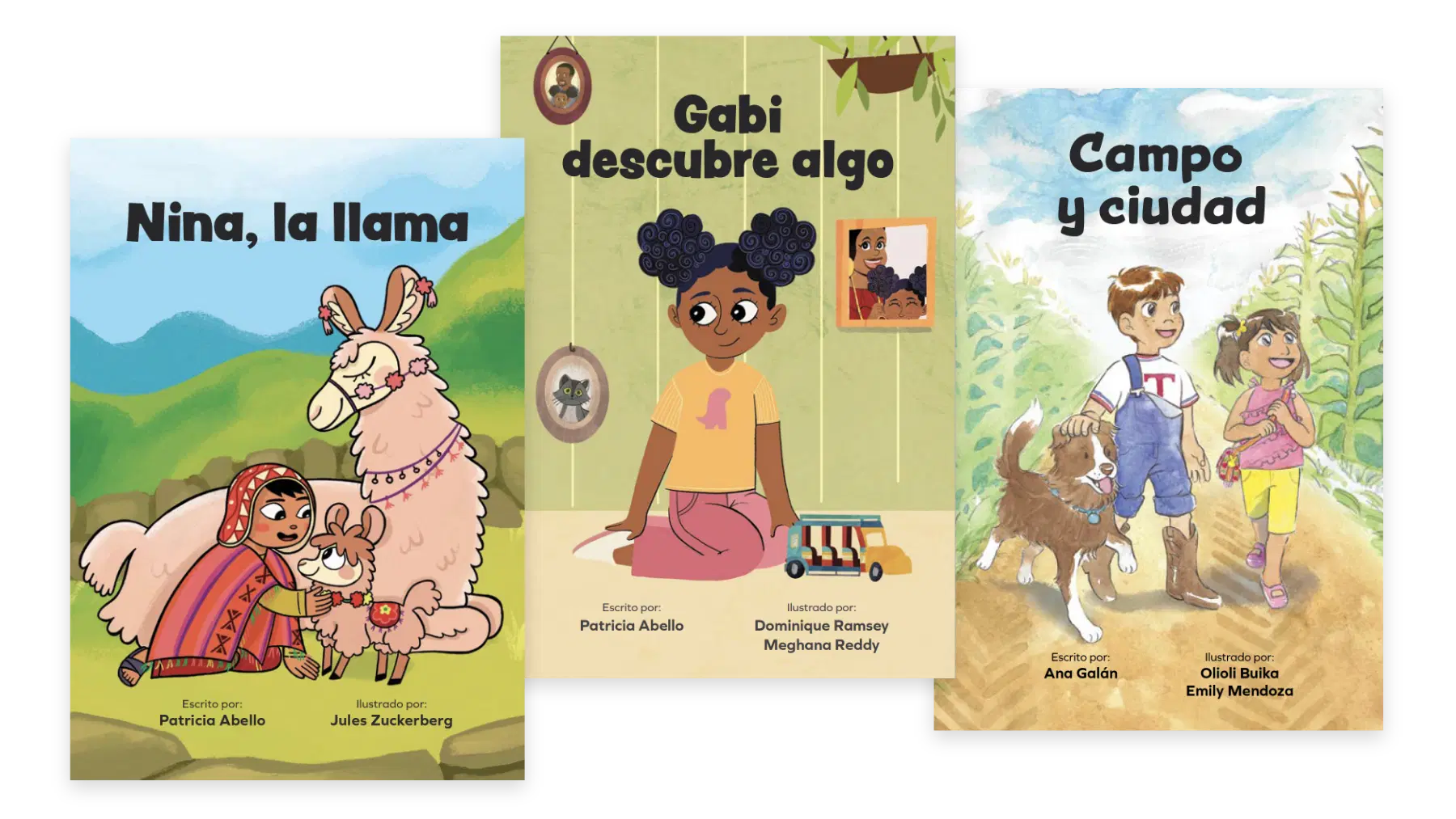
Student Readers are chapter books designed for kindergarten to second grade students to practice the sounds and spelling patterns they’ve just learned, along with commonly used Spanish words. This helps them understand what they read while enjoying engaging stories with interesting characters.

alt="Three book covers in Spanish, featuring colorful illustrations of children with animals in varied settings: a llama, a dog, and both rural and urban backgrounds, ideal for the Core Knowledge Language Arts curriculum."

Student Activity Books

As part of the daily lessons, these activity pages ask students to respond to the text they’ve read and apply skills and knowledge. They also include assessments (to which teachers have access) that track students’ skills development.

Illustration of a llama and desert elements on an orange background in the Amplify CKLA educational material, adjacent to a page teaching letter formation and number writing.

Caminos Hub for students

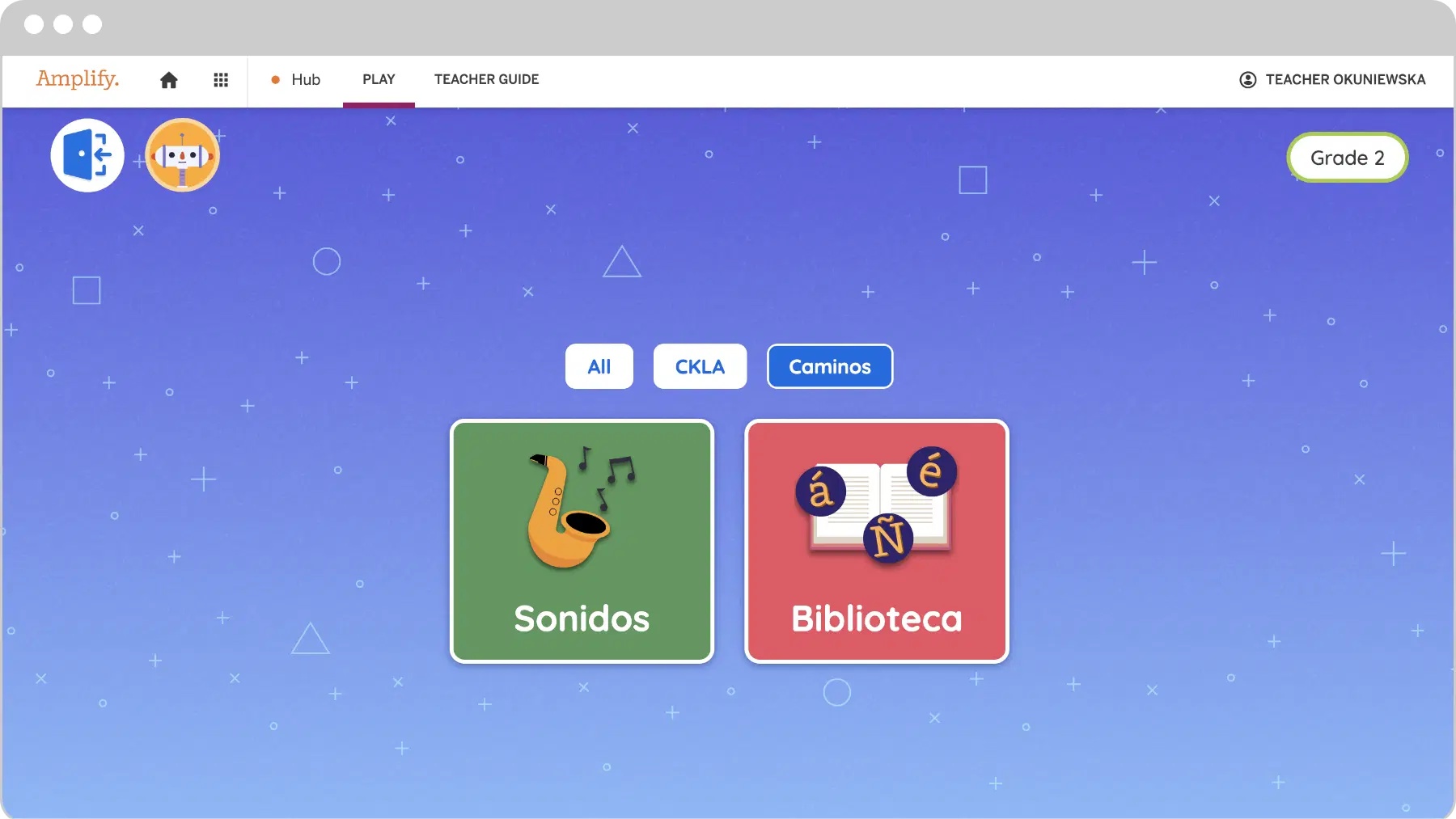
Students access multimedia resources and engage in a new digital experience on the Caminos Hub. They can access the Hub at home, in the classroom, and on the go, making it ideal for remote learning. It’s also compatible with laptops, Chromebooks, tablets, and desktops—we’ve even optimized it for mobile devices.

A digital educational interface shows two options: "sonidos" with a saxophone icon and "biblioteca" an open book icon, under the label "caminos" for grade 2.

Sonidos for Grades K–2

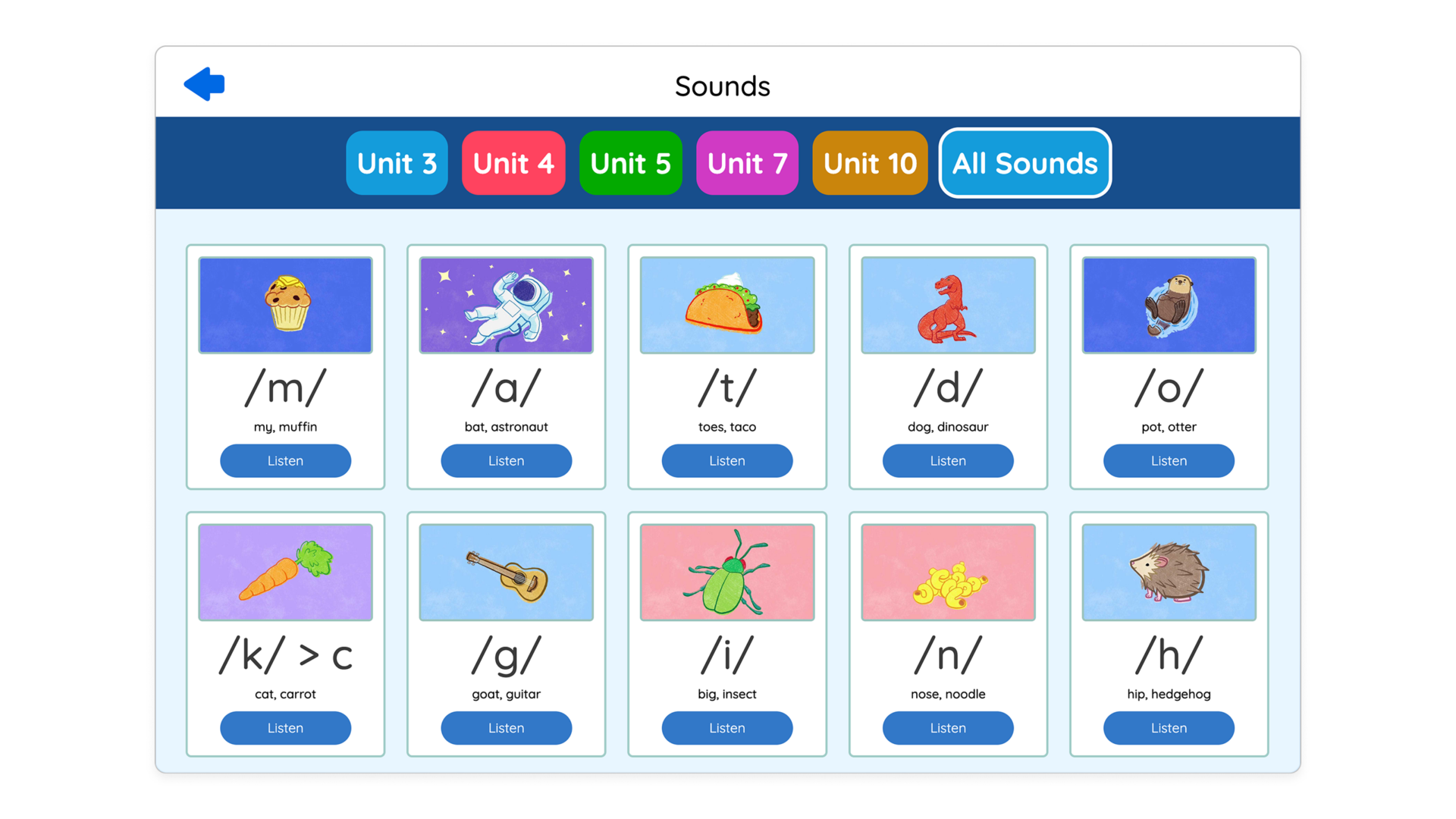
The Sonidos Library contains audio recordings of phonemes. Teachers can incorporate the Sonidos Library materials at any point into existing activities, at the start of skills lessons, or as a review to bring a sense of fun into the classroom.
The sounds in the library are organized by unit, and you can find the sounds for each unit by going through the tabs at the top of the screen. Each tab contains cards for each sound, on which you can play a recording of the sound by selecting the speaker icon.

Screenshot of an Amplify CKLA language learning app displaying vowel sounds with corresponding images: tree, ring, and sheep, labeled in Spanish, with a

Biblioteca

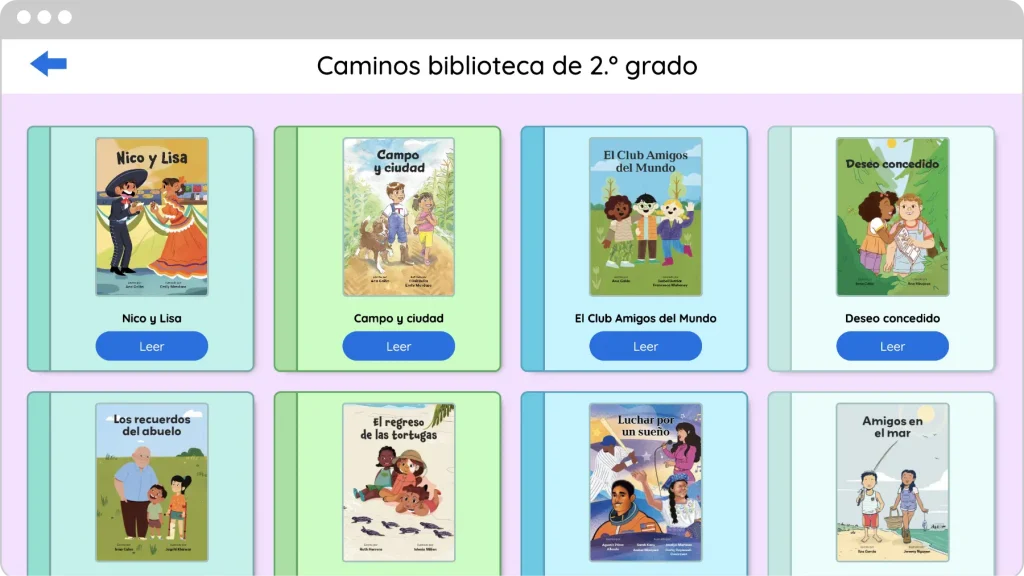
The Hub eReader is an easy way for kids to connect to the entire Caminos Lectoescritura library of readers. A simple table of contents makes it easy to navigate longer books. Amplify Caminos Lectoescritura e-books include the full set of Grade K–2 Student Readers.

Grid of eight illustrated book covers titled "caminos biblioteca de 2º grado," each depicting children in various settings, with "leer" buttons below each cover, part of the Core

Have a question about Amplify Caminos Lectoescritura? 

Visit our help library to search for articles with answers to your program questions. 

For additional curriculum support, please contact your student’s teacher.

Welcome, Amplify Reading families

Welcome to the Amplify Reading Caregiver hub. We are here to support you and your child with all things Amplify!

Para acceder a este sitio en español haga clic aquí.

Collage of six diverse images including a teacher with students, amplify curriculum resources & guides, studying, a thinking child, notebook and pen, and a spider-man poster.

Welcome to Amplify Reading!

Welcome to Amplify Reading! We know how important—and challenging—it is for parents and caregivers to support kids’ remote learning. That’s why we are here to support you. On this site, you’ll find valuable information and resources to help you guide your child as they use Amplify Reading.

What is Amplify Reading?

Amplify Reading provides your child with the opportunity to learn and practice literacy skills within an engaging story world that adapts to each student as they move through the program. Your child can learn with Amplify Reading during school hours and independently at home.

Learn about Amplify Reading in middle school here.

What is my role in Amplify Reading?

Ensuring your child can log in independently

We recommend that caregivers assist their children by helping them log in at home. Below, you’ll find a step-by-step video on how to log in to the program with the login information or QR code provided by your child’s teacher.

Note that your child may log in via Clever or another platform. Reach out to your child’s teacher if you’re unsure or did not receive login information.

Watch the video below for an overview of how to get your elementary schooler started with Amplify Reading:

How to get your child started with Amplify Reading

Tips

  • Practice logging in with your child consistently until they can log in independently.
  • Keep your child’s login information in a single place so they know where to go if they forget it!

Giving your child the time and space to play independently

Amplify Reading is personalized to your child’s needs, so you do not need to assist students with their learning. Once your child can log in, they’re ready to start using the program. Students will need headphones or to be in a quiet place when they play.

Some students will begin with a placement Quest. Their answers help the Amplify Reading program match them to the best content and games for their reading skill levels. To ensure the most accurate placement, it is important that your child complete each activity independently. If your child needs help understanding the instructions, you can refer to this instruction guide. And it is always helpful to encourage your child to have fun and do their best!

We recommend reviewing this Protecting Kids Online article by the Federal Trade Commission addressing digital safety.

Joining in on the fun!

Each child in grades K–3 has a customizable companion called a Curioso. Print these Curioso Coloring Pages so your child can design their own!

Students in grades K–5 encounter eReader texts along their adaptive learning path. These texts give students the opportunity to transfer the skills they practice in the games to actual texts. Consider watching the following read aloud videos with your child for some extra exposure to the texts and skill transfer activities, as well as opportunities for discussion.

Hedgehog and Fox – Fox keeps taunting Hedgehog that he can beat him in a race. But Hedgehog may have a trick up his sleeve that Fox doesn’t know about…

Lifting Up the Sky – A Snohomish legend that explains how the constellations came to be in the sky. 

The Best Present – Anjali and Anuj try to find Mom the best birthday present while they’re at a baseball game. What will they choose? 

The Big Ride – Rosa and her dad are about to go on a roller coaster, but Rosa is a little frightened. Will she enjoy it after all? 

The Busy Wolf – The Big Bad Wolf wasn’t trying to be bad, he was just too busy! Join us in Bookerton to hear this spin on classic fairy tales and engage with embedded skill practice and discussion prompts!

The Day They Became Americans – Three students who were born in different countries come together on a special day when they become American citizens.

Knowing where to go for help

Whether you have questions about your technology or want to know more about the program, Amplify’s Support Team is here to help!

Contact Support via telephone at (833) 97-Care-8 (833-972-2738) or caregiver@amplify.com.

Our support hours are Monday through Friday, 7 a.m. to 9 p.m. ET.

Frequently asked questions for caregivers

We recommend that your child use Amplify Reading two to three times per week for a weekly total of 30-45 minutes. However, your child’s teacher might have different daily or weekly recommendations.

If your child is having trouble with the content, Amplify Reading will adapt to provide your child with additional support and instructions within the game. For this reason, it is not recommended that caregivers help their child. While this can be hard, the program is carefully designed to provide the level of support your child needs to move forward.

If your child is having any technical challenges, please contact Amplify customer support at (833) 972-2738 or caregiver@amplify.com from Monday – Friday, 7 a.m. – 9 p.m. EDT and Saturday – Sunday from 10 a.m. – 6 pm. EDT.

We’re excited that you want to learn more! This recorded webinar for caregivers provides a deeper dive on the program and how you can support your child.

Welcome, mCLASS Math families!

We’re excited to partner with you this school year to support your child’s math learning. This mCLASS® Math Caregiver Hub is designed to help you understand how mCLASS Math works and give you easy ways to support math learning at home—both before and after assessments.

Para la versión en español, haga clic aquí.

A teacher assists a student wearing headphones at a laptop in a classroom, using math resources for teachers, while other students work at their desks in the background.

What is mCLASS Math?

mCLASS Math is a digital assessment system that gives teachers a clear picture of how students are thinking about major grade-level math concepts. It helps identify what your child knows and where they might need more support, so teachers can personalize instruction and help every student grow. mCLASS Math assessments are entirely digital and allow students to show how they think through open-ended questions. Teachers then gain immediate insight into student progress and instructional needs. You can learn more about the student experience here.

Learn more about mCLASS Math.

Getting started

Why is assessment important?

With mCLASS Math assessments, teachers understand not just what students know, but also how they think. This lets teachers better support students’ growth.

Going beyond right or wrong answers, mCLASS Math captures how students solve problems by highlighting their individual strengths, experiences, understandings, and strategies (or assets, as we collectively refer to them) and using them to inform instruction. With these insights, teachers can personalize learning, celebrate student strengths, and support meaningful growth.

Learn more about asset-based assessment.

Ways to support your child

Preview sample items at home with your child.

Explore mCLASS Math sample items together to help your child feel more comfortable and familiar with the assessment experience. These examples show the types of questions your child may see and how they’ll interact with the platform.

As you review the items together, encourage your child to explain their thinking. Try prompts like:

  • “What are they asking you to solve?”
  • “How can you show your thinking?”
  • “Can you explain your answer?”

If your child feels stuck, guide them with questions such as:

  • “What do you know so far?”
  • “How could you represent this problem using objects or drawings?”

Remind your child that getting stuck is normal and a necessary part of the learning process. Many children (and adults) fear making mistakes, but research shows that making mistakes helps your brain grow. Building math confidence starts with practicing in a safe, supportive space.

Support math growth with daily Fluency Practice.

Help your child strengthen core math skills—in addition, subtraction, multiplication, and division—with just 5–10 minutes of daily fluency activities. Fluency Practice uses a proven learning method called spaced repetition to boost accuracy, speed, and confidence with math facts and operations.

Get started with Fluency Practice here.

Other ideas to support math learning

  • Use and point out your child’s use of math in the real world wherever possible.
  • Help with math homework as much as possible.
  • Use intentional, positive phrasing about math—including about your child’s own use of it.

Coming soon: Caregiver-assisted math activities

For at-home learning, mCLASS offers a number of math resources families can use together, including caregiver-assisted math activities to help reinforce and practice skills at home.

We recommend reviewing this Protecting Kids Online article by the Federal Trade Commission, addressing digital safety.

We’re here to help!

Have a question about mCLASS Math? Visit our Help Library to search for articles with answers to your program questions.

For additional support, contact your child’s teacher.

Does your child’s class also use Amplify Desmos Math for their core math instruction Explore the Amplify Desmos Math Caregiver Hub to find additional resources and support!

Welcome, mCLASS Lectura families!

We’re excited to welcome you and your child to the mCLASS® Lectura Caregiver Hub for the new school year. We’ve assembled the following resources and guides to help you support your child and enable them to have the most productive experience with our platform throughout the year.

Para ver a este sitio en español haga, clic aquí. (En breve)

Collage of images featuring a magnifying glass icon, a teacher and student working together, a child using an mClass laptop, and a puzzle piece icon.

What is mCLASS Lectura?

mCLASS Lectura is an authentic personalized Spanish instruction and assessment system built specifically for bilingual children learning to read. It highlights what reading skills your child already knows, and it shares where they may need additional support.

mCLASS Lectura also provides teachers with instructional reading activities for each student based on their assessment score, in order to deliver targeted guidance on specific skills they may need support with.

Getting started

Ways to support your child

Home Connect

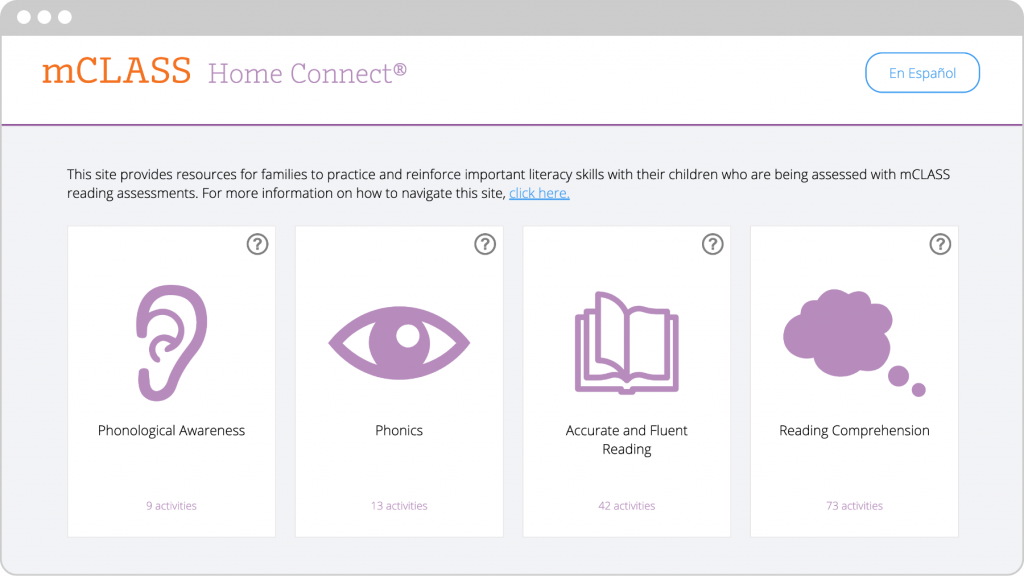
The mCLASS Home Connect website houses literacy resources for parents and caregivers, including at-home lessons organized by skill to support bilingual students learning to read in English. Our mCLASS caregiver letters in English and Spanish ensure that families know how to best support their child.

We recommend reviewing this “Protecting Kids Online” article by the Federal Trade Commission, addressing digital safety.

Screenshot of the mclass Home Connect© website homepage featuring four educational resources: phonological awareness, phonics, accurate and fluent reading, and reading comprehension.

How to get help

Have a question about Amplify mCLASS Lectura? 

Visit our help library to search for articles with answers to your program questions.

For additional curriculum support, contact your student’s teacher.

Amplify ELA Community Review Site

Welcome to the Amplify ELA community review site for Idaho Falls School District. This site is designed to help you learn about Amplify ELA—a core English Language Arts curriculum for Grade 6.

Your district leaders want to hear from you! Please share your thoughts by completing this district survey.

Looking for Grades K–5 materials? Click here.

What is Amplify ELA?

Amplify ELA helps kids in grades 6–8 read and understand complex texts that encourage them to grapple with interesting ideas and find relevance for themselves. Amplify ELA is a blended program that includes both digital and print materials, as well as a print-only version. Students using Amplify ELA read text passages closely, interpret what they find, discuss their thinking with peers, and develop their ideas in writing. The lesson structure is easy to follow, but flexible enough to allow for a variety of learning experiences and varied enough to keep students engaged. 

Features include:

  • Functionality that allows individual students to work at their own level while also being challenged appropriately.
  • Built-in tools that allow teachers to track and respond to student work.
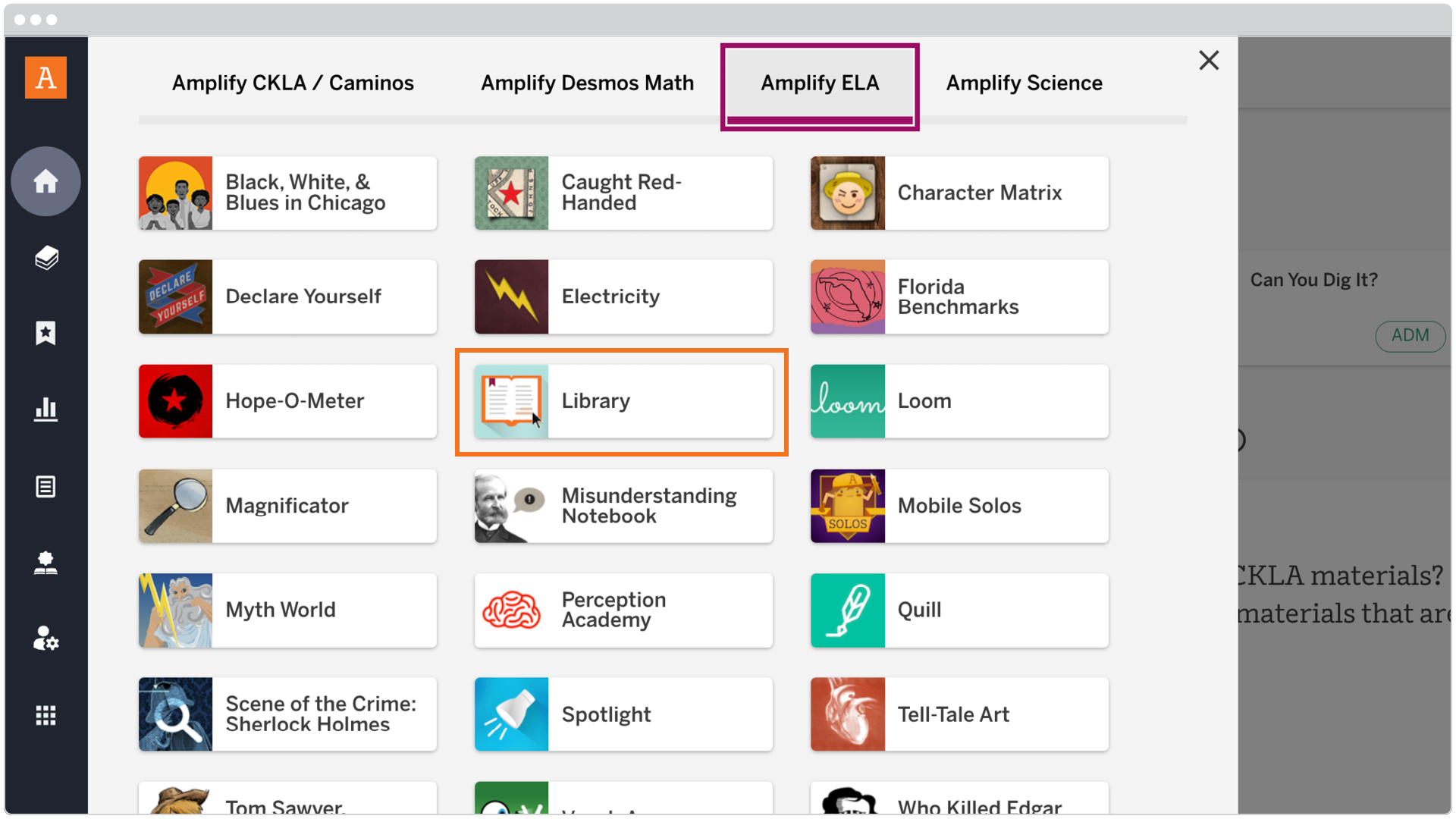
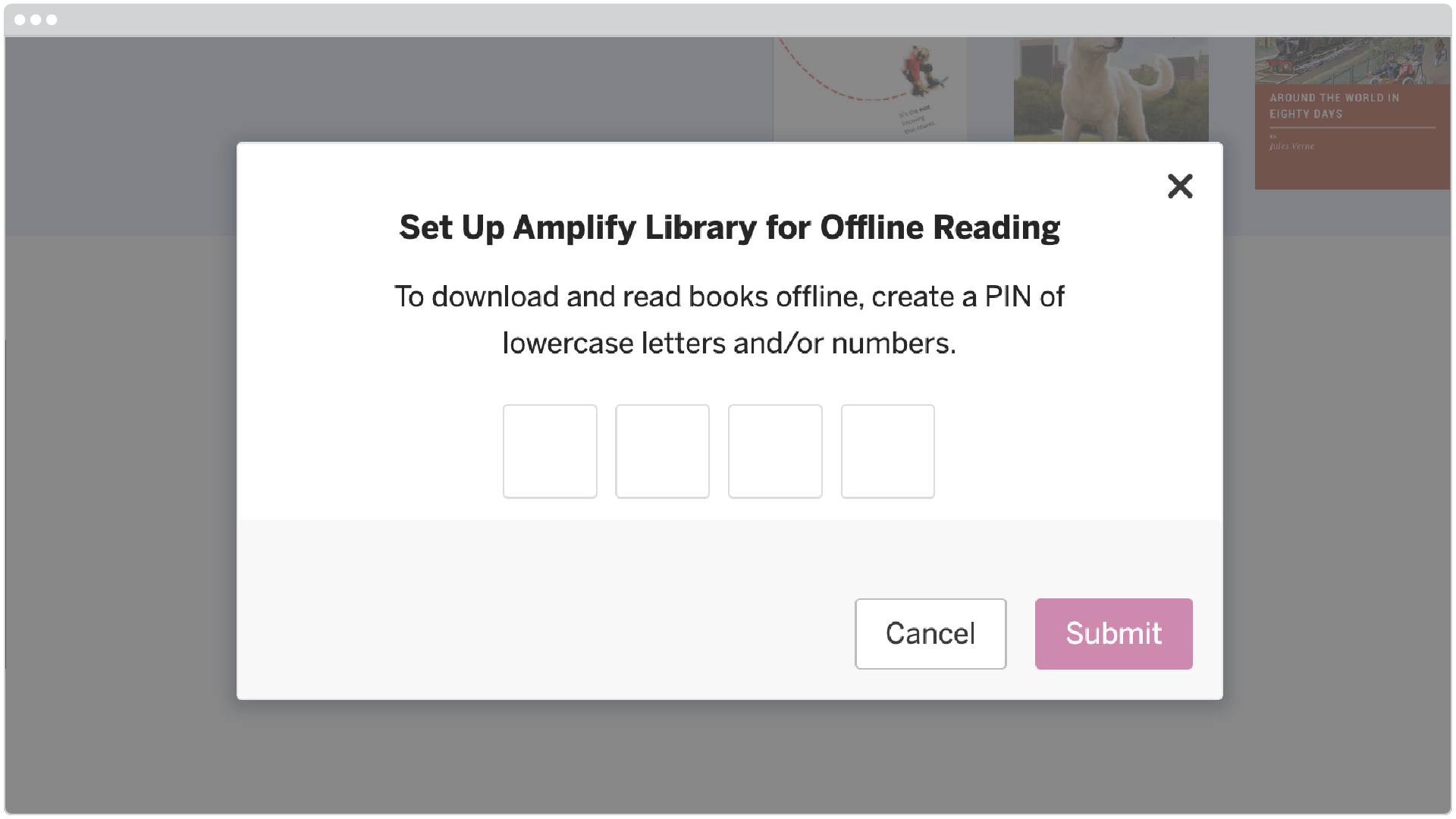
  • The digital Amplify Library, which contains more than 700 downloadable full-length fiction and nonfiction books.
  • The Vocab App, which uses game-like activities to help students master keywords from the program’s texts. (Students using print materials will see keywords highlighted).
  • Independent writing assignments called Solos, available on mobile devices.

Unit Overviews

Students begin with narrative writing to quickly boost their writing production, learn the foundational skill of focus, and become comfortable with key classroom habits and routines they will use all year. Students then apply their new observational focus to some lively readings from Roald Dahl’s memoir Boy and learn how to work closely with textual evidence.

Unit 6A: Dahl & Narrative Caregiver Letter

Students read like an investigator to embark on a multi-genre study of the mesmerizing world of scientific and investigative sleuthing. At the end of the unit, students write an essay explaining which trait is most useful to problem-solving investigators.

Unit 6B: Mysteries & Investigations Caregiver Letter

The Aztecs used it as currency. Robert Falcon Scott took it to the Antarctic. The Nazis made it into a bomb designed to kill Churchill. The 3,700-year-long history of chocolate is full of twists and turns, making it a rich and rewarding research topic. In this unit, students explore primary source documents and conduct independent research to better understand the strange and wonderful range of roles that chocolate has played for centuries around the world.

Unit 6C: The Chocolate Collection Caregiver Letter

Greek myths help us understand not only ancient Greek culture, but also the world around us and our role in it. Drawing on the routines and skills established in previous units, these lessons ask students to move from considering the state of a single person—themselves or a character—to contemplating broader questions concerning the role people play in the world and the communities they inhabit within it.

Unit 6D: The Greeks Caregiver Letter

The borderlands between the United States and Mexico are the place of legends, both true and fictional. Summer of the Mariposas, by Guadalupe Garcia McCall, plants a retelling of the Odyssey into this setting, launching five sisters on an adventure into a world of heroes and evildoers derived from Aztec myths and Latinx legends. On the journey, the sisters reconcile the dissolution of their parent’s marriage and find new strength in their identity and connection to Aztec lineage. Students consider how McCall uses the structure of the hero’s journey to celebrate women, heritage, and a broad definition of family. Students also have the opportunity to compare these characters’ fictional journey into Mexico to a description of one boy’s true journey into the United States.

Unit 6E: Summer of the Mariposas Caregiver Letter

In this research unit, students learn to tell the difference between primary, secondary, and tertiary sources; determine if a given source is reliable; and understand the ethical uses of information. Students then construct their own research questions and explore the internet for answers. They also take on the role of a passenger from the Titanic‘s manifest to consider gender and class issues as they research and write narrative accounts from the point of view of their passenger.

Unit 6F: The Titanic Collection Caregiver Letter

In this unit, students get to practice their creative writing skills and learn the elements of storytelling and character development, as well as the importance of vivid language. Students gain a sense of ownership over their writing as they experiment with the impact of their authorial choices on sentences, language, character traits, and plot twists.

Unit 6G: Beginning Story Writing Caregiver Letter

In this unit, students complete self-guided grammar instruction and practice that teachers assign to them throughout the year. Sub-units are organized by key grammar topics, so teachers can assign the content that best meets their student’s needs while making sure students work with the key grammar topics for their grades.

Grade 6: Grammar Caregiver Letter

Materials overview

Amplify ELA is a blended program, which means your student will be interacting with both print and digital materials.

Print materials

Student Edition

Includes all of the readings and activities necessary for instruction throughout the year. Students can read the selections both digitally and in print throughout the year, annotating in either format. The lessons in the print Student Edition reflect each digital lesson, but have been modified to work effectively in print.

Writing Journals

Where students respond to Writing Prompts and complete other written assignments.

Novel Guides

Teachers can also access, print, and mail student Novel Guides for up to 12 commonly taught novels. Six of these novels are available in the Amplify Library, and most should be available in a public library.

Digital materials

Quests

You may notice your student working with peers on the same interactive project over several days, trying to solve a mystery or explain a historical event. That’s what happens when a teacher assigns a Quest: an in-depth week-long exploration that requires collaboration and deepens engagement with texts and topics.

Vocab App

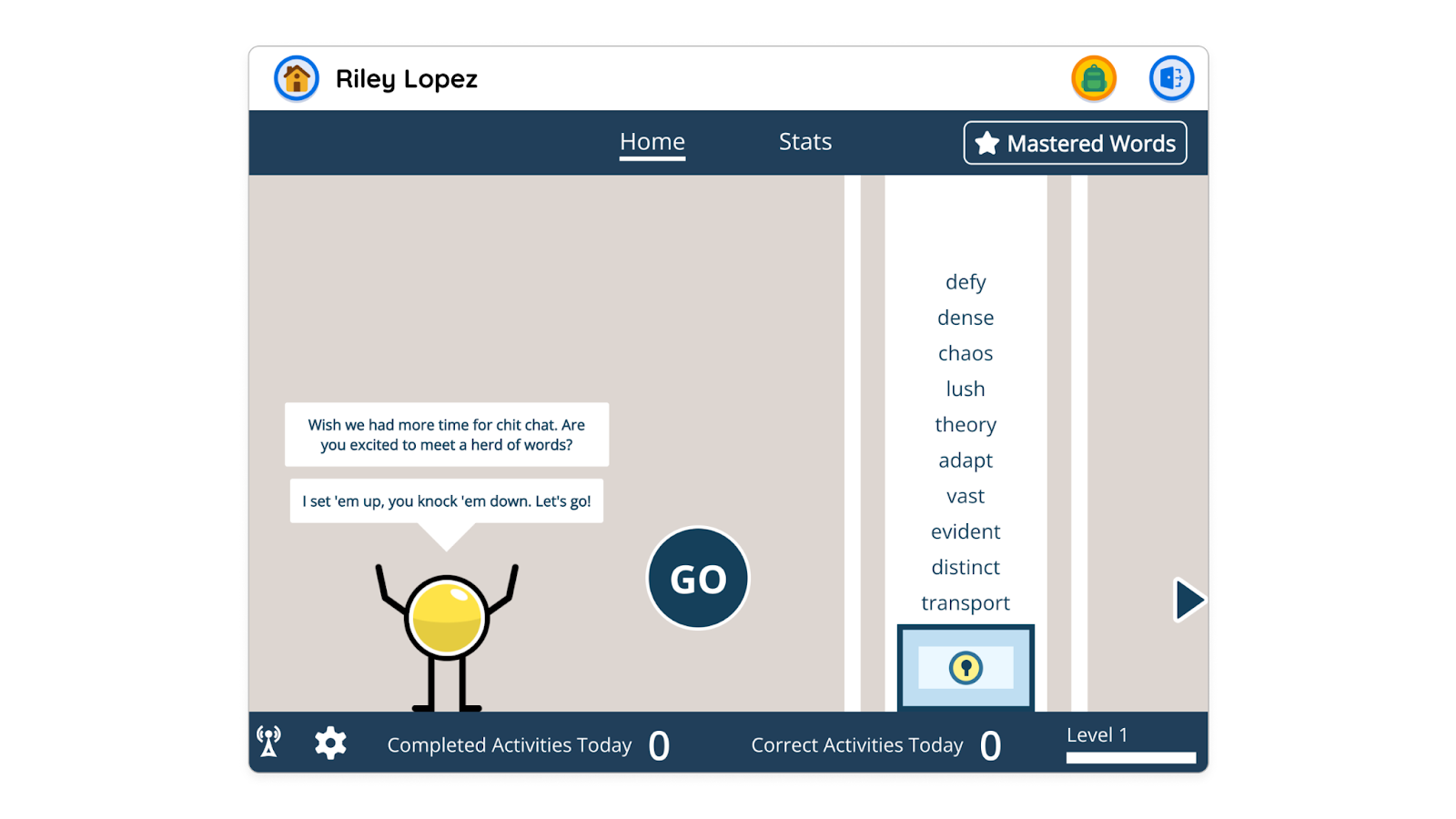
The Vocab App helps students master vocabulary words through game-like activities that challenge them to think through morphology, analogy, and synonyms/antonyms, and to decipher meaning through context.

Support your child at home

How you can support the child in your care

  • If possible, read with your student daily; even 15 minutes of reading together each day can make a huge impact. You can read aloud sections of the text together—many middle grade students enjoy performing sections of dialogue by taking on the role of a character in a play, or adding some dramatic flair to a poem with which they are working. If your student struggles with reading aloud, you might try reading the text to them with expression, then having them read it back to you. For additional practice, there are an array of fluency activities in the program’s Flex Days. Ask your student to help you find this activity.
  • Find moments to discuss what they are reading and discovering. Examples of questions you could ask: What stood out to you from what you read today? Were any sentences or words confusing? What was most surprising? What do you think the writer was trying to communicate? Do you agree with the writer’s ideas or descriptions? What connections can you make between what you are reading and your own life or other issues?
  • Listen to your student read their written responses or have them share with a friend over the phone or video chat. 
  • Browse the Amplify Library with your student to find books they’ll enjoy and be able to read fluently and independently.
  • Review this Protecting Kids Online article by the Federal Trade Commission addressing digital safety.

Program access

Before accessing the program, watch the below video to learn even more about Amplify ELA! Then scroll down and follow the login instructions provided.

Take a closer look at the program with the Idaho Falls Community demo account! Follow these simple instructions to access our program digitally.

  • Click the ELA Digital Platform button.
  • Select Log in with Amplify.
  • Enter this username: t1.ifela6@demo.tryamplify.net
  • Enter this password: Amplify1-ifela6
  • Select any unit to explore.

Where to go for help

Whether you have questions about your technology or want to know more about the program, Amplify’s Support Team is here to help!

Contact Support via telephone at (833) 97-Care-8 (833-972-2738) or caregiver@amplify.com.

Our support hours are Monday – Friday, 7 am – 9 PM ET, and Sunday, 10 – 6 ET.

Amplify CKLA Community Review Site

Welcome to the Amplify CKLA community review site for Idaho Falls School District. This site is designed to help you learn about Amplify CKLA—a core English Language Arts curriculum for Grades K–5.

Your district leaders want to hear from you! Please share your thoughts by completing this district survey.

Looking for 6th grade material? Click here.

What is Amplify CKLA?

Amplify Core Knowledge Language Arts (CKLA) is a core English language arts program for Grades K-5 that combines phonics with rich texts designed to build content knowledge—so that students learn to read and read to learn at the same time. It is also a blended program, which means your student will be interacting with both print and digital materials.

  • In Grades K–2, students complete one full lesson each day that builds foundational reading skills, as well as one full lesson that builds background knowledge.
  • In Grades 3–5, foundational reading skills and background knowledge are taught together through one integrated lesson each day.

Looking for 6th grade material? Click here.

There’s no better way to understand the power of Amplify CKLA than seeing it in action. Watch Ms. Lehman’s second-graders in the video below as they learn how to decode and spell words with the long /ā/ sound.

What do students learn?

Amplify CKLA is an evidence-based program built on research about how students learn to read. This collection of research is often referred to as the Science of Reading or The Simple View of Reading. It tells us that:

  • Students learn to read best when they are taught foundational reading skills (like phonics) and comprehension skills (like vocabulary and background knowledge) at the same time. That’s why Amplify includes a combination of skills and concepts in every unit.
  • The more students know about a particular topic, the better they are able to comprehend what they read. That’s why Amplify CKLA incorporates rich stories, texts, and articles about a variety of topics throughout the program.

Because students learn so much with Amplify CKLA, it can be hard to review it all at once. To make it easier for you to review the program, we’ve provided links to a variety of resources below, including unit overviews and text lists by grade.

Important note:
Amplify believes in empowering teachers to make the best instructional decisions for their students. For that reason, we include a variety of optional materials for teachers to use at their own discretion. For example: Trade Books are an optional tool that teachers can choose to use to extend a lesson. These books do not come with the program and only serve as a suggestion to assist teachers in finding additional material that ties to the unit topic.

Print materials

Student Readers

These readers are uniquely designed to provide intensive practice while reading simple but authentic stories. All readers are also available as ebooks and audiobooks on the teacher resource site.

In grades K-2, these readers are chapter books that allow students to practice just-learned sound-spellings within an authentic reading experience that incorporates compelling plots and interesting characters.

In grades 3-5, readers develop close reading and other literacy skills through a selection of diverse, content-rich literary and informational texts.

Student Activity Books

Part of the daily lessons, these activity pages ask students to respond to the text they’ve read and apply skills and knowledge. They also include assessments that track students’ skills development, to which teachers have access.

Digital materials

We are excited to announce that students will be able to access multimedia resources and engage in a new digital experience on the CKLA Hub. Unlike ever before, students can access digital resources independently from anywhere, taking full advantage of the instructional multimedia experiences that Amplify CKLA has to offer. Students can access the Hub at home, in the classroom, and on the go, making it ideal for remote learning. It’s compatible with laptops, Chromebooks, tablets, and desktops—we’ve also optimized it for mobile devices.

Knowledge Builder videos for grades K–2

Each Knowledge Domain starts with a Knowledge Builder video: a short, fun, animated story that enriches the lesson and motivates students with new characters, places, and concepts.

Recorded daily read-alouds for grades K–2

Teachers and students will have access to video recordings of all K–2 Knowledge Read-Alouds with pictures from the Flip Books.

Sound Library for grades K-2

The Sound Library uses audio sounds, catchy songs, and animated articulation videos to help students learn and master sounds.

Foundational Skills Boost for grades 1–3

Designed for grades 1–3, these video-based, self-guided lessons target critical foundational skills from the previous year’s instruction in order to fill in any gaps. They offer approximately nine weeks of instruction organized as daily lessons, with additional teacher-led small-group activities and family resources.

Vocab App for grades 3-5

The Vocabulary App is designed for independent practice with vocabulary. Students can use the Vocabulary App for game-like activities that challenge them.

Quests for grades 3–5

Each of the grade levels in 3–5 contains a Core Quest. In these special units, all the normal rules of the classroom change, and students engage with language in surprising new ways. For example, in grade 5, they learn to love the dense Shakespearian language of A Midsummer Night’s Dream through imagery, close reading, and performance.

Support your child at home

Read and talk at home

  • If possible, read with your child daily; even 15 minutes of reading together each day can make a huge impact. 
  • You can read sections of the text aloud together. If your child struggles, you might try reading the text to them with expression, and then have them read it aloud back to you. 
  • For additional practice, watch the recorded read-alouds with your K-2 student or have your grade 3-5 student use the Vocabulary App. 
  • Find moments to discuss what they are reading and discovering. Examples of questions you could ask: What stood out to you from what you read today? Were any sentences or words confusing? What was most surprising? What do you think the writer was trying to communicate? Do you agree with the writer’s ideas or descriptions? What connections can you make between what you are reading and your own life or other issues?
  • Listen to your child read their written responses or have them share with a friend over video chat. 
  • We recommend reviewing this Protecting Kids Online article by the Federal Trade Commission addressing digital safety.

Skills practice at home

We’ve developed a set of resources for families to use with their students that includes instructions and materials to teach and practice grade-level phonics at home. Resources include sound videos, Readers, and a how-to video with editable instructions that family members can customize to meet individual student needs.

Program access

Before accessing the program, watch the below video to learn even more about Amplify CKLA! Then scroll down and follow the login instructions provided.

Take a closer look at the program with the Idaho Falls Community demo account! Follow these simple instructions to access our program digitally.

  • Click the CKLA Teacher Resource Site button.
  • Select Log in with Amplify.
  • Enter this username: t1.ifckla@demo.tryamplify.net
  • Enter this password: Amplify1-ifckla
  • Select the desired grade level.

Where to go for help

Whether you have questions about your technology or want to know more about the program, Amplify’s Support Team is here to help!

Contact Support via telephone at (833) 97-Care-8 (833-972-2738) or caregiver@amplify.com.

Our support hours are Monday – Friday, 7 am – 9 PM ET, and Sunday, 10 – 6 ET.

Puyallup families, welcome to Amplify CKLA!

Welcome to the Amplify CKLA Caregiver Hub for Puyallup School District. This site is designed to help you learn about Amplify CKLA—a core English Language Arts curriculum.

We want to hear from you! Please share your thoughts by completing this district survey.

Illustration showing a man with a tree, colorful abstract shapes, and various scientific and nature-related icons including a laboratory setup, an animal skeleton, and marine life.

What is Amplify CKLA?

Amplify Core Knowledge Language Arts (CKLA) is a language arts program for Grades PreK-5 that combines a multi-sensory approach to phonics with rich texts carefully sequenced to build content knowledge—so that students learn to read and read to learn at the same time. 

Every day in Grades PreK–2, students complete one full lesson that builds foundational reading skills, as well as one full lesson that builds background knowledge. In Grades 3–5, students start to master the skills of reading, further opening up their worlds.

Illustrative circles depicting educational stages from prek to grade 5, each showing children engaged in age-appropriate activities or learning themes.

CKLA in Action

There’s no better way to understand the power of Amplify CKLA than seeing it in action. Watch Ms. Lehman’s second graders in the video below as they learn how to decode and spell words with the long /ā/ sound.

Unit Overviews

Below are quick overviews of the units your student will be working through in their grade throughout the year. Next to each unit are downloadable guides which provide a more in-depth look at the content covered and how you can help your student advance their understanding of the topics.

Materials overview

Amplify CKLA is a blended program, which means your student will be interacting with both print and digital materials.

Print materials

Student Readers

These readers are uniquely designed to provide intensive practice while reading simple but authentic stories. All readers are also available as ebooks and audiobooks on the teacher resource site, which caregivers can now access.

In grades K-2, these readers are chapter books that allow students to practice just-learned sound-spellings within an authentic reading experience that incorporates compelling plots and interesting characters.

In grades 3-5, readers develop close reading and other literacy skills through a selection of diverse, content-rich literary and informational texts.

A collage of kindergarten-level reading books titled Kit and Seth, with illustrated pages showing children, plants, and scenes of reading and eating grapes and cake.
Grade 1 reading materials featuring illustrated children, a Snapshots cover, two open storybooks showing kids and activities, and a page about a holiday with text and drawings.
Open educational book for grade 2, showing illustrations and text about a chicken nugget story and the war of 1812.

Student Activity Books

Part of the daily lessons, these activity pages ask students to respond to the text they’ve read and apply skills and knowledge. They also include assessments that track students’ skills development, to which teachers have access.

Two illustrated pages titled Knowledge 1-6 and Knowledge 7-12, each showing colorful scenes representing different educational topics in numbered circles.

Digital materials

CKLA Hub for grades K–5

We are excited to announce that students will be able to access multimedia resources and engage in a new digital experience on the CKLA Hub. Unlike ever before, students can access digital resources independently from anywhere, taking full advantage of the instructional multimedia experiences that Amplify CKLA has to offer. Students can access the Hub at home, in the classroom, and on the go, making it ideal for remote learning. It’s compatible with laptops, Chromebooks, tablets, and desktops—we’ve also optimized it for mobile devices.

Knowledge Builder videos for grades K–2

Each Knowledge Domain starts with a Knowledge Builder video: a short, fun, animated story that enriches the lesson and motivates students with new characters, places, and concepts.

A cartoon scientist stands next to a sparking robot in a laboratory, displayed on a laptop screen with purple-themed laboratory equipment in the background.

Recorded daily read-alouds for grades K–2

Teachers and students will have access to video recordings of all K–2 Knowledge Read-Alouds with pictures from the Flip Books.

Cover image for Cycles in Nature by Amplify CKLA. Features illustrations of a dinosaur, plant, wagon, book, fish, cat on desk, and various nature-related items against a pink background.

Sound Library for grades K-2

The Sound Library uses audio sounds, catchy songs, and animated articulation videos to help students learn and master sounds.

A webpage titled Sound Library displays search bar and sound cards for different phonemes, each with example words and buttons for sound, video, and song.

Foundational Skills Boost for grades 1–3

Designed for grades 1–3, these video-based, self-guided lessons target critical foundational skills from the previous year’s instruction in order to fill in any gaps. They offer approximately nine weeks of instruction organized as daily lessons, with additional teacher-led small-group activities and family resources.

A chocolate chip cookie in a glass of milk, a person speaking, a speech bubble saying Let's say it together!, and two illustrated eyes on a green background.

Vocab App for grades 3-5

The Vocabulary App is designed for independent practice with vocabulary. Students can use the Vocabulary App for game-like activities that challenge them.

Screenshot of the Amplify Vocab App webpage, showing interactive vocabulary tools for students in grades 3-5, with a Launch App button and navigation menu at the top.

Quests for grades 3–5

Each of the grade levels in 3–5 contains a Core Quest. In these special units, all the normal rules of the classroom change, and students engage with language in surprising new ways. For example, in grade 5, they learn to love the dense Shakespearian language of A Midsummer Night’s Dream through imagery, close reading, and performance.

A collage showing illustrated cards of Titania, Puck, and Athens, a lesson on performing Shakespeare, and two photos of actors performing on stage.

Support your child at home

Read and talk at home

  • If possible, read with your child daily; even 15 minutes of reading together each day can make a huge impact. 
  • You can read sections of the text aloud together. If your child struggles, you might try reading the text to them with expression, and then have them read it aloud back to you. 
  • For additional practice, watch the recorded read-alouds with your K-2 student or have your grade 3-5 student use the Vocabulary App. 
  • Find moments to discuss what they are reading and discovering. Examples of questions you could ask: What stood out to you from what you read today? Were any sentences or words confusing? What was most surprising? What do you think the writer was trying to communicate? Do you agree with the writer’s ideas or descriptions? What connections can you make between what you are reading and your own life or other issues?
  • Listen to your child read their written responses or have them share with a friend over video chat. 
  • We recommend reviewing this Protecting Kids Online article by the Federal Trade Commission addressing digital safety.

Skills practice at home

We’ve developed a set of resources for caregivers to use with their students that includes instructions and materials to teach and practice grade-level phonics at home. Resources include sound videos, Readers, and a how-to video with editable instructions that caregivers can customize to meet individual student needs.

Parent and child at home working on sofa

Where to go for help

Whether you have questions about your technology or want to know more about the program, Amplify’s Support Team is here to help!

Contact Support via telephone at (833) 97-Care-8 (833-972-2738) or caregiver@amplify.com.

Our support hours are Monday – Friday, 7 am – 9 PM ET, and Sunday, 10 – 6 ET.

Northshore families, welcome to Amplify CKLA!

Welcome to the Amplify CKLA Caregiver hub for Northshore School District. We are here to support you and your child with all things Amplify!

CKLA in Action

There’s no better way to understand the power of Amplify CKLA than seeing it in action. Watch Ms. Lehman’s second graders in the video below as they learn how to decode and spell words with the long /ā/ sound.

What is Amplify CKLA?

Amplify Core Knowledge Language Arts (CKLA) is a language arts program for Grades PreK-5 that combines a multi-sensory approach to phonics with rich texts carefully sequenced to build content knowledge—so that students learn to read and read to learn at the same time. 

Every day in Grades PreK–2, students complete one full lesson that builds foundational reading skills, as well as one full lesson that builds background knowledge. In Grades 3–5, students start to master the skills of reading, further opening up their worlds.

Equitable Spanish instruction

Our equivalent Spanish language arts program, Amplify Caminos, ensures our native Spanish-speaking students are equally inspired to become confident readers, writers, and thinkers.

Like Amplify CKLA, Amplify Caminos is designed to spark curiosity through content-rich instruction. Amplify Caminos features complex interactive Read-Alouds and authentic Spanish literature to develop reading and writing skills and build bridges across Spanish and English.

Most importantly, Amplify Caminos is more than just a translation. It includes transadaptations and authentic texts written by Latin American and Spanish authors across a diversity of topics and genres.

Unit Overviews

Below are quick overviews of the units your student will be working through in their grade throughout the year. Next to each unit are downloadable guides which provide a more in-depth look at the content covered and how you can help your student advance their understanding of the topics.

Materials overview

Amplify CKLA is a blended program, which means your student will be interacting with both print and digital materials.

Print materials

Student Readers

These readers are uniquely designed to provide intensive practice while reading simple but authentic stories. All readers are also available as ebooks and audiobooks on the teacher resource site, which caregivers can now access.

In grades K-2, these readers are chapter books that allow students to practice just-learned sound-spellings within an authentic reading experience that incorporates compelling plots and interesting characters.

In grades 3-5, readers develop close reading and other literacy skills through a selection of diverse, content-rich literary and informational texts.

Student Activity Books

Part of the daily lessons, these activity pages ask students to respond to the text they’ve read and apply skills and knowledge. They also include assessments that track students’ skills development, to which teachers have access.

Digital materials

CKLA Hub for grades K–5

We are excited to announce that students will be able to access multimedia resources and engage in a new digital experience on the CKLA Hub. Unlike ever before, students can access digital resources independently from anywhere, taking full advantage of the instructional multimedia experiences that Amplify CKLA has to offer. Students can access the Hub at home, in the classroom, and on the go, making it ideal for remote learning. It’s compatible with laptops, Chromebooks, tablets, and desktops—we’ve also optimized it for mobile devices.

Knowledge Builder videos for grades K–2

Each Knowledge Domain starts with a Knowledge Builder video: a short, fun, animated story that enriches the lesson and motivates students with new characters, places, and concepts.

Recorded daily read-alouds for grades K–2

Teachers and students will have access to video recordings of all K–2 Knowledge Read-Alouds with pictures from the Flip Books.

Sound Library for grades K-2

The Sound Library uses audio sounds, catchy songs, and animated articulation videos to help students learn and master sounds.

Foundational Skills Boost for grades 1–3

Designed for grades 1–3, these video-based, self-guided lessons target critical foundational skills from the previous year’s instruction in order to fill in any gaps. They offer approximately nine weeks of instruction organized as daily lessons, with additional teacher-led small-group activities and family resources.

Vocab App for grades 3-5

The Vocabulary App is designed for independent practice with vocabulary. Students can use the Vocabulary App for game-like activities that challenge them.

Quests for grades 3–5

Each of the grade levels in 3–5 contains a Core Quest. In these special units, all the normal rules of the classroom change, and students engage with language in surprising new ways. For example, in grade 5, they learn to love the dense Shakespearian language of A Midsummer Night’s Dream through imagery, close reading, and performance.

Support your child at home

Read and talk at home

  • If possible, read with your child daily; even 15 minutes of reading together each day can make a huge impact. 
  • You can read sections of the text aloud together. If your child struggles, you might try reading the text to them with expression, and then have them read it aloud back to you. 
  • For additional practice, watch the recorded read-alouds with your K-2 student or have your grade 3-5 student use the Vocabulary App. 
  • Find moments to discuss what they are reading and discovering. Examples of questions you could ask: What stood out to you from what you read today? Were any sentences or words confusing? What was most surprising? What do you think the writer was trying to communicate? Do you agree with the writer’s ideas or descriptions? What connections can you make between what you are reading and your own life or other issues?
  • Listen to your child read their written responses or have them share with a friend over video chat. 
  • We recommend reviewing this Protecting Kids Online article by the Federal Trade Commission addressing digital safety.

Skills practice at home

We’ve developed a set of resources for caregivers to use with their students that includes instructions and materials to teach and practice grade-level phonics at home. Resources include sound videos, Readers, and a how-to video with editable instructions that caregivers can customize to meet individual student needs.

Explore the program

Watch the below video to learn even more about Amplify CKLA!

Take a closer look at the program with our demo account! Follow these simple instructions to access our program digitally.

  • Click the CKLA Teacher Resource Site button.
  • Select Log in with Amplify.
  • Enter this username: t1.northshoreckla@demo.tryamplify.net
  • Enter this password: Amplify1-northshoreckla
  • Select the desired grade level.

Where to go for help

Whether you have questions about your technology or want to know more about the program, Amplify’s Support Team is here to help!

Contact Support via telephone at (833) 97-Care-8 (833-972-2738) or caregiver@amplify.com.

Our support hours are Monday – Friday, 7 am – 9 PM ET, and Sunday, 10 – 6 ET.

Amplify CKLA Review Site for Bonneville Joint School District #93

Welcome to the Amplify CKLA community review site for Bonneville Joint School District #93. This site is designed to help you learn about Amplify CKLA—a core English Language Arts curriculum.

What is Amplify CKLA?

Amplify Core Knowledge Language Arts (CKLA) is a core English language arts program for Grades K-5 that combines phonics with rich texts designed to build content knowledge—so that students learn to read and read to learn at the same time. It is also a blended program, which means your student will be interacting with both print and digital materials.

  • In Grades K–2, students complete one full lesson each day that builds foundational reading skills, as well as one full lesson that builds background knowledge.

There’s no better way to understand the power of Amplify CKLA than seeing it in action. Watch Ms. Lehman’s second-graders in the video below as they learn how to decode and spell words with the long /ā/ sound.

What do students learn?

Amplify CKLA is an evidence-based program built on research about how students learn to read. This collection of research is often referred to as the Science of Reading or The Simple View of Reading. It tells us that:

  • Students learn to read best when they are taught foundational reading skills (like phonics) and comprehension skills (like vocabulary and background knowledge) at the same time. That’s why Amplify includes a combination of skills and concepts in every unit.
  • The more students know about a particular topic, the better they are able to comprehend what they read. That’s why Amplify CKLA incorporates rich stories, texts, and articles about a variety of topics throughout the program.

Because students learn so much with Amplify CKLA, it can be hard to review it all at once. To make it easier for you to review the program, we’ve provided links to a variety of resources below, including unit overviews and text lists by grade.

Print materials

Student Readers

These readers are uniquely designed to provide intensive practice while reading simple but authentic stories. All readers are also available as ebooks and audiobooks on the teacher resource site.

In grades K-2, these readers are chapter books that allow students to practice just-learned sound-spellings within an authentic reading experience that incorporates compelling plots and interesting characters.

Student Activity Books

Part of the daily lessons, these activity pages ask students to respond to the text they’ve read and apply skills and knowledge. They also include assessments that track students’ skills development, to which teachers have access.

Digital materials

We are excited to announce that students will be able to access multimedia resources and engage in a new digital experience on the CKLA Hub. Unlike ever before, students can access digital resources independently from anywhere, taking full advantage of the instructional multimedia experiences that Amplify CKLA has to offer. Students can access the Hub at home, in the classroom, and on the go, making it ideal for remote learning. It’s compatible with laptops, Chromebooks, tablets, and desktops—we’ve also optimized it for mobile devices.

Knowledge Builder videos for grades K–2

Each Knowledge Domain starts with a Knowledge Builder video: a short, fun, animated story that enriches the lesson and motivates students with new characters, places, and concepts.

Recorded daily read-alouds for grades K–2

Teachers and students will have access to video recordings of all K–2 Knowledge Read-Alouds with pictures from the Flip Books.

Sound Library for grades K-2

The Sound Library uses audio sounds, catchy songs, and animated articulation videos to help students learn and master sounds.

Foundational Skills Boost for grades 1–3

Designed for grades 1–3, these video-based, self-guided lessons target critical foundational skills from the previous year’s instruction in order to fill in any gaps. They offer approximately nine weeks of instruction organized as daily lessons, with additional teacher-led small-group activities and family resources.

Support your child at home

Read and talk at home

  • If possible, read with your child daily; even 15 minutes of reading together each day can make a huge impact. 
  • You can read sections of the text aloud together. If your child struggles, you might try reading the text to them with expression, and then have them read it aloud back to you. 
  • For additional practice, watch the recorded read-alouds with your K-2 student. 
  • Find moments to discuss what they are reading and discovering. Examples of questions you could ask: What stood out to you from what you read today? Were any sentences or words confusing? What was most surprising? What do you think the writer was trying to communicate? Do you agree with the writer’s ideas or descriptions? What connections can you make between what you are reading and your own life or other issues?
  • Listen to your child read their written responses or have them share with a friend over video chat. 
  • We recommend reviewing this Protecting Kids Online article by the Federal Trade Commission addressing digital safety.

Skills practice at home

We’ve developed a set of resources for families to use with their students that includes instructions and materials to teach and practice grade-level phonics at home. Resources include sound videos, Readers, and a how-to video with editable instructions that family members can customize to meet individual student needs.

Program access

Watch the below video to learn even more about Amplify CKLA digital!

Where to go for help

Whether you have questions about your technology or want to know more about the program, Amplify’s Support Team is here to help!

Contact Support via telephone at (833) 97-Care-8 (833-972-2738) or caregiver@amplify.com.

Our support hours are Monday – Friday, 7 am – 9 PM ET, and Sunday, 10 – 6 ET.

Welcome, Boost Reading families!

To view this protected page, enter the password below:


What is mCLASS?

An assessment and instruction system that helps measure your child’s literacy and math development, mCLASS highlights what reading and math skills your child already knows and shares where they may need additional support.

The program also provides teachers with instructional reading activities for each student based on their assessment score, enabling educators to deliver targeted guidance on specific skills students may need support with.

Getting started

Ways to support your child

Home Connect

The mCLASS Home Connect® website houses literacy resources for parents and caregivers, including at-home lessons organized by skill to support students. Our mCLASS caregiver letters in English and Spanish ensure that families know how to best support their child.

Caregiver-assisted math activities

For at-home learning, mCLASS offers a number of activities families can use to support the student(s) in their care, including caregiver-assisted math activities to help reinforce and practice skills at home.

We recommend reviewing this “Protecting Kids Online” article by the Federal Trade Commission addressing digital safety.

Screenshot of the mclass Home Connect© website homepage featuring four educational resources: phonological awareness, phonics, accurate and fluent reading, and reading comprehension.

Contact us

We’re here to help you!

Have a question about Amplify mCLASS? 

Read our caregiver guide or visit our help library to search for articles with answers to your program questions.

For additional curriculum support, contact your student’s teacher.

What is mCLASS Lectura?

mCLASS Lectura is an authentic personalized Spanish instruction and assessment system built specifically for bilingual children learning to read. It highlights what reading skills your child already knows, and it shares where they may need additional support.

mCLASS Lectura also provides teachers with instructional reading activities for each student based on their assessment score, in order to deliver targeted guidance on specific skills they may need support with.

Getting started

Ways to support your child

Home Connect

The mCLASS Home Connect website houses literacy resources for parents and caregivers, including at-home lessons organized by skill to support bilingual students learning to read in English. Our mCLASS caregiver letters in English and Spanish ensure that families know how to best support their child.

We recommend reviewing this “Protecting Kids Online” article by the Federal Trade Commission, addressing digital safety.

Screenshot of the mclass Home Connect© website homepage featuring four educational resources: phonological awareness, phonics, accurate and fluent reading, and reading comprehension.

How to get help

Have a question about Amplify mCLASS Lectura? 

Visit our help library to search for articles with answers to your program questions.

For additional curriculum support, contact your student’s teacher.

Eureka Math-NEW

To view this protected page, enter the password below:


Eureka Math® crosswalk to Amplify Desmos Math free lessons

Grade 6

Module 1: Ratios and Unit Rates

Eureka MathAmplify Classroom
Topic A Representing and Reasoning About Ratios 
Lesson 3: Equivalent Ratios
Lesson 4: Equivalent Ratios
Unit 2
Lesson 4: Fruit Lab
Topic C Unit Rates 
Lesson 16: From Ratio to RatesUnit 3
Lesson 6: Soft Serve
Lesson 18: Finding a Rate by Dividing Two QuantitiesUnit 3
Lesson 6: Soft Serve
Lesson 24: Percent and Rates per 100Unit 3
Lesson 9: Lucky Duckies

Module 2: Arithmetic Operations Including Division of Fractions

Topic A Dividing Fractions by Fractions
Lesson 2: Interpreting Division of a Whole Number by a Fraction —Visual Models.Unit 4
Lesson 3: Flour Planner
Lesson 3: Interpreting and Computing Division of a Fraction by a Fraction—More Models
Lesson 4: Interpreting and Computing Division of a Fraction by a Fraction—More Models
Unit 4
Lesson 6: Fill the Gap
Lesson 8: Dividing Fractions and Mixed NumbersUnit 4
Lesson 6: Fill the Gap
Topic B Multi-Digit Decimal Operations—Adding, Subtracting, and Multiplying
Lesson 9: Sums and Differences of DecimalsUnit 5
Lesson 2: Decimal Diagrams and Algorithms

Module 3: Rational Numbers

Topic B Order and Absolute Value
Lesson 7: Ordering Integers and Other Rational Numbers
Lesson 8: Ordering Integers and Other Rational Numbers
Lesson 9: Comparing Integers and Other Rational Numbers
Unit 7Lesson 4: Order in the Class

Module 4: Expressions and Equations

Topic D Expanding, Factoring, and Distributing Expressions 
Lesson 9: The Relationship of Addition and SubtractionUnit 6
Lesson 8: Products and Sums
Take Away (coming soon!)
Lesson 10: Writing and Expanding Multiplication Expressions
Lesson 11: Factoring Expressions
Lesson 12: Distributing Expressions
Unit 6
Lesson 8: Products and Sums
Take Away (coming soon!)
Topic F Writing and Evaluating Expressions and Formulas 
Lesson 18: Writing and Evaluating Expressions—Addition and Subtraction
Lesson 19: Substituting to Evaluate Addition and Subtraction Expressions
Lesson 20: Writing and Evaluating Expressions—Multiplication and Division
Lesson 21: Writing and Evaluating Expressions—Multiplication and Addition
Unit 6
Lesson 8: Products and Sums
Take Away (coming soon!)
Topic G Solving Equations 
Lesson 23: True and False Number Sentences
Lesson 24: True and False Number Sentences
Unit 6
Lesson 1: Weight for It
Lesson 25: Finding Solutions to Make Equations TrueUnit 6
Lesson 1: Weight for It
Lesson 26: One-Step Equations—Addition and SubtractionUnit 6
Lesson 1: Weight for It
Topic H Applications of Equations 
Lesson 33: From Equations to Inequalities
Lesson 34: Writing and Graphing Inequalities in Real-World Problems
Unit 7
Lesson 7: Tunnel Travels

Module 5: Area, Surface Area, and Volume Problems

Topic A: Area of Triangles, Quadrilaterals, and Polygons
Lesson 1: The Area of Parallelograms Through Rectangle FactsUnit 1
Lesson 3: Exploring Parallelograms
Exploring Parallelograms, Part 2
Topic D Nets and Surface Area 
Lesson 18: Determining Surface Area of Three-Dimensional FiguresUnit 1
Lesson 10: Renata’s Stickers

Module 6: Statistics

Topic A Understanding Distributions 
Lesson 2: Displaying a Data Distribution
Lesson 3: Creating a Dot Plot
Unit 8
Lesson 3: Minimum Wage
Lesson 4: Creating a Histogram
Lesson 5: Describing a Distribution Displayed in a Histogram
Unit 8
Lesson 5: The Plot Thickens
Topic C Summarizing a Distribution That Is Skewed Using the Median and the Interquartile Range 
Lesson 12: Describing the Center of a Distribution Using the MedianUnit 8
Lesson 11: Toy Cars
Topic D Summarizing and Describing Distributions 
Lesson 18: Connecting Graphical Representations and Numerical SummariesUnit 8
Lesson 5: The Plot Thickens
Lesson 3: Creating a Dot PlotUnit 8
Lesson 3: Minimum Wage

Grade 7

Module 1: Ratios and Proportional Relationships

Eureka MathAmplify Classroom
Topic A Proportional Relationships 
Lesson 1: An Experience in Relationships as Measuring RateUnit 2
Lesson 1: Paint
 
Unit 4
Lesson 1: Mosaics
Lesson 5: Identifying Proportional and Non-Proportional Relationships in Graphs
Lesson 6: Identifying Proportional and Non-Proportional Relationships in Graphs
Unit 2
Lesson 8: Dino Pops
Topic B Unit Rate and the Constant of Proportionality 
Lesson 8: Representing Proportional Relationships with Equations
Lesson 9: Representing Proportional Relationships with Equations
Unit 2
Lesson 6: Two and Two
Lesson 10: Interpreting Graphs of Proportional RelationshipsUnit 2
Lesson 8: Dino Pops
Topic C Ratios and Rates Involving Fractions 
Lesson 11: Ratios of Fractions and Their Unit Rates
Lesson 12: Ratios of Fractions and Their Unit Rates
Unit 2
Lesson 6: Two and Two
Lesson 15: Equations of Graphs of Proportional Relationships Involving FractionsUnit 2
Lesson 8: Dino Pops
Topic D Ratios of Scale Drawings 
Lesson 16: Relating Scale Drawings to Ratios and RatesUnit 1
Lesson 1: Scaling Machines
Lesson 18: Computing Actual Lengths from a Scale DrawingUnit 1
Lesson 7: Will It Fit?
Lesson 19: Computing Actual Areas from a Scale DrawingUnit 1
Lesson 7: Will It Fit?

Module 2: Rational Numbers

Topic A Addition and Subtraction of Integers and Rational Numbers 
Lesson 1: Opposite Quantities Combine to Make ZeroUnit 5
Lesson 1: Floats and Anchors
Lesson 2: Using the Number Line to Model the Addition of Integers
Lesson 3: Understanding Addition of Integers
Lesson 4: Efficiently Adding Integers and Other Rational Numbers
Lesson 5: Understanding Subtraction of Integers and Other Rational Numbers
Unit 5
Lesson 4: Draw Your Own
Lesson 10: Integer Puzzles
Lesson 7: Addition and Subtraction of Rational NumbersUnit 5
Lesson 4: Draw Your Own
Lesson 10; Integer Puzzles
Topic B Multiplication and Division of Integers and Rational Numbers 
Lesson 10: Understanding Multiplication of Integers
Lesson 11: Develop Rules for Multiplying Signed Numbers
Unit 5
Lesson 10: Integer Puzzles
Lesson 15: Multiplication and Division of Rational NumbersUnit 5
Lesson 10: Integer Puzzles

Module 3: Expressions and Equations

Topic A Use Properties of Operations to Generate Equivalent Expressions 
Lesson 3: Writing Products as Sums and Sums as Products
Lesson 4: Writing Products as Sums and Sums as Products
Unit 6
Lesson 10: Collect the Squares
Topic B Solve Problems Using Expressions, Equations, and Inequalities 
Lesson 8: Using If-Then Moves in Solving Equations
Lesson 9: Using If-Then Moves in Solving Equations
Unit 6Lesson 10: Collect the Squares
Lesson 10: Angle Problems and Solving EquationsUnit 7
Lesson 2: Friendly Angles
Lesson 4: Missing Measures
Lesson 12: Properties of Inequalities
Lesson 13: Inequalities
Lesson 14: Solving Inequalities
Unit 6
Lesson 16: Shira the Sheep
Topic C Use Equations and Inequalities to Solve Geometry Problems 
Lesson 16: The Most Famous Ratio of AllUnit 3
Lesson 3: Measuring Around
Lesson 17: The Area of a CircleUnit 3
Lesson 9: Area Challenges
Lesson 18: More Problems on Area and CircumferenceUnit 3
Lesson 9: Area Challenges

Module 4: Percent and Proportional Relationships

Topic A Finding the Whole 
Lesson 1: PercentUnit 4
Lesson 1: Mosaics
Lesson 2: Part of a Whole as a PercentUnit 4
Lesson 1: Mosaics
Lesson 3: Comparing Quantities with PercentUnit 4
Lesson 1: Mosaics
Lesson 4: Percent Increase and DecreaseUnit 4
Lesson 5: Percent MachinesLesson 12: Posing Percent Problems(coming soon!)
Lesson 5: Finding One Hundred Percent Given Another Percent 
Lesson 6: Fluency with PercentsUnit 4
Lesson 5: Percent MachinesLesson 12: Posing Percent Problems(coming soon!)
Topic B Percent Problems Including More Than One Whole 
Lesson 7: Markup and Markdown ProblemsUnit 4
Lesson 5: Percent MachinesLesson 12: Posing Percent Problems(coming soon!)
Lesson 8: Percent Error Problems
Lesson 9: Problem Solving When the Percent Changes
Unit 4
Lesson 5: Percent MachinesLesson 12: Posing Percent Problems(coming soon!)
Lesson 10: Simple Interest 
Lesson 11: Tax, Commissions, Fees, and Other Real-World Percent ApplicationsUnit 4
Lesson 12: Posing Percent Problems
(coming soon!)
Topic C Scale Drawings 
Lesson 13: Changing ScalesUnit 1
Lesson 1: Scaling Machines
Lesson 7: Will It Fit?
Lesson 14: Computing Actual Lengths from a Scale DrawingUnit 1
Lesson 7: Will It Fit?
Topic D Population, Mixture, and Counting Problems Involving Percents 
Lesson 16: Population ProblemsUnit 8
Lesson 10: Crab Island

Module 5: Statistics and Probability

Topic A Calculating and Interpreting Probabilities 
Lesson 1: Chance ExperimentsUnit 8
Lesson 1: How Likely?
Lesson 2: Prob-bear-bilities
Topic C Random Sampling and Estimating Population Characteristics 
Lesson 13: Populations, Samples, and Generalizing from a Sample to a PopulationUnit 8
Lesson 10: Crab Island
Lesson 14: Selecting a Sample
Lesson 15: Random Sampling
Lesson 16: Methods for Selecting a Random Sample
Unit 8
Lesson 10: Crab Island
Topic D Comparing Populations 
Lesson 22: Using Sample Data to Compare the Means of Two or More Populations
Lesson 23: Using Sample Data to Compare the Means of Two or More Populations
Unit 8
Lesson 10: Crab Island

Module 6: Geometry

Topic A Unknown Angles 
Lesson 1: Complementary and Supplementary AnglesUnit 7
Lesson 2: Friendly Angles
Lesson 2: Solving for Unknown Angles Using Equations
Lesson 3: Solving for Unknown Angles Using Equations
Lesson 4: Solving for Unknown Angles Using Equations
Unit 7
Lesson 4: Missing Measures
Topic B Constructing Triangles 
Lesson 8: Drawing TrianglesUnit 7
Lesson 5: Can You Build It?
Lesson 11: Conditions on Measurements That Determine a TriangleUnit 7
Lesson 5: Can You Build It?
Topic D Problems Involving Area and Surface Area 
Lesson 22: Area Problems with Circular RegionsUnit 3
Lesson 9: Area Challenges

Grade 8

Module 1: Integer Exponents and Scientific Notation

Eureka MathAmplify Classroom
Topic A Exponential Notation and Properties of Integer Exponents 
Lesson 1: Exponential NotationUnit 7 
Lesson 1: Circles
Lesson 2: Multiplication of Numbers in Exponential Form
Lesson 3: Numbers in Exponential Form Raised to a Power
Unit 7 
Lesson 3: Power Pairs
Topic B Magnitude and Scientific Notation 
Lesson 9: Scientific Notation
Lesson 10: Operations with Numbers in Scientific Notation
Unit 7 
Lesson 9: Specific and Scientific
Lesson 11: Balance the Scale

Module 2: The Concept of Congruence

Topic A Definitions and Properties of the Basic Rigid Motions 
Lesson 1: Why Move Things Around?
Lesson 2: Definition of Translation and Three Basic Properties
Unit 1
Lesson 1: Transformers
Lesson 2: Spinning, Flipping, Sliding
Lesson 3: Translating LinesUnit 1
Lesson 1: Transformers
Lesson 2: Spinning, Flipping, Sliding
Lesson 4: Definition of Reflection and Basic Properties
Lesson 5: Definition of Rotation and Basic Properties
Lesson 6: Rotations of 180 Degrees
Unit 1
Lesson 1: Transformers
Lesson 2: Spinning, Flipping, Sliding
Lesson 4: Moving Day
Topic B Sequencing the Basic Rigid Motions 
Lesson 9: Sequencing Rotations
Lesson 10: Sequences of Rigid Motions
Unit 1
Lesson 13: Tessellate
Lesson 14: More on the Angles of a TriangleUnit 1 
Lesson 12: Puzzling It Out

Module 3: Similarity

Topic A Dilation 
Lesson 1: What Lies Behind “Same Shape”?Unit 2
Lesson 1: Sketchy Dilations
Lesson 2: Dilation Mini Golf
Lesson 2: Properties of Dilations
Lesson 3: Examples of Dilations
Unit 2
Lesson 1: Sketchy Dilations
Lesson 2: Dilation Mini Golf
Lesson 4: Fundamental Theorem of Similarity
Lesson 5: First Consequences of FTS
Unit 2
Lesson 6: Social Scavenger Hunt
Topic B Similar Figures 
Lesson 8: Similarity
Lesson 9: Basic Properties of Similarity
Unit 2
Lesson 6: Social Scavenger Hunt
Topic C The Pythagorean Theorem 
Lesson 13: Proof of the Pythagorean TheoremUnit 8
Lesson 8: Triangle-Tracing Turtle

Module 4: Linear Equations

Topic A Writing and Solving Linear Equations 
Lesson 4: Solving a Linear EquationUnit 4
Lesson 5: Equation Roundtable
Lesson 5: Writing and Solving Linear EquationsUnit 4
Lesson 5: Equation Roundtable
Lesson 6: Solutions of a Linear EquationUnit 4
Lesson 5: Equation Roundtable
Topic B Linear Equations in Two Variables and Their GraphsUnit 3
Lesson 4: Flags
Lesson 10: A Critical Look at Proportional RelationshipsUnit 3
Lesson 1: Turtle Time TrialsLesson 4: Flags
Lesson 11: Constant RateUnit 3
Lesson 4: Flags
Lesson 13: The Graph of a Linear Equation in Two VariablesUnit 3 
Lesson 4: Flags
Topic C Slope and Equations of Lines 
Lesson 15: The Slope of a Non-Vertical LineUnit 3
Lesson 4: Flags
Lesson 18: There Is Only One Line Passing Through a Given Point with a Given SlopeUnit 3
Lesson 4: Flags
Lesson 19: The Graph of a Linear Equation in Two Variables Is a LineUnit 3
Lesson 4: Flags
Lesson 20: Every Line Is a Graph of a Linear EquationUnit 3
Lesson 4: Flags
Lesson 22: Constant Rates RevisitedUnit 3
Lesson 1: Turtle Time Trials
Topic D Systems of Linear Equations and Their Solutions 
Lesson 25: Geometric Interpretation of the Solutions of a Linear SystemUnit 4  
Lesson 11: Make Them Balance
Lesson 12: Line Zapper

Module 5: Examples of Functions from Geometry

Topic A Functions 
Lesson 1: The Concept of a FunctionUnit 5
Lesson 1: Turtle Crossing
Lesson 2: Guess My Rule
Lesson 2: Formal Definition of a FunctionUnit 5
Lesson 1: Turtle Crossing
Lesson 2: Guess My Rule
Lesson 3: Linear Functions and ProportionalityUnit 3
Lesson 1: Turtle Time Trials
Lesson 5: Graphs of Functions and EquationsUnit 5
Lesson 5: The Tortoise and the Hare
Lesson 6: Graphs of Linear Functions and Rate of ChangeUnit 3
Lesson 4: Flags
Lesson 7: Comparing Linear Functions and GraphsUnit 5
Lesson 5: The Tortoise and the Hare
Topic B Volume 
Lesson 10: Volumes of Familiar Solids—Cones and CylindersUnit 5
Lesson 11: Cylinders

Module 6: Linear Functions

Topic A Linear Functions 
Lesson 2: Interpreting Rate of Change and Initial ValueUnit 3
Lesson 1: Turtle Time Trials
Lesson 4: Increasing and Decreasing Functions
Lesson 5: Increasing and Decreasing Functions
Unit 5
Lesson 1: Turtle CrossingLesson 5: The Tortoise and the Hare
Topic B Bivariate Numerical Data 
Lesson 6: Scatter Plots
Lesson 7: Patterns in Scatter Plots
Unit 6 
Lesson 3: Robots
Lesson 8: Informally Fitting a LineUnit 6
Lesson 4: Dapper Cats
Lesson 6: Find the Fit
Lesson 10: Linear Models
Lesson 11: Using Linear Models in a Data Context
Unit 5
Lesson 5: The Tortoise and the Hare
Topic D Bivariate Categorical Data 
Lesson 14: Association Between Categorical VariablesUnit 6
Lesson 11: Finding Associations

Module 7: Introduction to Irrational Numbers Using Geometry

Topic A Square and Cube Roots 
Lesson 2: Square RootsUnit 8
Lesson 4: Root Down
Lesson 4: Simplifying Square RootsUnit 8
Lesson 4: Root Down
Topic C The Pythagorean Theorem 
Lesson 18: Applications of the Pythagorean TheoremUnit 8
Lesson 10: Taco Truck

Algebra 1

Module 1: Relationships Between Quantities and Reasoning with Equations and Their Graphs

Topic A: Introduction to Functions Studied this Year—Graphing Stories

Lesson 1: Graphs of Piecewise FunctionsPumpkin Prices
Lesson 2: Graphs of Quadratic FunctionsRevisiting Visual Patterns, Part 1
Quadratic Visual Patterns

Topic C: Solving Equations and Inequalities

Lesson 10: True and False EquationsSame Position
Lesson 11: Solution Sets for Equations and InequalitiesWorking Backwards
Solving Strategies
Shelley the Snail
Lesson 19: Rearranging FormulasSubway Seats
Various Variables
Lesson 21: Solution Sets to Inequalities with Two VariablesPizza Delivery
Lesson 22 & Lesson 23: Solution Sets to Simultaneous Equations (and Inequalities)Shape It Up
Lizard Lines
Quilts
Seeking Solutions

Module 2: Descriptive Statistics

Topic D: Numerical Data on Two Variables

Lesson 14: Modeling Relationships with a LineCity Slopes
Residual Fruit
Penguin Populations
Lesson 19: Interpreting CorrelationCorrelation Coefficient
How Hot Is It?
Behind the Headlines
City Data

Module 3: Linear and Exponential Functions

Topic A: Linear and Exponential Sequences

Lesson 3: Arithmetic and Geometric SequencesSequence Carnival
More Visual Patterns
Lesson 5: The Power of Exponential GrowthCarlos’s Fish

Topic B: Describing Variability and Comparing Distributions

Lesson 4: Summarizing Deviations from the MeanFinding Desmo
Lesson 13: Interpreting the Graph of a FunctionCraft-a-Graph
Lesson 14: Linear and Exponential Models – Comparing Growth RatesDetroit’s Population, Part 1
Detroit’s Population, Part 2

Topic D: Using Functions and Graphs to Solve Problems

Lesson 21: Comparing Linear and Exponential Models AgainPlane, Train, and Automobile
Lesson 21: Comparing Linear and Exponential Models AgainCarlos’s Fish

Module 4: Polynomial and Quadratic Expressions, Equations, and Functions

Topic A: Quadratic Expressions, Equations, Functions, and Their Connection to Rectangles

Lesson 8: Exploring the Symmetry in Graphs of Quadratic FunctionsOn the Fence
Plenty of Parabolas
Robot Launch
Lesson 9: Graphing Quadratic Functions from Factored Form, 𝑓(𝑥)=𝑎(𝑥−𝑚)(𝑥−𝑛)Two for One
Parabola Zapper
Shooting Stars
Lesson 10: Interpreting Quadratic Functions from Graphs and TablesStomp Rockets

Topic B: Using Different Forms for Quadratic Functions

Lessons 11–12: Completing the SquareSquare Tactic
Lesson 15: Using the Quadratic FormulaStomp Rockets in Space

Topic C: Function Transformations and Modeling

Lesson 18: Graphing Cubic, Square Root, and Cube Root FunctionsSorting Relationships
Lesson 22: Comparing Quadratic, Square Root, and Cube Root Functions Represented in Different WaysSorting Relationships

Disclaimer

This document is for informational purposes only; references to third-party programs do not imply endorsement or affiliation, and all trademarks are the property of their respective owners.

Grade 6

Module 1: Ratios and Rates

Module 2: Fractions, Decimals, and Percents

Lesson 1: Understand PercentsUnit 3Lesson 8: Lucky Duckies [Free lesson]Lesson 9: Bicycle Goals
Lesson 2: Percents Greater Than 100% and Less Than 1% 
Lesson 3: Relate Fractions, Decimals, and PercentsUnit 5Lesson 2: Decimal Diagrams [Free lesson]Lesson 13: Grocery Prices (Print available)
Lesson 4: Find the Percent of a NumberUnit 3Lesson 10: What’s Missing? (Print available)Lesson 11: Cost Breakdown
Lesson 5: Estimate the Percent of a Number 
Lesson 6: Find the WholeUnit 3Lesson 10: What’s Missing? (Print available)

Module 3: Compute with Multi-Digit Numbers and Fractions

Module 4: Integers, Rational Numbers, and the Coordinate Plane

Lesson 1: Represent IntegersUnit 7Lesson 1: Can You Dig It [Free lesson]Lesson 4: Sub-Zero
Lesson 2: Opposites and Absolute ValueUnit 7Lesson 5: Distance on the Number Line
Lesson 3: Compare and Order IntegersUnit 7Lesson 2: Digging DeeperLesson 3: Order in the Class (Print available) [Free lesson]
Lesson 4: Rational NumbersUnit 7Lesson 2: Digging Deeper
Lesson 5: The Coordinate PlaneUnit 7Lesson 9: Sand Dollar SearchLesson 10: The A-maze-ing Coordinate Plane
Lesson 6: Graph Reflections of Points
Lesson 7: Absolute Value and DistanceUnit 7Lesson 5: Distance on the Number Line

Module 5: Numerical and Algebraic Expressions

Module 6: Relationships in Geometry

Module 7: Relationships Between Two Variables

Module 8: Area

Module 9: Volume and Surface Area

Module 10: Statistical Measures and Displays

Grade 7

Module 1: Proportional Relationships

Module 2: Solve Percent Problems

Module 3: Operations with Integers

Module 4: Operations with Rational Numbers

Module 5: Simplify Algebraic Expressions

Module 6: Write and Solve Equations

Lesson 1: Write and Solve One-Step EquationsUnit 6Lesson 3: EquationsLesson 4: Seeing Structure (Print available)Lesson 14: Unbalanced HangersLesson 15: BudgetingLesson 16: Shira the Sheep [Free lesson]Lesson 17: Write Them and Solve Them (Print available)
Lesson 2: Solve Two-Step Equations: px + q = r
Lesson 3: Write and Solve Two-Step Equations: px + q = r
Lesson 4: Solve Two-Step Equations: p(x + q) = r
Lesson 5: Write and Solve Two-Step Equations: p(x + q) = r
Unit 6Lesson 4: Seeing Structure (Print available)Lesson 6: Balancing EquationsLesson 7: Keeping It True (Print available)Lesson 12: Community Day (Print available)Practice Day 1 (Print available)

Module 7: Write and Solve Inequalities

Lesson 1: Solve One-Step Addition and Subtraction Inequalities
Lesson 2: Write and Solve One-Step Addition and Subtraction Inequalities
Lesson 3: Solve One-Step Multiplication and Division Inequalities
Lesson 4: Solve One-Step Multiplication and Division Inequalities with Negative Coefficients
Unit 6Lesson 14: Unbalanced HangersLesson 15: Budgeting (Print available)Lesson 16: Shira the SheepLesson 17: Write Them and Solve Them (Print available)
Lesson 5: Write and Solve One-Step Multiplication and Division InequalitiesUnit 6Lesson 15: Budgeting (Print available)
Lesson 6: Write and Solve Two-Step InequalitiesUnit 6Lesson 15: Budgeting (Print available)Lesson 16: Shira the Sheep [Free lesson]Lesson 17: Write Them and Solve Them (Print available)Practice Day 2 (Print available)

Module 8: Geometric Figures

Module 9: Measure Figures

Module 10: Probability

Lesson 1: Find Likelihoods
Lesson 2: Relative Frequency of Simple Events
Lesson 3: Theoretical Probability of Events
Unit 8Lesson 1: How Likely? (Print available) [Free lesson]Lesson 2: Prob-bear-bilities [Free lesson]Lesson 3: Mystery Bag
Lesson 4: Compare Probabilities of Simple EventsUnit 8Lesson 4: Spin ClassLesson 5: Is It Fair?
Lesson 5: Probability of Compound EventsUnit 8Lesson 6: Fair GamesLesson 7: Weather or NotLesson 8: Simulate It
Lesson 6: Simulate Chance EventsUnit 8Lesson 8: Simulate ItPractice Day 1 (Print available)

Module 11: Sampling and Statistics

Grade 8

Module 1: Exponents and Scientific Notation

Module 2: Real Numbers

Lesson 1: Terminating and Repeating DecimalsUnit 8
Lesson 12: Fractions to Decimals
Lesson 13: Decimals to Fractions
Lesson 2: RootsUnit 8
Lesson 2: From Squares to Roots
Lesson 3: Between Squares
Lesson 4: Root Down [Free lesson]
Practice Day 1 (Print available)
Lesson 3: Real NumbersUnit 8
Lesson 14: Hit the Target
Lesson 4: Estimate Irrational NumbersUnit 8
Lesson 3: Between Squares
Lesson 5: Compare and Order Real NumbersUnit 8
Lesson 14: Hit the Target

Module 3: Solve Equations with Variables on Each Side

Module 4: Linear Relationships and Slope

Module 5: Functions

Module 6: Systems of Linear Equations

Lesson 1: Solve Systems of Equations by GraphingUnit 4 
Lesson 9: On or Off the Line?
Lesson 10: On Both Lines
Lesson 11: Make Them Balance [Free lesson]
Lesson 12: Line Zapper
Lesson 13: All, Some, or None? Part 2
(Print available)Practice Day 2 
Lesson 2: Determine Number of SolutionsUnit 4 
Lesson 13: All, Some, or None? Part 2
Lesson 3: Solve Systems of Equations by Substitution
Lesson 4: Solve Systems of Equations by Elimination
Lesson 5: Write and Solve Systems of EquationsUnit 4 
Lesson 14: Strategic Solving, Part 2 (Print available)

Module 7: Triangles and the Pythagorean Theorem

Lesson 1: Angle Relationships and Parallel LinesUnit 1 Lesson 10: Transforming Angles
Lesson 2: Angle Relationships and TrianglesUnit 1 Lesson 10: Transforming Angles Lesson 11: Tearing It Up (Print available)Lesson 12: Puzzling It Out [Free lesson]
Lesson 3: The Pythagorean TheoremUnit 8Lesson 6: The Pythagorean TheoremLesson 7: Pictures to Prove It
Lesson 4: Converse of the Pythagorean TheoremUnit 8Lesson 9: Make It Right
Lesson 5: Distance on the Coordinate PlaneUnit 8Lesson 11: Pond HopperPractice day 2 (Print available)

Module 8: Transformations

Module 9: Congruence and Similarity

Lesson 1: Congruence and Transformations
Lesson 2: Congruence and Corresponding Parts
Unit 1 Lesson 7: Are They the Same?Lesson 9: Are They Congruent?
Lesson 3: Similarity and TransformationsUnit 2Lesson 5: Transformations Golf with DilationsLesson 6: Social Scavenger Hunt (Print available) [Free lesson]
Lesson 4: Similarity and Corresponding PartsUnit 2Lesson 7: Are Angles Enough?Lesson 8: Shadows
Lesson 5: Indirect MeasurementUnit 2Lesson 8: Shadows

Module 10: Volume

Lesson 1: Volume of CylindersUnit 5Lesson 10: Volume LabLesson 11: Cylinders [Free lesson]Lesson 12: Scaling Cylinders
Lesson 2: Volume of ConesUnit 5Lesson 10: Volume LabLesson 13: Cones [Free lesson]Lesson 14: Missing Dimensions (Print available)
Lesson 3: Volume of SpheresUnit 5Lesson 15: Spheres
Lesson 4: Finding Missing DimensionsUnit 5Lesson 14: Missing Dimensions (Print available)
Lesson 5: Volume of Composite SolidsUnit 5Lesson 15: Spheres

Module 11: Scatter Plots and Two-Way Tables

Welcome, Boost Lectura families!

We’re excited to welcome you and your student to the Boost Lectura Caregiver Hub for the new school year. We’ve put together the following resources and guides to help you support your child throughout the year and give them the most productive experience possible with our platform.

Para la versión en español, haga clic aquí.

Cartoon dog in a soccer uniform kicks a "ma" ball toward a goal, saying "¡Hola!" and "Hello!"—highlighting how the Science of Reading can help boost reading skills in fun ways.

What is Boost Lectura?

Boost Lectura is an easy-to-use digital intervention program. The engaging world of Boost Lectura provides differentiated Spanish reading instruction for grades K–2, adapting to the unique needs of each reader. Your child can use the program during school hours and also independently at home.

Welcome to Boost Lectura!

Captura de pantalla de un video de dibujos animados educativos en pausa destinado a impulsar la lectura, que muestra un pájaro en un arbusto y una niña mirando desde detrás de un árbol, con opciones de palabras "ad" y "at".

What is my role?

Make sure your student can log in independently.

We recommend that you help your child log in at home via Clever or another platform. Your child’s teacher may also download and print a QR code or unique username and password that your child can use to log in. Please reach out to your child’s teacher if you’re unsure about the login process or did not receive login information.

Tips

  • Practice logging in with your child consistently until they can log in independently.
  • Keep their login information in a single place so they know where to go if they forget it.

Ilustración colorida de criaturas y objetos caprichosos, incluida una bola de cristal que muestra la silueta de un paisaje urbano, libros para estimular la lectura, una poción y una criatura vibrante que se asemeja a un gato.

Give your child a quiet space to work.

Get your child set up to use Boost Lectura at home: Make sure they have a set of headphones and a quiet place to play. You won’t need to assist them with their learning, since Boost Lectura is personalized to your child’s needs. Once they can log in, they can start using the program(s) independently. 

Give your child time to play independently.

Your child may begin with a placement activity, which will use their answers to match them to the content and games that are best for their reading skill level. It’s important that your child completes each activity independently, so the program accurately assesses their level. Encourage them to have fun and do their best!

Review digital safety.

Take a few moments to look at Protecting Kids Online, a site by the Federal Trade Commission all about safety for kids in the digital world.

Add to the fun!

Each K–2 student has a customizable digital companion called a Curioso. Print these Curioso coloring pages so your student can decorate their own Curioso!

Páginas para colorear con animales de dibujos animados vestidos con atuendos festivos y la palabra "¡Impulsa la lectura!" en un cartel en la parte superior.

Download Curioso Coloring Pages

How to get help

Screenshot of the Amplify support page with an orange header, bear illustration, search bar, and Boost Reading help article categories displayed in a grid layout.

We’re here to help you!

Have a question about Boost Lectura? 

Visit our help center to search for articles with answers to your questions about the program. 

For additional support, please contact your child’s teacher.

Frequently asked questions

We recommend checking in with your child’s teacher to find out how much they should be using these programs at home, since they may also be using the programs during the school day. This is our general recommendation:

Boost Lectura

If using only Boost Lectura, your student should play for about 30–45 minutes total per week, broken up into 10–15-minute sessions.

Boost Lectura and Boost Reading 

If using both Boost Lectura and Boost Reading, your student should play each week for about 40 minutes total across both programs, with each session lasting about 10–15 minutes.

We actually recommend that you don’t step in to help if your child is having trouble with the content! While this can be hard, please understand that Boost Lectura is designed to adapt based on your student’s answers, providing them with additional support and instructions to help them move forward.

Welcome, Amplify Caminos families!

We’re excited to welcome you and your student to the Amplify Caminos program for the new school year, and to provide your student with exceptional learning opportunities through our program. We’ve assembled the following resources and guides to help you support your student and enable them to have the most productive experience with our platform throughout the year.

Para la versión en español, haga clic aquí.

What is Amplify Caminos?

Amplify Caminos is an authentic elementary Spanish language arts program for Grades K–5, grounded in the Science of Reading and built from the ground up for the Spanish language.

We’ve designed Amplify Caminos around topics that interest kids, from science to world history to great literature and art. Students connect what they learn across units and grades, deepening their understanding and engagement each year.

Getting started

There are a few ways you can support the student in your care:

  • If possible, read with them daily; even 15 minutes of reading together each day can create a huge impact.
  • Read sections of the text aloud together. If your student struggles, you might try reading the text to them with expression, and then have them read it aloud back to you.
  • Find moments to discuss what they are reading and discovering in class. Examples of questions you could ask: What stood out to you from what you read today? Were any sentences or words confusing? What was your takeaway from the author’s passage? What do you think the writer was trying to communicate? Do you agree with the writer’s ideas or descriptions? What connections can you make between what you are reading and your own life or other issues you’ve heard about?
  • Listen to your student read their written responses or have them share with a friend over video chat.
  • Review this Protecting Kids Online article by the Federal Trade Commission addressing digital safety.

Logging in

Grade K–2 students

K–2 students will be able to log in with Shared Credentials created and provided by the teacher.

On each student device, go to learning.amplify.com.

Select “Log in,” then enter shared login credentials or select “Scan QR code” for QR code login. Students will be directed to Student Home, where they’ll be able to change their avatar and click on a mood emoji of the day! At Student Home, there will be an easy redirect link to the Student Hub.

Note: Shared student logins provide K–2 students using the Amplify Caminos Hub and students who aren’t yet enrolled by their school or district a way to access Amplify’s digital programs.

Grade 3–5 students

Go to learning.amplify.com.

Select “Log in,” then enter shared login credentials or select “Scan QR code” for QR code login. Students will be directed to Student Home, where they’ll be able to change their avatar and click on a mood emoji of the day! At Student Home, there will be an easy redirect link to the Student Hub.

Note: Students in this grade band must be enrolled and have an appropriate license to access Student Home. Contact your student’s teacher for login information.

Materials overview

Some of Amplify Caminos’ digital curriculum may be accessible to your student at home, if internet access is available. Contact your student’s teacher for login information.

Student Readers

Amplify Caminos is a Spanish Language Arts (SLA) program, so the student readers are in Spanish and align to the Spanish code that is taught in Amplify Caminos. Those readers would only be available to teachers and students who are implementing Caminos in their SLA or Dual Language classroom.

Student Readers are uniquely designed to provide students with intensive practice while they read simple but authentic stories.

Student Readers are chapter books designed for kindergarten to second grade students to practice the sounds and spelling patterns they’ve just learned, along with commonly used Spanish words. This helps them understand what they read while enjoying engaging stories with interesting characters. For students in Grades 3–5, the Student Readers help improve close reading and other literacy skills by offering a range of content-rich stories and informative texts.

alt="Three book covers in Spanish, featuring colorful illustrations of children with animals in varied settings: a llama, a dog, and both rural and urban backgrounds, ideal for the Core Knowledge Language Arts curriculum."

Student Activity Books

As part of the daily lessons, these activity pages ask students to respond to the text they’ve read and apply skills and knowledge. They also include assessments (to which teachers have access) that track students’ skills development.

Illustration of a llama and desert elements on an orange background in the Amplify CKLA educational material, adjacent to a page teaching letter formation and number writing.

Caminos Hub for students

Students access multimedia resources and engage in a new digital experience on the Caminos Hub. They can access the Hub at home, in the classroom, and on the go, making it ideal for remote learning. It’s also compatible with laptops, Chromebooks, tablets, and desktops—we’ve even optimized it for mobile devices.

A digital educational interface shows two options: "sonidos" with a saxophone icon and "biblioteca" an open book icon, under the label "caminos" for grade 2.

Sonidos for Grades K–2

The Sonidos Library contains audio recordings of phonemes. Teachers can incorporate the Sonidos Library materials at any point into existing activities, at the start of skills lessons, or as a review to bring a sense of fun into the classroom.
The sounds in the library are organized by unit, and you can find the sounds for each unit by going through the tabs at the top of the screen. Each tab contains cards for each sound, on which you can play a recording of the sound by selecting the speaker icon.

Screenshot of an Amplify CKLA language learning app displaying vowel sounds with corresponding images: tree, ring, and sheep, labeled in Spanish, with a

Biblioteca

The Hub eReader is an easy way for kids to connect to the entire Caminos library of readers. A simple table of contents makes it easy to navigate longer books. Amplify Caminos e-books include the full set of Grade K–5 Student Readers.

Grid of eight illustrated book covers titled "caminos biblioteca de 2º grado," each depicting children in various settings, with "leer" buttons below each cover, part of the Core

Quests

In Grades 3–5, each grade contains a Core Quest. In these special units, all the normal rules of the classroom change, and students engage with language in surprising new ways. For example, in Grade 5, they learn to love the dense Shakespearian language of “A Midsummer Night’s Dream” through imagery, close reading, and performance.

Have a question about Amplify Caminos? 

Visit our help library to search for articles with answers to your program questions. 

For additional curriculum support, please contact your student’s teacher.

Welcome, Boost Reading families!

We’re excited to welcome you and your student to the Boost Reading Caregiver Hub for the new school year. We’ve put together the following resources and guides to help you support your child throughout the year and give them the most productive experience possible with our platform.

Para la versión en español, haga clic aquí.

A young girl wearing headphones uses a tablet, with colorful cartoon trees and a bird character in the background. A label reads "Built on the Science of Reading" and highlights how Boost Reading supports learning.

What is Boost Reading?

Boost Reading is a student-led, digital intervention program based on the Science of Reading. The engaging world of Boost Reading uses adaptive technology to deliver targeted remediation support for K–5 students, adjusting to the unique needs of each reader. Your child can use the program during school hours and also independently at home.

Welcome to Boost Reading!

Captura de pantalla de un video de dibujos animados educativos en pausa destinado a impulsar la lectura, que muestra un pájaro en un arbusto y una niña mirando desde detrás de un árbol, con opciones de palabras "ad" y "at".

What is my role?

Make sure your student can log in independently.

We recommend you help your child log in at home via Clever or another platform. Your child’s teacher may also download and print a QR code or unique username and password that your child can use to log in. Please reach out to your child’s teacher if you’re unsure about the login process or did not receive login information.

Tips

  • Practice logging in with your student consistently until they can log in independently.
  • Keep their login information in a single place so they know where to go if they forget it.

Ilustración colorida de criaturas y objetos caprichosos, incluida una bola de cristal que muestra la silueta de un paisaje urbano, libros para estimular la lectura, una poción y una criatura vibrante que se asemeja a un gato.

Give your child a quiet space to work.

Get your child set up to use Boost Reading at home: Make sure they have a set of headphones and a quiet place to play. You won’t need to assist them with their learning, since Boost Reading is personalized to your child’s needs. Once they can log in, they can start using the program independently.

Give your child time to play independently.

Your child may begin with a placement activity, which will use their answers to match them to the content that is best for their reading skill level. It’s important that your child completes each activity independently, so the program accurately assesses their level. Encourage them to have fun and do their best!

Review digital safety.

Take a few moments to look at Protecting Kids Online, a site by the Federal Trade Commission all about safety for kids in the digital world.

Add to the fun!

Each student has a digital companion called a Curioso. Print these Curioso coloring pages so your student can decorate their own Curioso!

Páginas para colorear con animales de dibujos animados vestidos con atuendos festivos y la palabra "¡Impulsa la lectura!" en un cartel en la parte superior.

Curioso Coloring Pages

How to get help

Screenshot of the Amplify support page with an orange header, bear illustration, search bar, and Boost Reading help article categories displayed in a grid layout.

We’re here to help you!

Have a question about Boost Reading? 

Visit our help center to search for articles with answers to your questions about the program. 

For additional support, please contact your child’s teacher.

Frequently asked questions

We recommend checking in with your child’s teacher to find out how much they should be using this program at home, since they may also be using the program during the school day. This is our general recommendation:

Boost Reading

If using only Boost Reading in grades K–3, your student should play for about 30–45 minutes total per week, broken up into 10–15-minute sessions. If your student is using only Boost Reading in grades 4–5, they should play for 40–60 minutes total each week, broken up into 20–30-minute sessions.

Boost Reading and Boost Lectura

If your student is using both Boost Reading and Boost Lectura, they should play each week for about 40 total minutes  across both programs, with each session lasting about 10–15 minutes.

We actually recommend that you don’t step in to help if your child is having trouble with the content! While this can be hard, please understand that Boost Reading is designed to adapt based on your student’s answers, providing them with additional support and instructions to help them move forward in the game. 

Welcome, mCLASS DIBELS 8th Edition families!

We’re excited to welcome you and your child to the mCLASS® DIBELS® 8th Edition Caregiver Hub for the new school year. We’ve assembled the following resources and guides to help you support your child and enable them to have the most productive experience with our platform throughout the year.

Para la versión en español, haga clic aquí.

A woman and a boy sit at a table, looking at a tablet and a worksheet. Speech sound symbols and a "Built on the Science of Reading" label are displayed, highlighting helpful Curriculum resources & guides.

What is mCLASS DIBELS 8th Edition?

mCLASS DIBELS 8th Edition is an assessment and instruction system that provides valuable information on how students are progressing in their development of critical reading skills.

The program also provides teachers with instructional reading activities for each student based on their assessment score, enabling your child’s teacher to deliver lessons and provide practice opportunities that are specific to your child’s needs.

Ways to support your child

Home Connect

The mCLASS Home Connect® website houses reading practice resources for parents and caregivers, including at-home lessons organized by skill to support students. Our mCLASS caregiver letters in English and Spanish offer suggestions on how families can best support their child.

Screenshot of the mclass Home Connect© website homepage featuring four educational resources: phonological awareness, phonics, accurate and fluent reading, and reading comprehension.

Review digital safety

We recommend reviewing this Protecting Kids Online site by the Federal Trade Commission addressing digital safety.

How to get help

Have a question about mCLASS DIBELS 8th Edition?

Read our caregiver guide or visit our help center to search for articles with answers to your program questions.

For additional curriculum support, please contact your child’s teacher.

Welcome, mCLASS Lectura families!

We’re excited to welcome you and your child to the mCLASS® Lectura Caregiver Hub for the new school year. We’ve assembled the following resources and guides to help you support your child and empower them to grow and learn new skills both in and beyond the classroom.

Para la versión en español, haga clic aquí.

A teacher sits at a table with three young students, holding a tablet. Flashcards with “/ho/” and “/lo/” and a sign reading “Built on the Science of Reading” showcase the power of Amplify curriculum resources & guides.

What is mCLASS Lectura?

mCLASS Lectura is an authentic personalized Spanish instruction and assessment system built specifically for bilingual children learning to read. It highlights the reading skills your child already has, and it shares where they may need additional support.

mCLASS Lectura also provides teachers with instructional reading activities for each student based on their assessment score, giving targeted guidance on specific skills that may need additional support.

Ways to support your child

Home Connect

The mCLASS Home Connect® website houses reading practice resources for parents and caregivers, including at-home lessons organized by skill to support bilingual students learning to read in English. Our mCLASS caregiver letters in English and Spanish offer suggestions on how a family can best support their child.

Screenshot of the mclass Home Connect© website homepage featuring four educational resources: phonological awareness, phonics, accurate and fluent reading, and reading comprehension.

Review digital safety

We recommend reviewing this Protecting Kids Online site by the Federal Trade Commission addressing digital safety.

How to get help

Have a question about mCLASS Lectura? 

Read our caregiver guide or visit our help center to search for articles with answers to your program questions.

For additional curriculum support, please contact your child’s teacher.

Welcome, Amplify CKLA families!

We’re excited to welcome you and your student to the Amplify CKLA program for the new school year. We’ve assembled the following resources and guides to ensure your student has the most rewarding experience with our platform, and to help you support them throughout the year.

Para la versión en español, haga clic aquí.

Illustration of children reading, running, and jumping amid birds, greenery, letters, and a cityscape—capturing the joy of learning and connection to nature inspired by Amplify CKLA Espanol.

What is Amplify CKLA?

Amplify Core Knowledge Language Arts (CKLA) is a language arts program for grades PreK–5 that combines a multi-sensory approach to phonics with rich texts carefully sequenced to build content knowledge—all in support of students simultaneously learning to read and reading to learn.

Every day in grades PreK–2, Amplify CKLA students complete one full lesson that builds foundational literacy skills, as well as one full lesson that builds background knowledge. In grades 3–5, students start to master the skills of reading, further opening up their worlds.

Getting started

How you can support your student at home:

  • Read with your student daily. Even 15 minutes of reading together each day can have a huge impact.
  • Read sections of the text aloud together. If your student struggles, you might try reading the text to them with expression, then having them read it aloud back to you. For additional practice, watch the recorded Read-Alouds with your K–2 student or have your student in grades 3–5 use the Vocab App.
  • Find moments to discuss what they’re reading and learning. Examples of questions you could ask: What stood out to you from what you read today? What did you learn that you didn’t know before? Were any sentences or words confusing? What do you think the writer was trying to say? Do you agree with the writer’s ideas or descriptions? What connections can you make between what you’re reading and your own life?
  • Ask your student to read their written responses. You could also have them share with a friend over video chat.
  • Review this Protecting Kids Online article by the Federal Trade Commission, which addresses digital safety.

Logging in

Students in grades K–2

K–2 students will be able to log in with Shared Credentials created and provided by the teacher.

On each student device, navigate to learning.amplify.com.

Select “Log in,” then enter shared login credentials or select “Scan QR code” for QR code login. Students will be directed to Student Home, where they’ll be able to change their avatar and click on a mood emoji of the day! At Student Home, there will be an easy redirect link to the Student Hub.

Note: Shared student login credentials allow K–2 students and those not yet enrolled by their school or district to access Amplify’s digital programs through the Amplify CKLA Hub

Students in grades 3–5

Go to learning.amplify.com.

Select “Log in,” then enter shared login credentials or select “Scan QR code” for QR code login. Students will be directed to Student Home, where they’ll be able to change their avatar and click on a mood emoji of the day! At Student Home, there will be an easy redirect link to the Student Hub.

Note: Students in this grade band must be enrolled and have an appropriate license to access Student Home. Contact your student’s teacher for login information.

Materials overview

Some of Amplify CKLA’s digital curriculum may be accessible to your student at home, if internet access is available. Contact your student’s teacher for login information.

Student Activity Books

As part of daily lessons, Student Activity Book pages are where students respond to texts they’ve read and apply their skills and knowledge.

Student Readers

Student Readers are uniquely designed to provide students with intensive reading practice with simple, authentic stories.

K–2 Student Readers are chapter books that allow students to practice just-learned sound-spellings within a reading experience that incorporates compelling plots and characters, settings, and illustrations. In grades 3–5, students develop close reading and other literacy skills through a variety of content-rich literary and informational texts.

A selection of illustrated Amplify CKLA Espanol book covers organized into three rows labeled Kindergarten, Grade 1, and Grade 2, with various titles displayed in each row.

CKLA Hub for students

At the Amplify CKLA Hub, both students and teachers can access our engaging and instructional multimedia—whether they’re at home, or in the classroom. Students use the Amplify Hub outside of school, either on their own or with a parent, for extra practice or just for fun!

Students can log into the Amplify Hub on their home devices with the same method they use in class.

A digital student dashboard for Grade 3 featuring two options: "Vocab" with a yellow character, and "Library" with an open book icon—designed to support Amplify CKLA Espanol learners.

Sound Library for Grades K–2

The Sound Library uses audio sounds, catchy songs, and animated articulation videos to help students learn and master sounds.

A digital interface displays illustrated sound cards, each showing a letter sound, example words, and a related image, with colored unit buttons above—perfect for supporting Amplify CKLA Espanol lessons.

Vocab App for Grades 3–5

The Vocab App is designed for independent practice with vocabulary. Students are encouraged to use the App’s game-like activities for practice, or as an extra challenge!

A digital flashcard interface for Amplify CKLA Espanol shows a stick figure beside a "GO" button, a word list on the right, and activity stats at the bottom.

Unit Overview samples

The following Unit Overviews provide samples of the units your student will be engaging with throughout the year.

Contact us

We’re here to help you!

Have a question about Amplify CKLA? 

Visit our help library to search for articles with answers to your program questions. 

For additional curriculum support, contact your student’s teacher.

Welcome, Amplify ELA families!

We’re excited to welcome you and your student to the Amplify ELA program for the new school year, and to provide you with exceptional learning opportunities through ELA. We’ve assembled the following resources and guides to help you support your student and enable them to have the most productive experience with our platform throughout the year.

Para la versión en español, haga clic aquí.

Illustrated collage with people playing sports, riding bikes, and a thoughtful person’s portrait, framed by natural elements and a rocket launching, next to an "EdReports Review Year 2020" badge.

What is Amplify ELA?

Amplify ELA helps students in grades 6–8 read and understand complex texts that encourage them to grapple with interesting ideas and find relevance for themselves. Amplify ELA is a blended program that includes both digital and print materials, but can also be used as a print-only version. Students using Amplify ELA read text passages closely, interpret what they find, discuss their thinking with peers, and develop their ideas in writing. The lesson structure is easy to follow, but flexible enough to allow for a variety of learning experiences and varied enough to keep students engaged. 

Features include:

  • Functionality that allows individual students to work at their own level while also being challenged appropriately.
  • Built-in tools that allow teachers to track and respond to student work.
  • The digital Amplify Library, which contains more than 700 downloadable, full-length fiction and nonfiction books.
  • The Vocab App, which uses game-like activities to help students master keywords from the program’s texts. (Students using print materials will see keywords highlighted.)
  • Independent writing assignments called Solos, available on mobile devices.
  • Interactive projects called Quests that accompany certain units to provide additional practice with analytical reading, writing, speaking, and listening skills.

Getting started

How you can support the child in your care:

  • If possible, read with your student daily; even 15 minutes of reading together each day can make a huge impact. You can read aloud sections of the text together—many middle grade students enjoy performing sections of dialogue by taking on the role of a character in a play, or adding some dramatic flair to a poem with which they are working. If your student struggles with reading aloud, you might try reading the text to them with expression, then having them read it back to you. For additional practice, there are an array of fluency activities in the program’s Flex Days. Ask your student to help you find these activities.
  • Find moments to discuss what they are reading and discovering. Examples of questions you could ask: What stood out to you from what you read today? Were any sentences or words confusing? What was most surprising? What do you think the writer was trying to communicate? Do you agree with the writer’s ideas or descriptions? What connections can you make between what you are reading and your own life, or other issues you’ve heard about?
  • Listen to your student read their written responses or have them share with a friend over the phone or video chat. 
  • Browse the Amplify Library with your student to find books they’ll enjoy and be able to read fluently and independently.
  • Review this Protecting Kids Online website by the Federal Trade Commission addressing digital safety.

Accessing texts in the Amplify Library

We encourage students to utilize the core texts from the Amplify Library while at home! Please follow these steps to download a text for offline reading:

1. Navigate to the Program & Apps menu at the top of your screen and scroll through to find the Amplify Library icon. When you select it, the Amplify Library will open in a new tab.

A digital menu displays various educational tools and resources, with "Amplify ELA" highlighted at the top and the "Library" option outlined in orange.

2. If prompted, follow the directions to set up a pin for the Amplify Library; otherwise, proceed to the next step.

A pop-up window prompts the user to create a four-character PIN of lowercase letters and/or numbers for offline reading, with Cancel and Submit buttons.

3. In the upper right corner of your screen, search for the book you would like to download. Example: The Secret of the Yellow Death: A True Story of Medical Sleuthing.

A digital library search page displays "yellow death" in the search bar with no results found for title, authors, or genre. Book covers are visible in the left sidebar.

4. Select the Download button.

A digital library interface displays the book "The Secret of the Yellow Death" by Suzanne Jurmain, showing its cover, synopsis, and options to read or download.

5.  If you lose connection while still in the Amplify Library, you can continue to access and read the downloaded book(s). If the page refreshes without internet access, or you try to login on another device without internet access, you will lose access to the downloaded book(s) until the internet connection is restored. 

To retrieve your downloaded texts: 

  1.  In the Amplify Library app, open the My Library drop-down menu in the upper left corner.
  2. Select Downloaded. 
  3. Choose the text you wish to read from all of your pre-downloaded texts.
A dropdown menu under "My Library" shows options: Recently Read, Favorites, Downloaded (highlighted), and All Books. Below, a Recently Read section displays three book covers.

Materials overview

Not every school will operate the same way, but students attending schools that have both the print and digital editions of the program will likely have the following print materials at home:

  • Student Edition: This includes all of the readings and activities necessary for instruction throughout the year. Students can read the selections both digitally and in print, annotating in either format. The lessons in the print Student Edition reflect each digital lesson, but have been modified to work effectively in print. 
  • Writing Journals: This provides space for students to respond to Writing Prompts and complete other written assignments. 

In the case that students are without access to devices or the internet, they can continue to complete key reading and writing assignments using the print Student Editions and student Writing Journals.

Teachers can also access, print, and mail student Novel Guides for up to 12 commonly taught novels. Six of these novels are available in the Amplify Library, and most should be available in a public library.

Unit overviews

Below are quick overviews of each unit your student will be working through in their grade throughout the year. Included along with each unit is a downloadable guide that provides a more in-depth look at what content is covered and how you can help your student advance their understanding of the topics.

  • Unit 6A: Dahl & Narrative  
    • Students begin with narrative writing to quickly boost their writing production, learn the foundational skill of focus, and become comfortable with key classroom habits and routines they will use all year. Students then apply their new observational focus to some lively readings from Roald Dahl’s memoir Boy and learn how to work closely with textual evidence.
  • Unit 6B: Mysteries & Investigations
    • Students read like an investigator to embark on a multi-genre study of the mesmerizing world of scientific and investigative sleuthing. At the end of the unit, students write an essay explaining which trait is most useful to problem-solving investigators.
  • Unit 6C: The Chocolate Collection
    • The Aztecs used it as currency. Robert Falcon Scott took it to the Antarctic. The Nazis made it into a bomb designed to kill Churchill. The 3,700-year-long history of chocolate is full of twists and turns, making it a rich and rewarding research topic. In this unit, students explore primary source documents and conduct independent research to better understand the strange and wonderful range of roles that chocolate has played for centuries around the world.
  • Unit 6D: The Greeks
    • Greek myths help us understand not only ancient Greek culture but also the world around us and our role in it. Drawing on the routines and skills established in previous units, these lessons ask students to move from considering the state of a single person—themselves or a character—to contemplating broader questions concerning the role people play in the world and the communities they inhabit within it.
  • Unit 6E: Summer of Mariposas
    • The borderlands between the United States and Mexico are the place of legends, both true and fictional. Summer of the Mariposas, by Guadalupe Garcia McCall, plants a retelling of the Odyssey into this setting, launching five sisters on an adventure into a world of heroes and evildoers derived from Aztec myths and Latinx legends. On the journey, the sisters reconcile the dissolution of their parent’s marriage and find new strength in their identity and connection to Aztec lineage. Students consider how McCall uses the structure of the hero’s journey to celebrate women, heritage, and a broad definition of family. Students also have the opportunity to compare these characters’ fictional journey into Mexico to a description of one boy’s true journey into the United States.
  • Unit 6F: The Titanic Collection 
    • In this research unit, students learn to tell the difference between primary, secondary, and tertiary sources; determine if a given source is reliable; and understand the ethical uses of information. Students then construct their own research questions and explore the internet for answers. They also take on the role of a passenger from the Titanic’s manifest to consider gender and class issues as they research and write narrative accounts from the point of view of their passenger.  
  • Unit 6G: Beginning Story Writing
    • In this unit, students get to practice their creative writing skills and learn the elements of storytelling and character development, as well as the importance of vivid language. Students gain a sense of ownership over their writing as they experiment with the impact of their authorial choices on sentences, language, character traits, and plot twists.
  • Grade 6: Grammar
    • In this unit, students complete self-guided grammar instruction and practice that teachers assign to them throughout the year. Sub-units are organized by key grammar topics, so teachers can assign the content that best meets their student’s needs while making sure students work with the key grammar topics for their grades.
  • Unit 7A: Red Scarf Girl & Narrative
    • In this study of a highly engaging memoir of a young woman growing up in China during the Cultural Revolution, students quickly learn the history and politics of this tumultuous period by focusing on the story of someone living through the upheaval. As students follow her journey through a world turned upside down, they will track the changes in her feelings and motivations over time.
  • Unit 7B: Character & Conflict
    • By reading the play A Raisin in the Sun and the short story “Sucker,” students explore how people facing hardships can inflict unintentional harm on the people around them. The two narratives work together to provide opportunities for students to analyze characters’ responses to conflict and the author’s development of ideas over the course of a piece of fiction.
  • Unit 7C: Brain Science
    • Could you survive an iron rod through your skull? Phineas Gage did, and his gruesome-but-true story allows students to build background information and analyze other informational texts, including the contemporary The Man Who Mistook His Wife For A Hat and the relevant Demystifying the Adolescent Brain.
  • Unit 7D: Poetry & Poe
    • Poe’s texts always offer so much to notice, decipher, talk about—and creep us out. Since things are not always what they seem, students must use close reading skills to question whether they should believe what Poe’s narrator is telling them … or not.
  • Unit 7E: The Frida & Diego Collection
    • Mexico’s most famous and provocative artists, Diego Rivera and Frida Kahlo, were an extraordinary couple who lived in extraordinary times. They were both soul mates and complete opposites. Their multifaceted lives and work offer students rich and fascinating subjects to study as they examine primary source documents and conduct independent research.
  • Unit 7F: The Gold Rush Collection
    • In this research unit, students choose from a large collection of primary and secondary sources to learn about the wide range of people who took part in the California Gold Rush. They also take on the role of someone who lived during the gold rush and write journal entries from their perspective.
  • Unit 7G: Intermediate Story Writing
    • In this unit, students get to practice their creative writing skills and learn the elements of storytelling and character development, as well as the importance of vivid language. Students gain a sense of ownership over their writing as they experiment with the impact of their authorial choices on sentences, language, character traits, and plot twists.
  • Grade 7: Grammar
    • In this unit, students complete self-guided grammar instruction and practice that teachers assign to them throughout the year. Sub-units are organized by key grammar topics, so teachers can assign the content that best meets their student’s needs while making sure students work with the key grammar topics for their grades.
  • Unit 8A: Perspectives & Narrative
    • This unit aims to teach students to read like writersThey practice paying attention to the craft of writing and to the moves a good writer makes to shape the way we see a scene or feel about a character—to stir us up, surprise us, or leave us wondering what will happen next. Students closely read examples of rich, layered narrative nonfiction, analyze the techniques each author uses to make their writing resonate, and practice applying these techniques to their own narrative writing.
  • Unit 8B: Liberty & Equality
    • In this unit, students look at the words of a range of creators—from poet Walt Whitman to abolitionist Frederick Douglass to President Abraham Lincoln—to see how their writing contributed to an extreme shift in social organization: a whole new concept of what it means for people to be considered “equal.” They also study multiple perspectives on the Civil War, including the memoir of a girl who was enslaved, a confederate girl’s diary, and a nonfiction account of the young boys who served as soldiers during the war. 
  • Unit 8C: Science & Science Fiction
    • Students read Gris Grimly’s Frankenstein, a graphic novel that adds captivating illustrations to an abridgment of the 1818 edition of Mary Shelley’s book. Paired with Shelley’s text, Grimly’s haunting—and, at times, horrific—representations of Frankenstein’s creature push students to wrestle with some of the text’s central themes: the source of humanity and the root of evil. Students then write an essay in which, after arguing both sides of the question, they determine whether or not Frankenstein’s creature should ultimately be considered human.
  • Unit 8D: Shakespeare’s Romeo & Juliet
    • Romeo and Juliet combines romance with action, offering a wide range of themes and scenes for students to read about and act out. Your middle schoolers are at the right age to identify with the lovers’ strong feelings—and also old enough to think critically about the choices Romeo and Juliet make.
  • Unit 8E: Holocaust: Memory & Meaning
    • This unit uses a range of primary source articles, images, and videos, as well as literary nonfiction and graphic nonfiction, to study what made the atrocities of the Holocaust possible. Students investigate how propaganda was generated and employed to create a political environment that ultimately corrupted a society. The Olympics are seen through the lens of an international propaganda campaign, providing cover for Nazis to begin eliminating non-Aryans from their culture. The final sub-unit examines the outcomes of Nazi doctrine and the impact on Jewish victims and survivors.
  • Unit 8F: The Space Race Collection
    • In this unit, students to put their research and close-reading skills to the test to distinguish between reliable  and unreliable sources, explore primary documents, and conduct independent research to better understand the space race that took place between two of the world’s superpowers. This dramatic story offers students a rich research topic to explore as they build information literacy skills, learn how to construct their own research questions, and explore the internet for answers.
  • Grade 8: Grammar
    • In this unit, students complete self-guided grammar instruction and practice that teachers assign to them throughout the year. Sub-units are organized by key grammar topics, so teachers can assign the content that best meets their student’s needs while making sure students work with the key grammar topics for their grades.
  • Unit 8G: Advanced Story Writing
    • In this unit, students get to practice their creative writing skills. They’ll learn the elements of storytelling and character development, and the power of vivid language to grab readers and pull them into a story.

Additional activities

Quests: 

You may notice your student working with peers on the same interactive project over several days, trying to solve a mystery or explain a historical event. That’s what happens when a teacher assigns a Quest: an in-depth week-long exploration that requires collaboration and deepens engagement with texts and topics.

Vocab App:

The Vocab App helps students master vocabulary words through game-like activities that challenge them to think through morphology, analogy, and synonyms/antonyms, and to decipher meaning through context.

Have a question about Amplify ELA?

Visit our help library to search for articles with answers to your program questions. 

For additional curriculum support, please contact your student’s teacher.

Welcome, Amplify Science families!

We’re excited to welcome you and your student to the Amplify Science program for the new school year, and to provide your student with exceptional learning opportunities through our program. We’ve assembled the following resources and guides to help you support your student and enable them to have the most productive experience with our platform throughout the year.

Para la versión en español, haga clic aquí.

Illustration of a turtle on a laptop screen, a flowchart diagram in a pop-up window, an amplify science theme, and an EdReports 2023 review badge.

What is Amplify Science?

A collage of six illustrations: a snowboarder, abstract clouds, magnetic fields, melting popsicles, a stargazer with telescope, and a polar bear on ice under an orange sun.

Amplify Science is an engaging curriculum for grades K–8 designed by experts at UC Berkeley’s Lawrence Hall of Science. As you look through the program, you may notice that it looks different from any science curriculum you’ve seen before. That’s because, in recent years, science teaching has moved away from fact-based lessons, such as those that require memorization, and toward deep learning, where students actively investigate and figure out real-world problems. This shift in science teaching and learning is reflected in new national science standards (the Next Generation Science Standards) and in—you guessed it—Amplify Science.

Getting started

While Amplify Science lessons are designed to be completed in the classroom with peers, there are some activities that students can work on at home with your support. Prior to beginning that work, we recommend reviewing this Protecting Kids Online article by the Federal Trade Commission addressing digital safety.

Materials overview

Amplify Science integrates the latest best practices in science teaching and learning. Students will have numerous opportunities to use hands-on materials, engage with readings, develop evidence-based scientific written arguments, and explore digital applications.

Watch this video for a brief overview of the Amplify Science approach and program structure.

A powerful partnership

Amplify Science is the result of a collaboration between Amplify and the science education experts at UC Berkeley’s Lawrence Hall of Science. The team of science, math, engineering, and literacy experts at the Lawrence developed the content of the program, while Amplify’s team of designers and engineers developed the tools and components that bring the lessons to life for students.

Click here for more information on the Lawrence.

Explore grade-level resources

Contact us

We’re here to help you!

Have a question about Amplify Science? Visit our help library to search for articles with answers to your program questions. For additional curriculum support, contact your student’s teacher.

Welcome, caregivers!

We hope you enjoy learning more about Amplify Science and what students are learning in science this year.

Para acceder a este sitio en español haga clic aquí.

Collage of educational settings: top left, two young girls using laptop in library; bottom right, middle school science project display on tablet; bottom left, two boys with tablet discussing.

What is Amplify Science?

Amplify Science is an engaging curriculum for grades K–8 designed by experts at UC Berkeley’s Lawrence Hall of Science. As you look through the program, you may notice that it looks different from any science curriculum you’ve seen before. That’s because in  recent years, science teaching has moved away from fact-based lessons, such as those that require memorization, and toward deep learning, where students actively investigate and figure out real-world problems. This shift in science teaching and learning is reflected in new national science standards (the Next Generation Science Standards) and—you guessed it—in Amplify Science.

Watch the video below for a more detailed overview of the Next Generation Science Standards.

Back-to-school night with Amplify Science

Would you like to learn more about Amplify Science? We hosted our own back-to-school night for caregivers to provide an overview of the program your student is using at home.

Amplify Science K-5: Click here to watch the recording

Amplify Science 6-8: Click here to watch the recording

Getting started

While Amplify Science lessons are designed to be done in the classroom with peers, there are some activities that students can complete at home with your support. To make it as easy as possible to do these activities at home, ask your child’s teacher to provide the following resources:

  • Lesson Overview. Activities your student will complete at home are all part of larger lessons. The full lesson would be very difficult to complete at home, but the lesson overview will give you some context for the purpose of a given individual activity. 
  • Lesson Guide. This will provide step-by-step instructions if you want to guide your student through the specific activity in the lesson..
  • Investigation Notebook pages. Your student will use these to record their observations from the activity.

To help your student get up and running with digital access to Amplify Science, download our student navigational guide.

We recommend reviewing this Protecting Kids Online article by the Federal Trade Commission addressing digital safety.

Materials overview

Amplify Science integrates the latest best practices in science teaching and learning. Students will have numerous opportunities to use hands-on materials, engage with readings, develop evidence-based scientific written arguments, and explore digital applications.

Illustration of educational steps with icons: "manos a la labora" with goggles and flask, "lectura" with a schoolbook, "redacción" with notebook and pen,

Watch the video below for a brief overview of the Amplify Science approach and program structure.

A powerful partnership

Amplify Science is the result of a collaboration between the science education experts at University of California, Berkeley’s Lawrence Hall of Science (LHS) and Amplify. The team of science, math, engineering, and literacy experts at LHS developed the content of the program, while Amplify’s team of designers and engineers developed the tools and components that bring the lessons to life for students.

Click here for more information on the Lawrence Hall of Science.

Explore grade-level resources.

Where to go for help

Whether you have questions about your technology or want to know more about the program, Amplify’s Support Team is here to help!

Contact Support via telephone at (833) 97-Care-8 (833-972-2738) or caregiver@amplify.com.

Our support hours are Monday – Friday, 7 am – 9 PM ET, and Sunday, 10 – 6 ET.

Season 1, Episode 12

No broken children—only broken systems, starring Kareem Weaver

Today on Beyond My Years, host Ana Torres soaks up wisdom from Kareem Weaver, an educational powerhouse who has spent over 30 years working toward the end of illiteracy. Kareem levels with Ana about the hard truths of education reform. Together, they get vulnerable about the personal costs they’ve paid in being committed to their work and the belief they share that no teacher should have to make those sacrifices. Kareem also discusses his time working in juvenile detention facilities, how a frightening diagnosis changed the way he approaches education, and how administrators can best help create sustainable careers. Taking all those lessons back to the classroom, Ana and Beyond My Years Classroom Insider Eric Cross talk about preparing more than just lesson plans, developing focused skill improvement, and making the connections between academic success and behavior reform.

A man in a suit and tie stands in front of lush foliage, while the background features a pattern of apples, stars, and books. This scene hints at his role as host of an insightful teaching podcast.

Meet Our Guest(s):

A man wearing a suit and tie stands outdoors in front of leafy greenery, looking at the camera with a neutral expression.

Kareem Weaver

Kareem Weaver is an award-winning educator and community advocate with extensive experience leading schools and systems in district, juvenile justice, and managed-care settings. His advocacy is featured in the 2023 documentary The Right to Read.

Kareem has worked with the Council of the Great City Schools, the College Board, and the Ontario Human Rights Commission on literacy as a civil right. He has offered diagnostic support to districts, states, and educator preparation programs; presented at over 100 conferences, departments of education, universities, and community organizations; and led field visits for system leaders, all in service of bringing clarity to the literacy crisis and illuminating the most productive path forward so that all children have access to Full and Complete Reading, which is a Universal Mandate (FULCRUM). He is the current second vice president and education committee chair for the Oakland NAACP.

Meet our host, Ana Torres.

Ana has been an educator for 30 years, working in both the K–8 and higher education sectors. She served as an administrator and instructor at various public and private colleges and universities and as a bilingual and dual language teacher, dual language math and reading interventionist, dual language instructional coach, assistant principal, and principal in K–8 schools. Ana is currently the bilingual and multilingual specialist on Amplify’s product specialist team, and delivers literacy and biliteracy presentations across the nation. Ana’s passion and advocacy for biliteracy and multiculturalism has led her to educate leaders, teachers, and parents about the positive impact of bilingualism and biliteracy in our world.

A woman with long dark hair and hoop earrings smiles at the camera while wearing a black blazer, standing outdoors—ready to discuss classroom challenges or share insights on her teacher podcast.
A man with short, closely-cropped hair and a trimmed beard smiles at the camera against a light gray background, ready to inspire diverse learners in the math classroom.

Meet our Classroom Insider, Eric Cross.

Eric Cross is a middle school science teacher who hopes to someday be a lifelong educator, like the guests on Beyond My Years! In each episode, Eric connects with host Ana Torres to discuss her guests’ best insights gleaned from their long and rewarding careers in the classroom. Then, Eric talks about bringing some of their wisdom into his current classroom and busy life.

Quotes

“I’m at the age now where I really don’t have much patience for things that aren’t gonna make a difference.”

—Kareem Weaver

“We can busy ourselves doing a lot of other things, but when you learn to read, your life trajectory changes drastically.”

—Kareem Weaver

“Where do we want our young people to go? What opportunities, what paths do we want them to have access to? Reading is a gateway for life.”

—Kareem Weaver

“If you can’t grow people, what are you doing in a seat? If you’re an administrator and you can’t grow teachers’ practice, then you’re a manager, not an administrator.”

—Kareem Weaver

“Hope is wonderful, but that’s not a strategy. You have to be very specific about what you’re going to fix, what you’re going to address, and what you’re going to master.”

—Kareem Weaver

“There are no broken children; there’s broken systems.”

—Kareem Weaver

“Self-care has gotta be on the front of the agenda, not the back burner. Many educators, we just are so busy in the grind of teaching and learning, we forget.”

—Kareem Weaver

“ Being prepared in so many aspects of life outside of the classroom makes you better in the classroom.”

—Eric Cross