Amplify Science

A new NGSS-designed core curriculum for grades K–8

Illustration of a futuristic space station with large solar panels, orbiting in deep space, emitting a blue glow from its propulsion system.

Inspiring the next generation of Indiana scientists, engineers, and curious citizens

Amplify Science is a proven effective core curriculum designed for three-dimensional, phenomena-based learning that provides an immersive experience for science students. Amplify Science was developed in partnership with the science education experts at UC Berkeley’s Lawrence Hall of Science.

image of Amplify Science and science classroom materials for science teachers

What is Amplify Science?

Amplify Science is a curiosity-driven science curriculum that empowers students to Do, Talk, Read, Write, and Visualize like scientists. Through phenomena-based, literacy-rich, and interactive learning experiences, students develop as critical thinkers who will gain the skills they need to solve real problems in their communities and the world.

Each unit of Amplify Science engages students in a relevant, real-world problem where they investigate scientific phenomena, engage in collaboration and discussion, and develop models or explanations in order to arrive at solutions.

Grounded in research

Developed by the science education experts at UC Berkeley’s Lawrence Hall of Science in partnership with the digital learning team at Amplify, our program features:

  • A phenomena-based approach where students construct a deep understanding of each unit’s anchor phenomenon.
  • A blend of cohesive storylines, hands-on investigations, lively discussions, literacy-rich activities, and digital tools.
  • Carefully crafted units, chapters, lessons, and activities designed to deliver truly authentic three-dimensional learning.
  • An instructional design that supports all learners in accessing all standards.

See more of our research.

Aerial view of the lawrence hall of science at the university of california, berkeley, showcasing the building and surrounding trees with a foggy city backdrop.
Two boys sit at a desk using a laptop in a classroom. Insets show a close-up of sewing, and a child in rain boots splashing in water.

Instructional model

The Amplify Science program is rooted in the research-based proven effective pedagogy of Do, Talk, Read, Write, Visualize.

Here’s how each element works:

Do

Learners engage with scientific phenomena by conducting student-centered investigations.

Talk

Students engage in collaborative and inquisitive discussions and scientific argumentation.

Read

Reading scientific texts is an act of inquiry: Students ask questions, gather evidence, and make connections through literacy.

Write

Students write to share what they have learned and apply new evidence to strengthen written arguments and explanations.

Visualize

Students gather evidence through simulations, physical models, and modeling tools, allowing them to see and investigate complex, microscopic, or otherwise unobservable phenomena.

What’s included

Flexible resources that work seamlessly together

Four children gather around a desk, engaged in a hands-on activity. Two illustrations frame the main image: a storm cloud on the left and a sea turtle on the right.

Grades K–5 materials

A stack of educational science books, ideal for the curious mind of a science student, with titles like "What My Sister Taught Me About Magnets" and "Made of Matter." Perfectly aligned with any science curriculum to inspire young learners in the classroom.

Student Books

Age-appropriate Student Books allow students to:

  • engage with content-rich texts
  • obtain evidence
  • develop research and close-reading skills
  • construct arguments and explanations
Three science notebooks ideal for the science student, titled "Balancing Forces," "History of Earth and Sky," and "Properties of Matter." Each features colorful illustrated covers that enhance three-dimensional learning in the classroom.

Student Investigation Notebooks

Available for every unit, the Student Investigation Notebooks provide space for students to:

  • record data
  • reflect on ideas from texts and investigations
  • construct explanations and arguments
A digital illustration displays a laptop with screens showcasing environmental graphics, including plants and diagrams, perfect for a science student exploring rich science resources.

Simulations and practice tools (grades 2+)

Developed exclusively for the Amplify Science program, these engaging digital tools:

  • serve as venues for exploration
  • enable data collection
  • allow students to explore scientific concepts
  • show what might be impossible to see with the naked eye


A laptop displaying a web page titled "Spinning Earth" sits next to a book on investigation, ideal for the science student delving into valuable science resources.

Teacher’s Guides

Available digitally and in print, the Teacher’s Guides contain all of the information teachers need to facilitate classroom instruction, including:

  • detailed lesson plans
  • unit and chapter overview documentation
  • differentiation strategies
  • standards alignments
  • in-context professional development
A pegboard with pegs, a small solar panel with clips, and three containers with different powdered substances are perfect science resources for enhancing your science curriculum.

Hands-on materials kits

Hands-on learning is at the heart of Amplify Science. Each unit kit contains:

  • consumable and non-consumable hands-on materials
  • print classroom display materials
  • premium print materials for student use (sorting cards, maps, etc.)

Grades 6–8 materials

A laptop displays a diagram about jellyfish population explosion; next to it is a magazine page featuring a scientist who preserves artwork.

Science articles

The middle school science articles serve as sources for evidence collection and were authored by science and literacy experts at the Lawrence Hall of Science.

Four Amplify Science investigation notebooks are displayed, perfectly enhancing any science classroom with their covers showcasing diverse scientific topics.

Student Investigation Notebooks

Available for every unit, the Student Investigation Notebooks provide space for students to:

  • record data
  • reflect on ideas from texts and investigations
  • construct explanations and arguments
  • Available with full-color article compilations for middle school units
Images of data visualization tools displayed on a laptop, showcasing graphs, maps, and analytical data—essential resources for any science student looking to enhance their understanding through interactive learning.

Digital student experience

Students access the digital simulations and modeling tools, as well as lesson activities and assessments, through the digital student experience. Students can interact with the digital student experience as they:

  • conduct hands-on investigations
  • engage in active reading and writing activities
  • participate in discussions
  • record observations
  • craft end-of-unit scientific arguments


A laptop displaying the Geology on Mars webpage sits beside a book titled "Geology on Mars," both featuring the same cover image of Mars and a spacecraft, perfect for enhancing three-dimensional learning in any science classroom.

Teacher’s Guides

Available digitally and in print, the Teacher’s Guides contain all of the information teachers need to facilitate classroom instruction, including:

  • detailed lesson plans
  • unit and chapter overview documentation
  • differentiation strategies
  • standards alignments
  • in-context professional development
A pegboard with pegs, a small solar panel with clips, and three containers with different powdered substances are perfect science resources for enhancing your science curriculum.

Hands-on materials kits

Hands-on learning is at the heart of Amplify Science. Each unit kit contains:

  • consumable and non-consumable hands-on materials
  • print classroom display materials
  • premium print materials for student use (sorting cards, maps, etc.)
Collage of four images: a hairdryer testing a paper structure in a science classroom, a cartoon monkey on a vine, two kids interacting with a wall activity emblematic of three-dimensional learning, and a hand displaying dinosaur-topped pencils with math cards.

Unit Sequence

Our lessons follow a structure that is grounded in regular routines while still being flexible enough to allow for a variety of learning experiences.

In fact, our multimodal instruction offers more opportunities for students to construct meaning—and practice and apply concepts—than any other program. What’s more, our modular design means our units can be flexibly arranged to support your instructional goals.

A chart lists science topics by grade, from Kindergarten to Grade 5, covering subjects like plants, animals, forces, materials, weather, and Earth systems.
A list of science curriculum topics for Grades 6, 7, and 8, organized under each grade with bullet points for subjects like microbiome, geology, energy, and natural selection.

Contact us

Support is always available. Our team is committed to helping you every step of the way. Contact your dedicated Indiana representative here for program access, samples, and additional information.

A woman with long brown hair and a white top smiles at the camera in front of an orange background, showcasing her passion for the Science of Reading and dedication to Indiana middle school education.

Elizabeth Sillies Callahan

Southern IN
(513) 407-5801

A woman with long brown hair and blue eyes smiles gently at the camera. The background is a light purple circle, reflecting her passion for the Science of Reading and dedication to Indiana middle school education.

Jody Kammer

Central IN
(310) 402-7837

Woman with long brown hair, large black glasses, and a nose ring, wearing a striped shirt and dark blazer, posing in front of a neutral background—professional style suited for the Indiana Department of Education.

Amanda Knipper

Northern IN
(260) 894-5123

A woman with wavy red hair and blue eyes, dressed in a purple turtleneck, smiles at the camera against a dark background—reflecting the approachable spirit of Indiana middle school teachers.

Paige Lawrence

District enrollment below 1200
(980) 421-2608

Welcome to Amplify CKLA!

Amplify Core Knowledge Language Arts (CKLA) is a cutting-edge and effective core ELA program for students in grades K–5. It was developed in partnership with the Core Knowledge Foundation, features proven evidence-based instructional practices, and was specifically designed to help teachers implement Science of Reading principles.

Note: We’re continually adding information to this site, including specific details regarding our alignment with your non-negotiables. Keep checking back with us between now and April 20, 2023.

Getting Started

On this site, you’ll find a variety of resources designed to support your review and evaluation of the program. Before you dive in, watch the Orientation Overview and Program Overview videos below to learn about CKLA’s alignment to CCSD’s ELA adoption requirements, as well as where to find key program resources.

[Video] Orientation Overview

[Video] Program Overview

In the video below, learn about CKLA’s structure and materials, as well the research behind the curriculum.

Evidence-Based

[Video] Pedagogical Overview with Simple View of Reading

In the video below, Amplify’s Chief Academic Officer Susan Lambert shares the big picture of CKLA, and explains why it was created and the impact it’s making across the country. Below are a few portions of the video that you may find particularly helpful as you conduct your review.

  • 0-1:00 Why CKLA?
  • 1:00-4:40 How CKLA was built on the Simple View of Reading
  • 4:40-8:00 How to review the CKLA Components
  • 8:00-end Teacher Testimonial

[Features] Supporting the Simple View of Reading

Built out of the latest research in the Science of Reading, Amplify CKLA delivers explicit instruction in both foundational literacy skills (systematic phonics, decoding, and fluency) and background knowledge in grades K–2 with an integrated approach to explicit instruction in grades 3–5.

Review this Science of Reading toolkit to learn more about the Science of Reading best practices integrated throughout CKLA.

See our Science of Reading solutions in action! Click here to see a real example of how one Ohio district is implementing and educating their K–8 community on the Science of Reading as a response to Ohio’s Plan to Raise Literacy Achievement Initiative.

Great reading instruction starts with helping kids develop great decoding skills. By building a solid foundation of phonological awareness and phonics, reading the words on the page becomes automatic so that comprehension and critical thinking can happen. Our instruction is supported by:

  • Step-by-step lessons with multisensory approaches, clear lesson objectives, and embedded formative assessments.
  • Decodable books and student readers with ebook and audiobook versions that feature engaging plots and relatable characters.
  • An engaging sound library with fun songs and videos that develop phonological awareness.
  • An interactive Vocab App featuring engaging activities with immediate feedback and automated, customized instruction based on student performance.

Students build grade-appropriate subject-area knowledge and vocabulary in history, science, literature, and the arts while learning to read, write, and think creatively and for themselves. Our instruction is supported by:

  • Knowledge builders that provide a quick overview of each domain with its key ideas.
  • Interactive Read-Alouds designed to build knowledge and vocabulary.
  • Content-rich anchor texts that support students as they tackle increasingly complex text and sharpen their analytical skills.
  • Social and emotional learning paired with lessons in civic responsibility.

Easy-to-Use Materials

Amplify CKLA offers a number of digital and multimedia resources to support instruction and enhance the teacher and student experience.

  • Amplify CKLA Digital Experience Site: All teacher and student materials are posted on this site for planning and information purposes, including Teacher Guides, Readers, Activity Books, Ancillary Materials, videos, additional resources, and links to other useful sites, such as the Professional Learning site.
  • The Professional Learning Site: This site includes training materials, best practices, and other resources to develop program expertise. Access professional development anywhere, anytime.
  • Intervention Toolkit: The Intervention Toolkit provides easy-to use resources to assist teachers in filling gaps in students’ foundational skills. Teachers will find hundreds of activities to support phonics, fluency, comprehension, handwriting, and other key skills.
  • The Science of Reading: The Podcast: Hosted by Susan Lambert, The Podcast delivers the latest insights from researchers and practitioners in early reading. Each episode takes a conversational approach and explores a timely topic related to the Science of Reading.

In addition to the videos below, our CKLA Components Guide can be a helpful tool as you explore the materials provided within your sample tubs.

[Video] Physical Materials Walkthrough

As you explore your physical samples, the material walkthrough video below can be a helpful resource. In particular, we suggest watching the following portions of the video.

  • 0-4:38 CKLA components for K–2
  • 4:38-7:00 CKLA components for 3–5
  • 7-7:30 CKLA Program Guide
  • 10:12-13:20 CKLA’s Teacher Resource Site

Note: The below video covers both our K-5 program (Amplify CKLA) as well as our 6-8 program (Amplify ELA).

[Video] Digital Materials Walkthrough

In the video below, learn about CKLA’s digital tools for teachers and students across both classroom and asynchronous environments.

As you prepare to explore our digital platform, be sure to watch and refer to the video below.

Diverse Texts

In Amplify CKLA, texts serve a variety of purposes, from building background knowledge, vocabulary, and comprehension to building decoding and fluency skills.

In grades K–2, instruction is segmented between two strands: Knowledge and Skills.

  • Reading within the Knowledge Strand is centered around authentic read-alouds and trade books that are intentionally sequenced to build content knowledge and vocabulary in specific domain topics around literature, history, science, and the arts. Because research shows that students’ listening comprehension outpaces their reading comprehension until their early teens, Amplify CKLA strategically uses read-aloud text in this strand, allowing students to focus their cognitive energy on gaining meaning from the words and better understanding from the images.
  • Reading within the Skills Strand centers around carefully crafted Student Readers that teach students how to read. Structured as chapter books, these readers are 100% decodable and were developed to align with Amplify CKLA’s scope and sequence for phonics, directly connecting instruction to student practice in connected texts. Students use the Readers to practice decoding, fluency, and comprehension during shared reading lessons, targeted close reading sessions, in small groups, and independently.

In grades 3–5, integrated units bring the Skills and Knowledge strands together as students become increasingly automatic and strategic in their word recognition and language comprehension skills. Student reading and comprehension activities involve a variety of reading materials:

  • Authentic Read-Alouds and trade books ensure students encounter a variety of perspectives as they use these complex text to increase their knowledge while practicing vocabulary and listening comprehension skills.
  • Student Readers connect to each theme and are designed to increase in complexity over time, providing a continual challenge as students’ reading and listening comprehension skills develop and strengthen throughout the year.
  • Novel Guides provide teachers a flexible option for extending authentic reading and text-based activities in the classroom using award-winning and acclaimed novels.
  • ReadWorks articles give students access to additional high-quality texts aligned to both Amplify CKLA knowledge topics and the topics outlined in the Common Core State Standards.

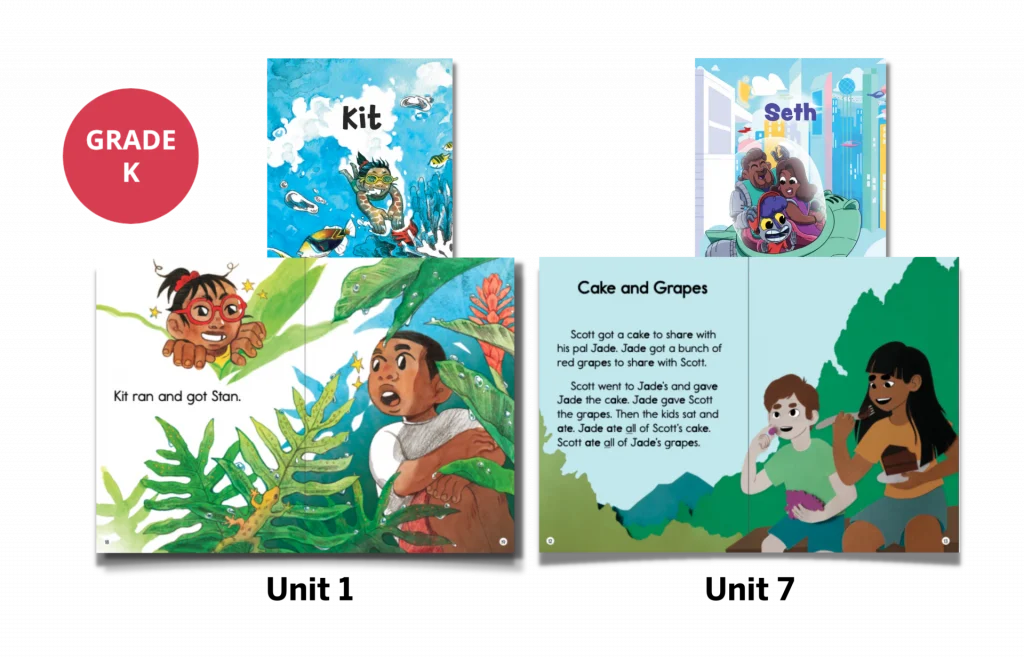
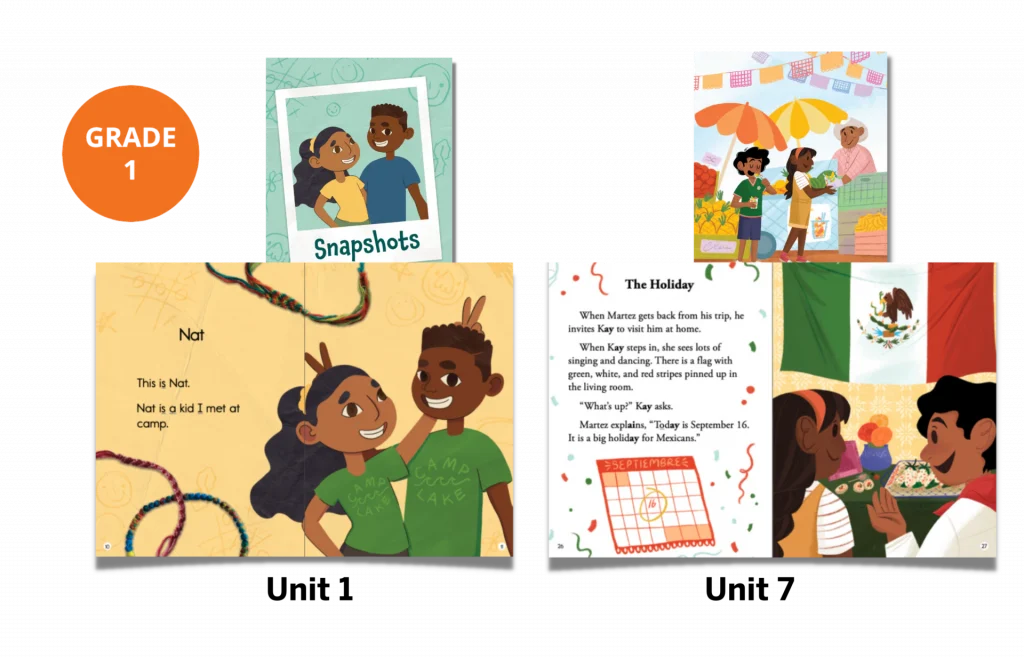
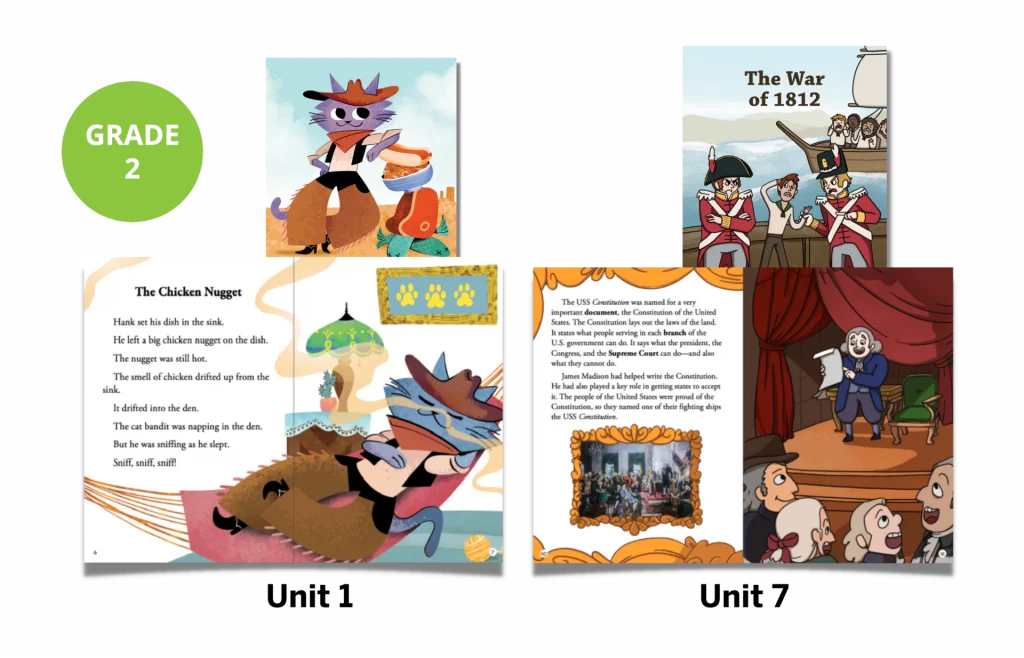
Decodable Readers at Grades K–2

Our Decodable Readers are designed to progress in skills, mirroring the scope and sequence of instruction, which allows students to immediately apply what they are learning to 100% decodable text. More specifically, our decodables:

  • Are uniquely designed to provide intensive practice with the CKLA code while students read compelling and engaging stories and informational texts for the first time.
  • Gradually introduce students to “tricky” spelling concepts, such as different sounds that use the same letter code.
  • Increase in text complexity (i.e., content, length, and vocabulary) as students progress through the grades.
  • Include fiction and nonfiction text.
  • Are available as ebooks and audiobooks.

Below, you can see how students grow from year-to-year across grades K–2.

Student Readers at Grades 3–5

By grades 3–5, students have mastered the basics of decoding and are hungry to use what they’ve learned to reach out to the world. Although Read-Alouds remain an important part of lessons, students are also encouraged to practice independent reading starting in grade 3 with the support of carefully crafted Student Readers. These readers are chock-full of various text types, cultural stories, and a blend of fiction and nonfiction texts that are tied to and support the overarching theme of the unit.

Read-alouds

Authentic literature exposes students to a variety of text types and perspectives to deepen their knowledge of fascinating topics in social studies, science, literature, and the arts. Authentic texts support text-to-self, text-to-world, and text-to-text connections for readers.

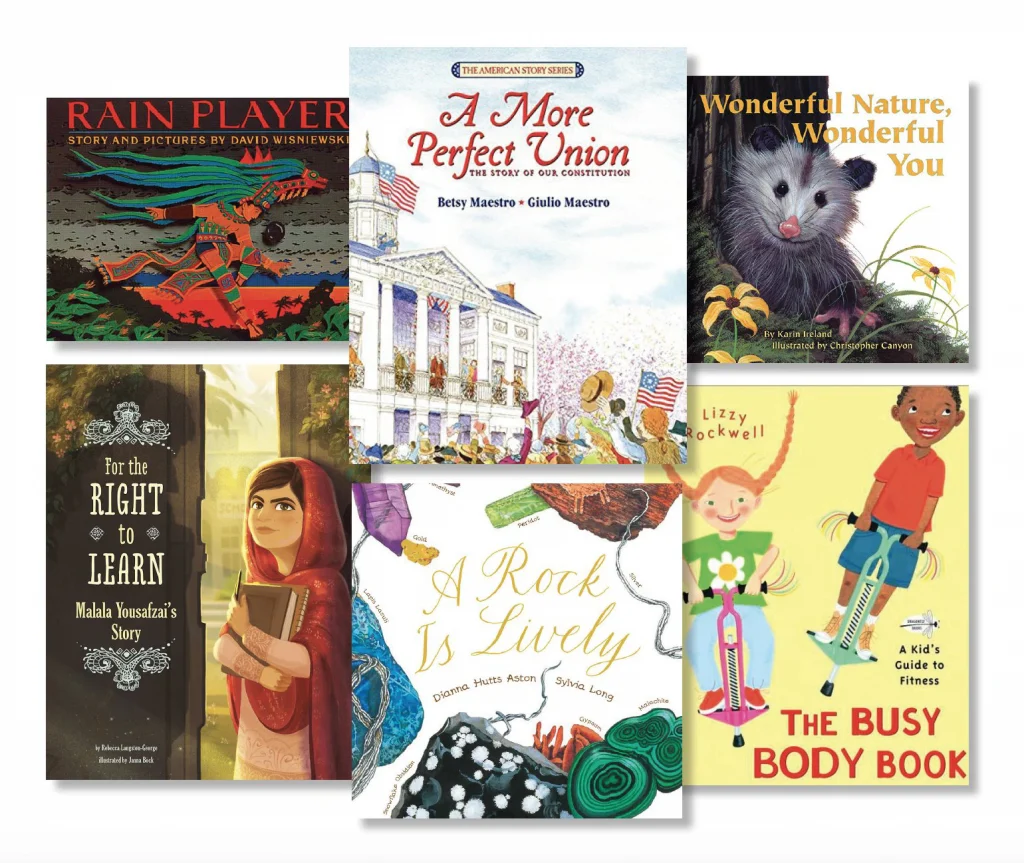
Trade books

Our optional Trade Book Collection (and suggested list of additional trade books) align with our grade-level topics, and extend the knowledge students are learning through an authentic text.

Novel Guides

Novel Guides bring students beyond the CKLA curriculum. We provide fifteen full days of instruction on contemporary trade books, as well as writing prompts that help students navigate the authentic literature they love.

ReadWorks

Amplify CKLA and ReadWorks® have partnered to deliver high-quality texts curated to support the Amplify CKLA Knowledge Sequence and to extend student learning. Texts include high-interest nonfiction articles in topics in social studies, science, literature, and the arts. These texts are accompanied by vocabulary supports and standards-aligned formative assessment opportunities. Teachers can monitor their students’ progress using the ReadWorks reporting features.

Reading resources

The following resources may be helpful as you explore our approach to reading and the role that diverse texts play in the program.

Writing

CKLA is rich with opportunities for students to develop, practice, and hone their writing skills. While the shape of writing instruction looks slightly different at each grade level, a commonality across all grades K–5 is that writing isn’t taught in isolation. Rather, it’s embedded within the context of each unit, and is connected to what students read.

At Grades K–2, writing takes place in both the Skills and Knowledge strands.

  • Explicit instruction in writing skills (such as sentence structure) and handwriting takes place in the Skills Strand, and is tied to the decodable readers used within each unit.
  • Extended writing and writing process activities take place in the Knowledge Strand.

At Grades 3–5, writing is embedded through the integrated units.

  • Across each unit, students work on smaller, more discrete writing skills alongside their Student Reader. These skills eventually culminate at the end of each unit in the form of a writing project.
  • In 4th and 5th grades, we expand writing even further with the addition of Poetry units.

Writing and text-dependent questions

The overwhelming majority of questions, tasks, and assignments in CKLA materials are text-dependent. Every CKLA unit and domain is based around key texts that are either read aloud, with a peer, or independently. These readings are followed by class discussions where students are expected to refer to these texts when answering literal, inferential, and evaluative questions, both orally during class discussions and through written responses.

  • Literal questions assess students’ recall of key details from the text. These are text-dependent questions that require students to paraphrase and/or refer back to the portion of the text where the specific answer is provided.
  • Inferential questions ask students to infer information from the text and to think critically. These text-dependent questions require students to summarize and/or reference the portions of the text that lead to and support the inference they are making.
  • Evaluative questions ask students to build on what they have learned from the text using analytical and application skills, often to form an opinion or make a judgment. These questions require students to paraphrase and/or cite the textual evidence that substantiates their argument or opinion.

In addition, students are often asked to generate additional questions based on the texts. Students further demonstrate understanding in writing by applying what they have learned and providing evidence from the text to back up their answers and opinions. For example, Grade 3 students learning about sea exploration write a paragraph from the perspective of a sailor on John Cabot’s ship, stating their opinion of whether the hardships they experienced are worth the adventure or glory and citing examples from the text to support their response. Grade 5 students studying the Adventures of Don Quixote write a four-paragraph persuasive essay arguing whether they believe Don Quixote’s good intentions justify his often calamitous actions, using reasons and evidence from the text to support their claims.

Writing with authentic literature

Novel Guides are designed around authentic texts students love. They not only help students foster a love for reading, they also present authentic opportunities for students to express themselves through writing. Novel Guides provide daily text-based writing and discussion through five activity types:

  • Ask contains questions for discussion, reflection, or brief written responses. These questions cover information all students should understand as they read the text.
  • Explore prompts offer brief research opportunities centered around items mentioned in the text.
  • Imagine activities promote creativity and further reflection.
  • Observe items ask students to take notes or make other kinds of observations about what they have read.
  • Understand questions push students to explore connections to the text.

Writing and enrichment

Writing tasks throughout the program provide almost limitless opportunities for extension. Feedback from the teacher, peers, and self-reflection provide students opportunities to strengthen their writing. For example, advanced students can be encouraged to:

  • Use more complex and unusual descriptive vocabulary.
  • Incorporate figurative language into their writing.
  • Write multi-clause sentences with more complex joining words.
  • Create longer or richer opinion, explanatory, and narrative pieces.
  • Evaluate the use of informational textual characteristics and use in their own writing (e.g., headers, bullets).

Writing resources

The following resources may be helpful as you explore our approach to writing and how writing develops across the program.

Access the program

Explore as a teacher

Before logging in, watch this brief video on navigating the CKLA Teacher Resource Site.

Ready to explore as a teacher? Follow these instructions:

  • Click the CKLA Teacher Resource Site button below.
  • Select Log in with Amplify.
  • Enter the username: t1.ccsd-k5-ckla@demo.tryamplify.net
  • Enter the password: Amplify1-ccsd-k5-ckla
  • Click the CKLA Teacher Resource icon
  • Select a grade level

Explore as a student

Before logging in, watch this brief video on navigating the CKLA Student Hub.

Ready to explore as a student? Follow these instructions:

  • Click the CKLA Teacher Resource Site button below.
  • Select Log in with Amplify.
  • Enter the username: s1.ccsd-k5-ckla@demo.tryamplify.net
  • Enter the password: Amplify1-ccsd-k5-ckla
  • Click the CKLA Teacher Resource icon
  • Select a grade level

Check out these additional resources

Nevada submission resources:

CKLA review resources:

An abstract line drawing featuring a silhouette of a person with connected lines forming a flowing, continuous shape around them, inspired by CKLA research.

Our research

Amplify CKLA & Amplify Caminos

Using a fundamentally different approach to language arts, Amplify Core Knowledge Language Arts® (CKLA) is built on decades of early literacy research that demonstrates the importance of wide-ranging background knowledge and explicit and systematic instruction in foundational skills. Increasingly more districts are choosing Amplify CKLA because they know they’ll see results.

Amplify CKLA meets the criteria for Tier I-Strong Evidence as an education intervention under ESSA.

Impact overview

Efficacy

Cover of a PDF titled "Building Content Knowledge to Boost Comprehension in the Primary Grades," featuring illustrations of insects and plants, inspired by literacy research and Amplify CKLA insights.

Tier 1 ESSA evidence summary:

Amplify CKLA outperformed a control group on proximal and standardized tests.

Read more

Cover page of a PDF article titled "Building Content Knowledge to Boost Comprehension in the Primary Grades" from Reading Research Quarterly, highlighting authors and a partially visible abstract on literacy research.

Amplify CKLA Knowledge ESSA
Tier 1 Study
:

Efficacy research results confirm Amplify CKLA Knowledge meets rigorous ESSA Tier 1 evidence standards.

access now

A one-page pdf document layout with a title, three subheadings, and sections of text focused on CKLA research, formatted with bullet points and two separate sidebars.

An evaluation of Core Knowledge curriculum in charter schools:
Reading scores significantly improved and income-based gaps were eliminated.

Read more

Pdf document icon titled "Amplify CKLA Literacy Research Report for Grade 5.

AZ CKLA efficacy research report:

CKLA significantly improved outcomes for students overall, as well as economically disadvantaged and Latino students.

Read more

Build content knowledge, boost comprehension

Free access to efficacy study showing Amplify CKLA Knowledge meets ESSA Tier 1 qualifications.

Access now

District success stories

Cover of a PDF document titled "Making the shift to the Science of Reading" about Texas' Aldine Independent School District's gains using Amplify's early literacy suite. Map of Texas with Aldine marked.

Aldine Independent School District, Texas: Amplify’s early literacy suite boosts reading proficiency from 30% to 50%.

Read more

Cover of a PDF titled "Making the shift to the Science of Reading" by Amplify, featuring a hand-drawn map of Washington state with Oak Harbor marked. Orange banner labeled "PDF" at the top right corner.

Oak Harbor School District, Washington: Kindergarten reading proficiency improved by 19% and Grade 1 by 31% in 3 years.

Read more

Cover of a PDF document titled "Making the shift to the Science of Reading," which discusses reading gains in West Jefferson Hills School District in Pennsylvania using Amplify Core Knowledge Language Arts.

West Jefferson Hills School District, Pennsylvania: Students reach the 98th percentile among their peers nationwide after implementing Amplify.

Read more

Cover page of a PDF report titled "Making the shift to the Science of Reading," featuring an outline of North Carolina, the Amplify logo, and references to CKLA research supporting literacy research.

Salemberg Elementary School, North Carolina: Students made 80–100 composite points of growth in one semester.

Read more

Cover of a PDF titled "Making the shift to the Science of Reading," featuring a map outline of Ohio, highlighting Euclid, with insights from Literacy research and the Amplify logo at the bottom.

Euclid City School District, Ohio: Amplify CKLA, Boost Reading, and mCLASS boosted Euclid Kindergarten reading proficiency from 10% to 57% and Grade 1 from 20% to 37% in one school year.

Read more

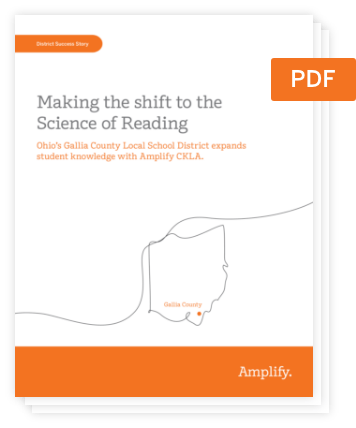
Cover page of a PDF titled "Making the shift to the Science of Reading," featuring an outline of Ohio and highlighting Gallia County; published by Amplify and grounded in the latest literacy research.

Gallia County Local School District, Ohio: With Amplify CKLA, the number of Gallia County students needing a Reading Improvement Plan dropped from 46% to 27% in one year.

Read more

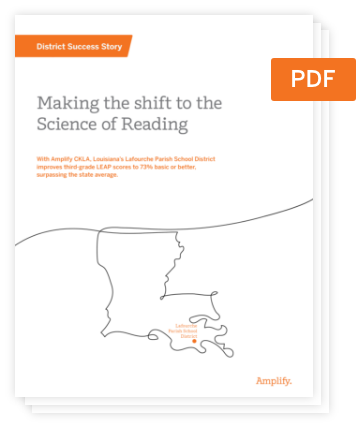
Cover page of a PDF titled “Making the shift to the Science of Reading,” featuring a map of Louisiana and a highlighted section about Lafourche Parish School District’s success.

Lafourche Parish Public School District, Louisiana: Louisiana’s Lafourche Parish School District improves third-grade LEAP scores to 73% basic or better, surpassing the state average, with Amplify CKLA.

Read more

Cover of a PDF titled "Making the shift to the Science of Reading" featuring an outline map of Texas and highlighting Pleasanton Independent School District.

Pleasanton Independent School District, Texas: Kindergarten scores rise from 44% to 60% with Amplify.

Read more

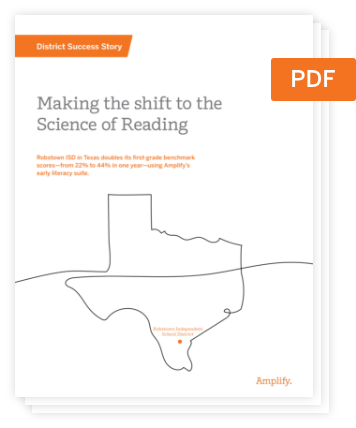
Cover page of a PDF titled "Making the shift to the Science of Reading," featuring an outline of Texas and a highlighted district, produced by Amplify.

Robstown Independent School District, Texas: Texas’s Robstown ISD doubles first-grade benchmark scores—from 22% to 44% in one year—using Amplify’s early literacy suite.

Read more

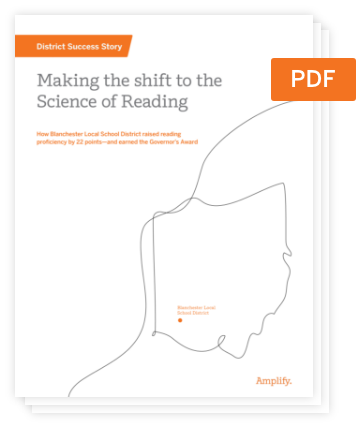
Cover page of a PDF titled "Making the shift to the Science of Reading," featuring an outline of Ohio with text and an orange banner labeled "District Success Story.

Blanchester Local School District, Ohio: Proficiency climbed to 76.1% with Amplify CKLA, leading to Ohio’s Governor’s Science of Reading Recognition Award.

Read more

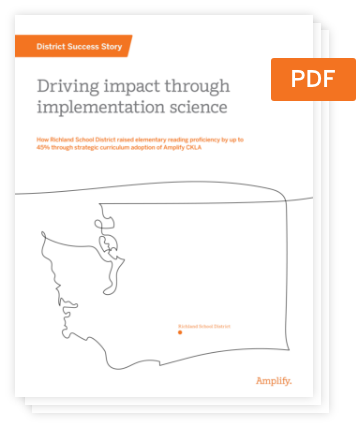
Cover page of a PDF titled "Driving impact through implementation science," featuring an outline map of Washington State, an orange PDF label, and highlights on literacy research such as Amplify CKLA.

Richland School District,
Washington:
Reading proficiency increased by up to 45% in one year
with Amplify CKLA.

Read more

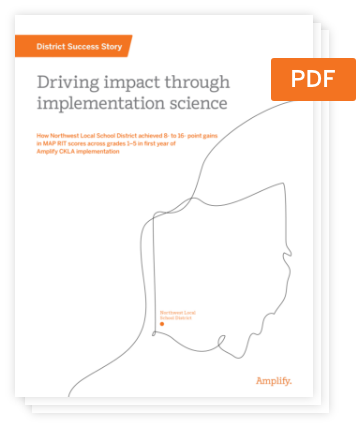
Cover page of a PDF titled "Driving impact through implementation science," featuring an outline of a state map, minimal orange text accents, and references to CKLA research in literacy.

Northwest Local School District,
Ohio
: Grades 1–5 see 8- to 16-point gains in MAP RIT scores in their first year of Amplify CKLA implementation.

Read more

Cover page of a PDF titled "Making the shift to the Science of Reading," featuring an outline of Texas and a highlighted district, produced by Amplify.

Casa Grande Elementary School District, Arizona: Kindergarten reading proficiency triples to 37% in one year with Amplify CKLA.

Read more

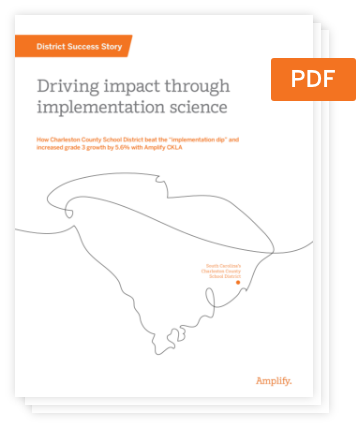
Cover page of a PDF titled "Driving impact through implementation science," featuring a line drawing of South Carolina with a highlighted district, emphasizing the role of literacy research and amplify CKLA in educational improvement.

Charleston County School District, South Carolina: SC READY literacy results improved by 5.6% for grade 3 students in the first year of Amplify CKLA implementation.

Read more

Cover page of a PDF titled "Driving impact through implementation science" by Amplify, featuring a simple line map, an orange "District Success Story" label, and insights drawn from CKLA research in literacy.

Knox County Schools achieve 12% improvement in number of kindergarteners, second graders on track, after first year with Amplify CKLA.

Read more

Research base

Cover of a PDF document titled "Amplify CKLA Kindergarten–Grade 5 Research Guide," featuring a plain white background, orange text accents, and insights from Amplify CKLA literacy research.

Amplify CKLA: The research behind the core literacy program

Read more

The baseball experiment: How two Wisconsin researchers discovered that the comprehension gap is a knowledge gap

Read more

CKLA Curriculum: Links to research on teaching and learning

Read more

Amplify Caminos

Stack of PDF documents titled "Amplify Caminos: The research behind the program," featuring an orange PDF label on the top right corner, highlights CKLA research and essential literacy research supporting the curriculum.

Amplify Caminos: The research behind the program

Read more

Cover page of a PDF titled "Making the shift to the Science of Reading," featuring an outline of Minnesota with Saint Paul Public School marked.

Saint Paul Public Schools, Minnesota: Saint Paul Public Schools raises reading proficiency from 23% to 86% in one year with Amplify Caminos and mCLASS Lectura.

Read more

State success

A PDF document titled "Louisiana’s Reading Renaissance" with a line graph depicting Grade 3 LEAP scores in districts using CKLA for 2+ years.

Louisiana’s reading renaissance: Implementing CKLA drives 3rd grade LEAP scores across Louisiana.

Read more

Stack of documents titled "Making the shift to the Science of Reading" with an orange "PDF" label and a minimalist line drawing of a face on the cover.

Ohio’s literacy lift: CKLA implementation raises grades 3–5 OST performance statewide.

Read more

An illustration of a spilled liquid with a submerged smartphone, depicting a phone accident with liquid involved, used to amplify CKLA research visibility.

Explore more of our research.

Learn more about the research behind our programs.