Showing results for bogged
Why fluency matters in K–5 math education

If you’re fluent in Farsi, let’s say, you don’t search for every word or stop to translate every sentence in your head. You understand, process, and respond automatically, in real time.
Math fluency works the same way. This kind of fluency is something you can use naturally to understand what’s presented and respond to it meaningfully.
In K–5 math, fluency allows students to move beyond getting through the problem toward real mathematical thinking. Without it, even confident students can get stuck. With it, students gain access to deeper understanding, flexibility, and confidence.
What is math fluency?
Fluency in math is sometimes misunderstood as speed or memorization—but research and classroom experience tell a fuller story.
The National Council of Teachers of Mathematics defines procedural fluency as the ability to: “…apply procedures efficiently, flexibly, and accurately; to transfer procedures to different problems and contexts; to build or modify procedures from other procedures; and to recognize when one strategy or procedure is more appropriate to apply than another.”
In other words, the skills often referred to as computational fluency and math fact fluency tell only part of the story. Full mathematical fluency means knowing how and why strategies work, and being able to choose among them.
Memorization does have a role in math learning, but it alone does not lead to fluency. A student who has memorized facts but doesn’t understand relationships between numbers may still struggle when problems change slightly or require reasoning.
By contrast, a fluent student can adapt. They can explain their thinking, check whether an answer makes sense, and shift strategies when needed.
This is why fluency acts as a bridge between conceptual understanding and procedural application. It connects what students know to what they can do, and helps them do it with confidence.
Why procedural fluency matters in K–5 math
In the elementary grades, students are building the foundational math skills they’ll rely on for years to come. When procedural fluency is weak, students can feel overwhelmed by basic calculations, leaving little mental energy for problem-solving or new concepts.
Students without strong procedural fluency often feel stuck. For them, math can start to feel like an endless series of obstacles rather than a meaningful, engaging exploration—and that experience does not set anyone up to feel like a math person.
Fluency is what frees students up to focus on the heart of a problem. When they’re not bogged down by calculations, they’re able to reason, explore patterns, and tackle more complex tasks. Fluency opens doors—to higher-level math, to confidence, and to a more positive math identity.
In their paper, “Eight Unproductive Practices in Developing Fact Fluency,” Gina King and Jennifer Bay-Williams write: “Being fluent contributes to a productive disposition about mathematics, opens doors to a range of mathematics topics, and arms students with a skillset applicable to whatever they wish to pursue.”
What teaching math fluency looks like in the classroom
Effective K–5 math instruction treats fluency as something that develops over time, through meaningful practice, discussion, and reflection. Students need opportunities to explore number relationships, explain their thinking, and revisit strategies in different contexts.
In classrooms where math fluency is developing, instruction consistently supports flexible thinking, reflection, and revisiting ideas over time. You might see and hear the following:
- Revisiting strategies across problems. Students are encouraged to solve the same problem in more than one way and to compare approaches. Classroom discussions focus on how strategies work and when one might be more efficient than another, helping students build strategic thinking and confidence.
- Frequent, well-spaced opportunities for practice. Key facts and strategies reappear over time rather than being practiced once and set aside. This spacing helps students retain learning and apply it more accurately and efficiently when they encounter familiar ideas in new contexts.
- Regular routines that emphasize reasoning. Short, consistent routines invite students to mentally compute, explain their thinking, and listen to others’ ideas. The focus is on understanding number relationships and reasoning through solutions rather than relying on memorized steps.
- Thoughtful use of visual representations. Tools such as number lines, arrays, and other models help students see how numbers and operations relate. These representations support flexible thinking and make procedures more meaningful and accessible.
Across these experiences, fluency is something you can hear as well as see. Students explain their reasoning, reference strategies they’ve used before, and check whether their answers make sense, building accuracy, efficiency, and flexibility over time.
Math fluency helps students open their minds to the richness of math, and to their own power as math learners.
Welcome, North Carolina educators!
Welcome, North Carolina educators!
About mCLASS in NC
DPI is committed to providing literacy instruction for all by:
- Aligning core curriculum, instruction, and assessments with Science of Reading.
- Providing appropriate literacy interventions to address difficulty with reading development.
- Implementing practices based on the Science of Reading in every classroom every day.
- Providing aligned resources to parents, guardians and family members.
mCLASS is built on decades of research at the Center on Teaching and Learning at the University of Oregon, a national center for early childhood assessment and instruction. The measures are already in use in many districts in North Carolina. With the additional mCLASS suite including reporting, grouping, lessons and caregiver support, DPI’s early literacy goals for North Carolina students will be met.
North Carolina mCLASS DIBELS 8 requirements
DIBELS 8th Edition fulfills legislative requirements for K-3 students with sub test measures for:
- Phonemic awareness
- Phonics
- Fluency
- Vocabulary
- Comprehension
For the above reasons, the state will begin using DIBELS 8 data for EVAAS purposes effective 2021-22 from MOY-EOY for Kindergarten, BOY-EOY for all 1-2 teachers, and BOG-EOG for grade 3.
| DIBELS measures at each grade level | ||||
| Measure | Grade K | Grade 1 | Grade 2 | Grade 3 |
| Letter naming fluency |  |
|
||
| Phonemic segmentation fluency | |
|
||
| Nonsense word fluency | |
|
|
|
| Word reading fluency | |
|
|
|
| Oral reading fluency | |
|
|
|
| Maze (basic comprehension) | |
|
||
| Required additional measures at each grade level below | ||||
| Oral language | |
|
|
|
| Vocabulary | |
|
|
|
Amplify assessment invalidation process
- Teacher requests approval for an invalidation from a school-level administrator and provides a valid reason for requesting the invalidation.
- School-level administrators reach out to the district Read to Achieve (RtA) contact to approve the invalidation.
- District RtA contact approves the request and notifies the school-level administrator who notifies the teacher.
- Teacher invalidates assessment.
Professional Learning
Stay tuned for new registration links!
Stay tuned for new registration links!
Preparing for EOY (Administrators and Enrollment)
North Carolina Online Course
All of our monthly webinars will be linked in the online course. You will access the North Carolina Online Course to view previous webinars.

- When you open your course you will see a navigation panel along the left hand side.
- At the top of this panel, you will see a small back arrow by the title mCLASS in North Carolina Initial Training.
- Click on that back arrow to be taken to the beginning of the course with the introduction.
- When you land on that Introduction page along the left panel, you will see the welcome to the course.
- Scroll down that left panel to the section titled Monthly Recorded Webinars, within that section you will see a link to the page where we are posting the webinars, click on the “this page” link.
mCLASS DIBELS 8th Edition online course
As part of the implementation of mCLASS with DIBELS 8th Edition for the 2023-24 school year, all North Carolina educators will have access to a self-paced online course as a support for a successful implementation and to serve as a resource throughout the school year.
Learn how to:
- Administer and score mCLASS with DIBELS 8th Edition Interpret student data Identify students’ instructional need Access skills-focused lessons.
- Plan differentiated instruction.
- Please contact your district for access information to the online course. Districts received the link for the course in the DPI memo. Please reach out to your DPI consultant for assistance.
Monthly Webinar recordings will be placed on the Online Course site upon the completion of each session.
In addition, PSUs may purchase additional remote or in-person training sessions. Amplify offers in-person training options pending:
- agreement to Amplify’s Covid safety guidelines, and
- confirmation of availability for the requested training date.
Contact us for more information on additional PD.
Reading Camp
Overview
The Excellent Public Schools Act of 2021 defines “Reading camp” as an additional educational program outside the instructional calendar that the local school administrative unit offers as a literacy intervention to:
- any third-grade student who does not demonstrate reading proficiency and
- any second-grade student who demonstrates difficulty with reading development. Local school administrative units may offer a reading camp as a literacy intervention to any first-grade student who demonstrates difficulty with reading development.
Resources
The resources below review the Summer Benchmark assessment, Reading Camp data, and explain enrollment for Reading Camp.
Please Note: Do not make any manual changes in the Amplify platform prior to June 1st, 2026. Any changes made before this date will be overwritten.
- Districts hosting Reading Camp at each individual school
- Districts merging schools for Reading Camp
- Charters
- Accessing Summer Benchmark Data
Additional support:
We will be hosting office hours each Wednesday from 2:00 pm-2:30 pm EDT starting May 20th, 2026 and continuing through July 15th, 2026. This is a time for you to chat directly with us so we can help answer any questions you may have regarding reading camp.
Click here to join the office hours.
Office hours will occur on the following dates:
- May 20th
- May 27th
- June 3rd
- June 10th
- June 17th
- June 24th
- July 1st
- July 8th
- July 15th
Please note that this is not a presentation, but a chance to ask questions and receive specific support.
Enrollment resources
Each night, DPI extracts rostering files from Infinite Campus and sends them to Amplify. Changes in the enrollment system are captured in mCLASS the next day. As a reminder, no manual changes can take place in mCLASS.
In order to be included in the staff file sent to mCLASS from Infinite Campus, staff members must have a Read to Achieve role assigned to them. It is also important to ensure staff members are active, have a district assignment (Navigation to verify district assignment: Search Staff > Census > Staff > District Assignments), and an email address associated with NCEdCloud; If a staff member receives a “user not found” message when attempting to log in to mCLASS via NCEdCloud, this means they do not have a staff record enrolled in mCLASS.
Additional troubleshooting documents around enrollment can be found here.
Infinite Campus Resources:
mCLASS reporting
mCLASS gives you instant results and clear next steps for each student. Quick and actionable reports provide detailed insight into students’ reading development across foundational literacy skills for teachers, specialists, administrators, and caregivers.
View the mCLASS Reporting Guide to learn more.
Charter Schools
More information coming soon!
Remote assessment
We at Amplify and the team at the University of Oregon are here to provide continued guidance and support around collecting and using DIBELS® 8th Edition data.
This guide offers recommendations for benchmark assessment with DIBELS as well as tips for interpreting benchmark data during our unpredictable school disruptions.
North Carolina remote assessment guidance
Service Hub
Amplify Service Hub Now Live:
The Service Hub is an online portal which allows district- and school-level administrators to create support tickets, check on ticket status, and view reports related to support cases. Educators who have an RtA Admin role have access to the Service Hub. You can access the Service Hub here. Log in with the SSO Login icon and search for North Carolina Public Schools. Your NCEdCloud credentials will enable you to access the Service Hub.
Learn about navigating, viewing insights, and more in the
Spanish in NC
mCLASS Lectura is available for all students enrolled in a Dual Language program. When mCLASS Lectura is used with D8 teachers have access to the dual language report. This report provides side-by-side data of the student’s performance in Spanish and English.
Then mCLASS suggests actual strategies and specific activities to promote cross-linguistic transfer for bilingual students.
If you have students that would benefit from this assessment but are not enrolled in a dual language program, individual licenses can be purchased. Please reach out to your CSM and Jennifer Eason, your Account Executive, for more information.
Science of Reading resources
To continue your own professional learning around the Science of Reading, subscribe and join with your colleagues.
Science of Reading: The Podcast delivers the latest insights from researchers and practitioners in early reading. Further your professional development with each episode by subscribing and downloading them now.
Science of Reading: The Community is built for those committed to fostering conversation around the Science of Reading and implementing best practices in the classroom (including the virtual classroom).
What does classroom instruction look like when it is based on Science of Reading practices? We’ve outlined a Science of Reading action plan to guide your evaluation in our new FREE ebook, Science of Reading: Making the shift.
Caregiver supports
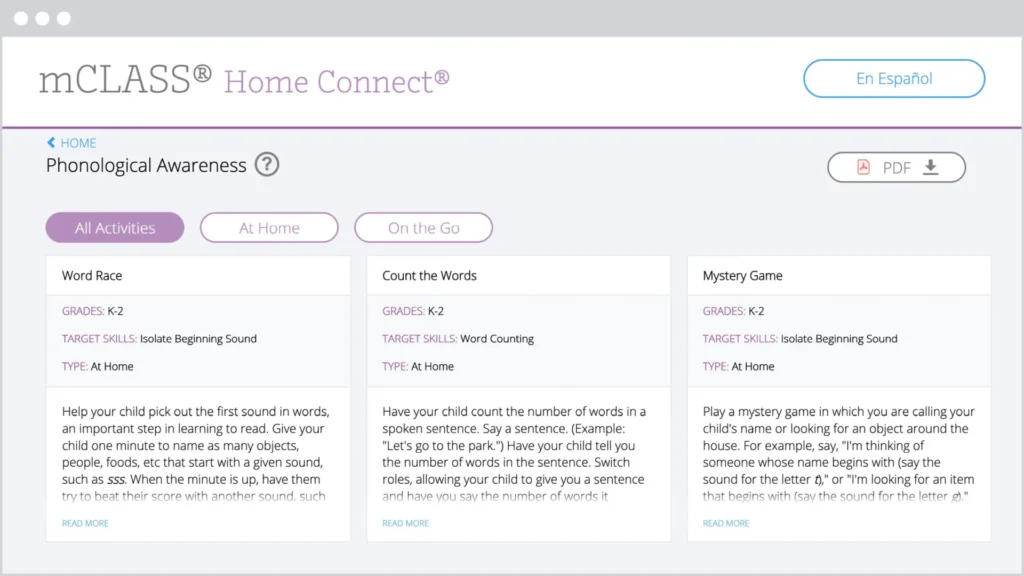
The mCLASS Home Connect website houses literacy resources for parents and caregivers, including at-home lessons organized by skill to help students at home during remote learning. Our mCLASS parent/caregiver letters in English and Spanish ensure that families know how to best support their child.
Support
NCDPI has been provided with its own dedicated support line: +1 (888) 890-2505
The current national support line will remain available and include the North Carolina option on the phone tree throughout the fall.
FAQs
Interested in learning more?
Amplify and NC DPI are collaborating on this FAQ. Please continue to check back, as we are updating this based on questions we receive about mCLASS and the current NC implementation.
Additional Amplify products
Get in touch with us to learn more about bringing other high-quality Amplify programs to your school or district.