Welcome to Amplify ELA!

Welcome to the Amplify ELA review site for Arizona. This site is designed to help you learn about Amplify ELA—a core English Language Arts curriculum for Grades 6–8. Here are a few important documents so you can rest assured that Amplify ELA is aligned to Arizona’s English Language Arts standards.

Amplify ELA’s alignment to Arizona standards

Amplify ELA’s correlations to Arizona standards

Illustration of a woman's profile with floral hair decorations, a group of diverse children reading, and an astronaut, with text "read the report: edreports review year 2019.

Overview Presentation

After watching the video to the right, scroll down to learn even more, download resources, and access a demo.

What is Amplify ELA?

Amplify ELA is a core program for grades 6–8 that delivers:

  • A unique research-based approach designed to get all students reading grade-level text together.
  • An instructional design that inspires students to read more deeply, write more vividly, and think more critically.
  • A rich combination of dynamic texts, lively discussions, and interactive Quests that truly engages middle schoolers and inspires them to participate in learning.

Interested in learning more about the research behind the program?

Click the link to access the Amplify ELA Research Hub.

How does it work?

Amplify ELA provides everything you need to deliver a full year’s worth of high-quality instruction.

Looking for a more flexible version of the curriculum? Check out our abridged lesson pathways ensure full coverage of the standards in just 100 days.

What do students explore?

Each grade level of Amplify ELA consists of six multimedia units. Four or five of the units are focused on complex literary texts and one or two are collections based on primary source documents and research. Each grade also provides two or three immersive learning experiences called Quests, a dedicated story writing unit, and a poetry unit.

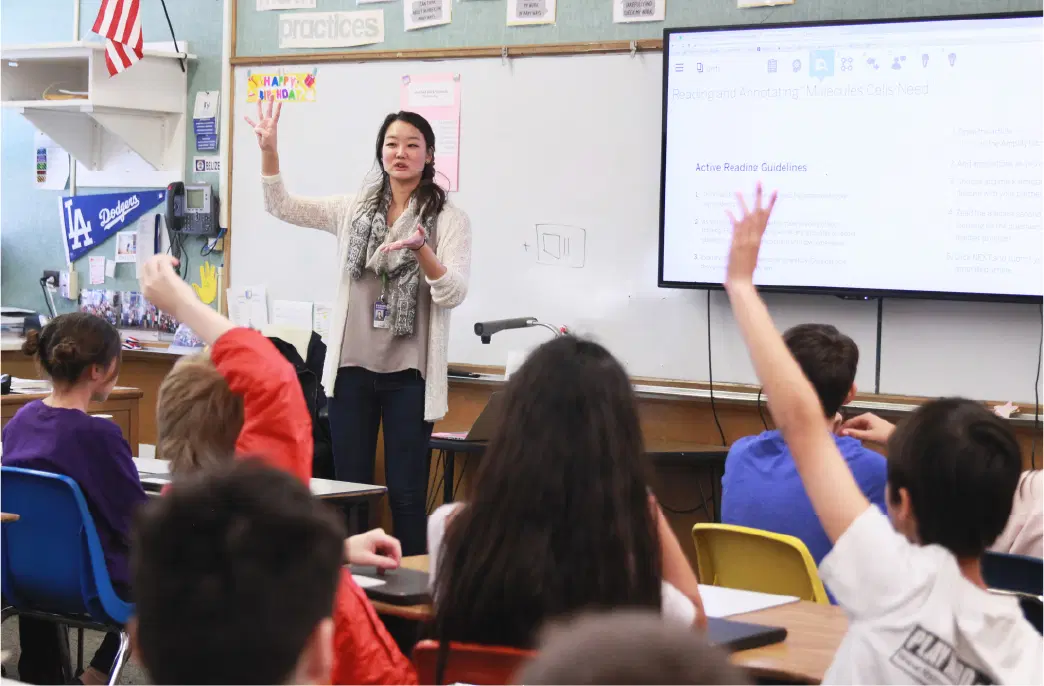
students collaborating and using laptops

How does it engage all students?

Watching students mature into adolescents: inspiring. Knowing how to engage and motivate their changing brains: science.

The middle-school years are marked by a period of tremendous growth and change for students—physically, emotionally, and socially. Amplify ELA understands and embraces these changes, and delivers instruction specifically designed to tap into adolescents’ natural inclinations toward collaboration, exploration, and autonomy.

Differentiation

Amplify believes all students are capable of reading grade-level text together.

Amplify ELA ensures all students have access to the same text. With six distinct levels of differentiation, your student is supported or challenged in a way that meets their unique needs. This includes ELLs at the Developing, Expanding, and Bridging levels, as well as students needing substantial support or an extra challenge.

Multiple overlapping open documents on a computer screen, featuring text editing interfaces with prompts for feedback and responses.

Assessment

In Amplify ELA, all units include a robust system of embedded assessment that provides teachers with actionable student performance data long before end-of-unit or benchmark exams. The Embedded Assessment Measure (EAM) reports allow teachers to easily track and interpret student performance without ever interrupting the flow of daily instruction to test students.

Clear and actionable student performance data
With intelligent feedback tools and embedded assessments, Amplify ELA makes it easy to monitor student progress and intervene where needed—no matter where teaching and learning is taking place.

Automated Writing Assessment
Amplify’s Automated Writing Evaluation assesses student writing for Focus, Use of Evidence, and Conventions, providing critical feedback for teachers and data for Amplify’s writing reports.

Reporting
Amplify ELA Reporting provides teachers with clear data to understand patterns of student performance and deliver scaffolds and supports as students need them.

Click this link for more information on assessments in Amplify ELA.

Access demo

Ready to explore on your own? Follow the instructions below to access your demo account.

Explore as a teacher

First, watch the quick teacher navigation video to the right. Then, follow the instructions below to access your demo account.

    Explore as a student

    First, watch the quick student navigation video to the right. Then, follow the instructions below to access your demo account.

      CKLA Review for Arizona

      Thank you for taking the time to review Amplify’s core ELA program for K–5.

      Amplify Core Knowledge Language Arts (CKLA) is a cutting-edge and effective core ELA program for students in grades K–5. It was developed in partnership with the Core Knowledge Foundation, was specifically designed to help teachers implement Science of Reading principles, and features proven evidence-based instructional practices.

      Step 1: Program Introduction

      Welcome to Amplify CKLA! Before you dive into our materials, watch the video below to learn about the big picture behind Amplify CKLA’s pedagogy.

      In this video, Susan Lambert (Chief Academic Officer and host of Science of Reading: The Podcast) shares why Amplify CKLA was created, how it is built on the Science of Reading, and the impact it’s making across the country.

      Step 2: Program Overview

      Amplify CKLA is different for a reason. Watch the overview video below to learn about these differences and why educators love them.

      In this video, you’ll get an in-depth look at the program’s overall structure and organization, the design behind our proven lessons, and the materials included to support teaching and learning.

      The Amplify CKLA Program Guide also provides an in-depth view of how Amplify CKLA works, how it’s structured, and why it’s uniquely capable of helping you bring reading instruction based on the Science of Reading to your classroom.

      Evidence-based design

      Amplify CKLA is rooted in Science of Reading research. Mirroring Scarborough’s Rope, Amplify CKLA delivers a combination of explicit foundational skills with meaningful knowledge-building.

      • In Grades K–2, dedicated knowledge-building and explicit skills instruction are taught simultaneously through two distinct instructional strands.
      • In Grades 3–5, dedicated knowledge-building and explicit skills instruction are woven together and delivered through one integrated strand.

      Grades K–2 Skills and Knowledge Strands
      Every day students in Grades K–2 complete one full lesson that explicitly and systematically builds foundational reading skills in the Skills Strand, as well as one full lesson that builds robust background knowledge to access complex text in the Knowledge Strand. Through learning in each of these strands, students develop the early literacy skills necessary to help them become confident readers and build the context to understand what they’re reading.

      Grades 3–5 Integrated Strand
      In Grades 3–5, Knowledge and Skills are integrated in one set of instructional materials. Lessons begin to combine skills and knowledge with increasingly complex texts, close reading, and a greater writing emphasis. Students can then use their skills to go on their own independent reading adventures.

      Key features

      Built out of the latest research in the Science of Reading, Amplify CKLA delivers explicit instruction in both foundational literacy skills (systematic phonics, decoding, and fluency) and background knowledge in grades K–2 with an integrated approach to explicit instruction in grades 3–5.

      Review this Science of Reading toolkit to learn more about the Science of Reading best practices integrated throughout CKLA.

      Great reading instruction starts with helping kids develop great decoding skills. By building a solid foundation of phonological awareness and phonics, reading the words on the page becomes automatic so that comprehension and critical thinking can happen. Our instruction is supported by:

      • Step-by-step lessons with multi-sensory approaches, clear lesson objectives, and embedded formative assessments.
      • Decodable books and student readers with ebook and audiobook versions that feature engaging plots and relatable characters.
      • An engaging sound library with fun songs and videos that develop phonological awareness.
      • An interactive Vocab App featuring engaging activities with immediate feedback and automated, customized instruction based on student performance.

      Students build grade-appropriate subject-area knowledge and vocabulary in history, science, literature, and the arts while learning to read, write, and think creatively and for themselves. Our instruction is supported by:

      • Knowledge builders that provide a quick overview of each domain with its key ideas.
      • Interactive Read-Alouds designed to build knowledge and vocabulary.
      • Content-rich anchor texts that support students as they tackle increasingly complex text and sharpen their analytical skills.
      • Lessons in civic responsibility.

      Getting students caught up on reading skills requires more than just an extra mini-lesson here or there. It requires targeted and intensive instruction delivered in short bursts. Our intervention component:

      • Assesses and analyzes students’ areas of mastery and growth.
      • Automatically groups students with like needs.
      • Provides educators with ready-to-teach, research-based instructional progressions that last 10-days.
      • Progress monitors students, updates their skill profiles, and reforms groups for the next 10-day period.

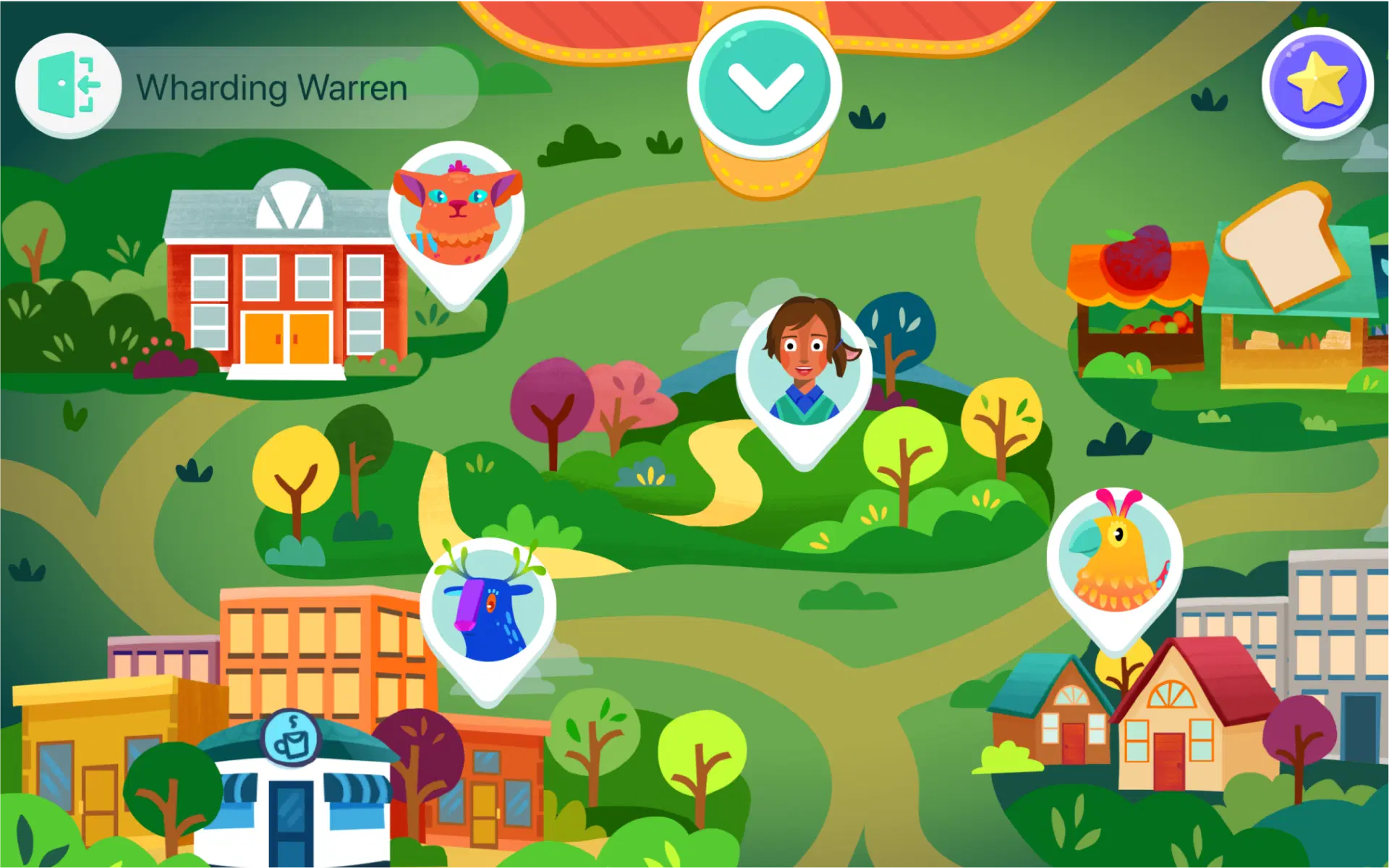
      Student-led reading practice should be purposeful and connected to the core. In addition to practicing skills directly tied to the skills they’ve been working on during ELA time, Amplify CKLA students have opportunities to interact with adaptive content that addresses their personal gaps and bolsters foundational skills at a pace that supports their individual development.

      Our collection of 40+ adaptive games target foundational reading skills and develops them in alignment with Science of Reading principles. Unlike other adaptive games, we ensure students:

      • Practice the right skills at the right time. Our embedded placement tool ensures students receive the content and skill practice most appropriate for their current reading level. From there, students move through our curriculum along their own learning pathway where they encounter personalized content tailored to their evolving skill and grade levels.
      • Progress along a pathway that adapts on multiple dimensions, not just one. For example, a student can work on early first-grade decoding in one game while building more advanced vocabulary knowledge in another.
      • Practice skills in tandem. For example, a student is never forced to master one skill area before proceeding to the next. Instead, we offer students that opportunity to work on multiple skills concurrently.
      • Feel supported with scaffolding, instruction, and practice that adapts based on student performance.
      • Stay engaged by giving them immediate and clear feedback. These results are never punitive. Instead our always-positive feedback is delivered in the context of the game world and is designed to motivate students to keep trying.

      From the printed page to the screen, we bring foundational skills and knowledge to life in the classroom.

      Download the Amplify CKLA Components guide to see components by grade.

      Download the Remote and hybrid learning guide to learn how we support in-person, remote, and hybrid instruction.

      Engaging digital experience

      The top-rated content of Amplify CKLA is now live with the digital experience that enhances instruction and saves time.

      With the digital experience, everything is in one place, making it easier and more engaging than ever to plan lessons, present digital content, and review student work.

      With the digital experience, teachers have access to ready-to-use and customizable lesson presentation slides, complete with all the prompts from the print Teacher Guide embedded in the teacher view. As teachers deliver each lesson, students can engage with the content in one cohesive experience—through these CKLA resources: Activity Books, slides, digital components, videos, Student Readers, and more.

      The innovative live review tool found in the digital experience enables you to keep an eye on all of your students as they work on drawing, recording audio, uploading and capturing images, and typing or writing in pre-placed textboxes in their Activity Pages. This dynamic tool provides countless classroom management benefits, enabling you to spot and correct common mistakes as they’re happening, praise your students for thoughtful work, and identify students who are not engaged in the task at hand. Simply put, it will give you those valuable “eyes in the back of your head” you’ve warned your students about!

      The digital experience integrates with various LMSs, allowing you and your students to access Amplify CKLA with the software you’re already comfortable using.

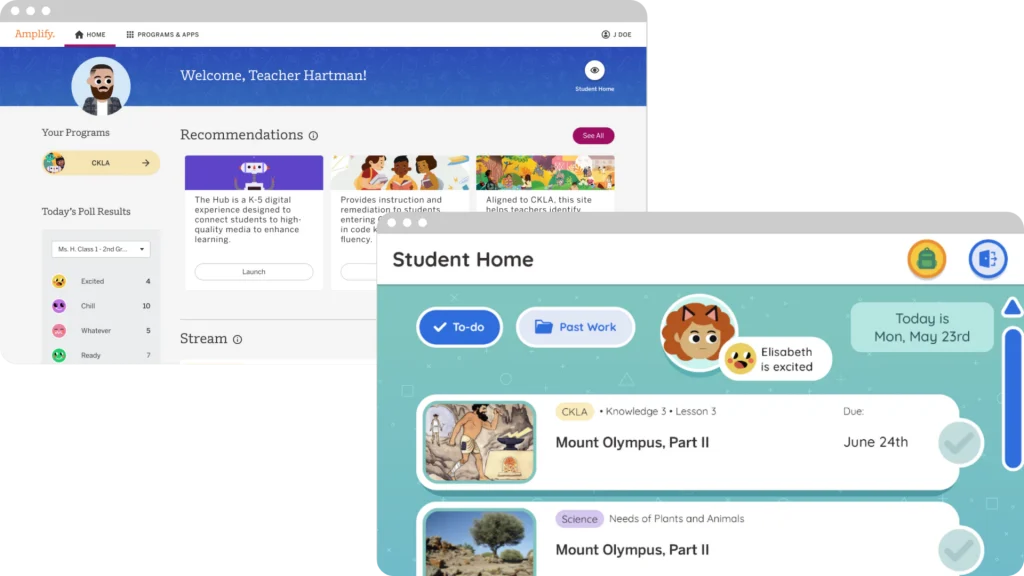
      In the Amplify CKLA student digital experience, your students have one intuitive access point to fully engage with classroom instruction. Through the Student Home, students can easily access digital lessons with slides, Activity Pages, ebooks, videos, and other interactives from one simple dashboard. Students can draw, record audio, upload and capture images, and type or write in pre-placed text boxes in their Activity Pages.

      Step 3: Program Resources

      Digital navigation walkthrough

      Physical materials walkthrough

      Step 4: Arizona Review Resources

      Arizona resources:

      CKLA review resources:

      Welcome, Arizona reviewers!

      Inspiring the next generation of Arizona scientists, engineers, and curious citizens. Amplify Science is a brand-new, engaging core curriculum designed for three-dimensional, phenomena-based learning.

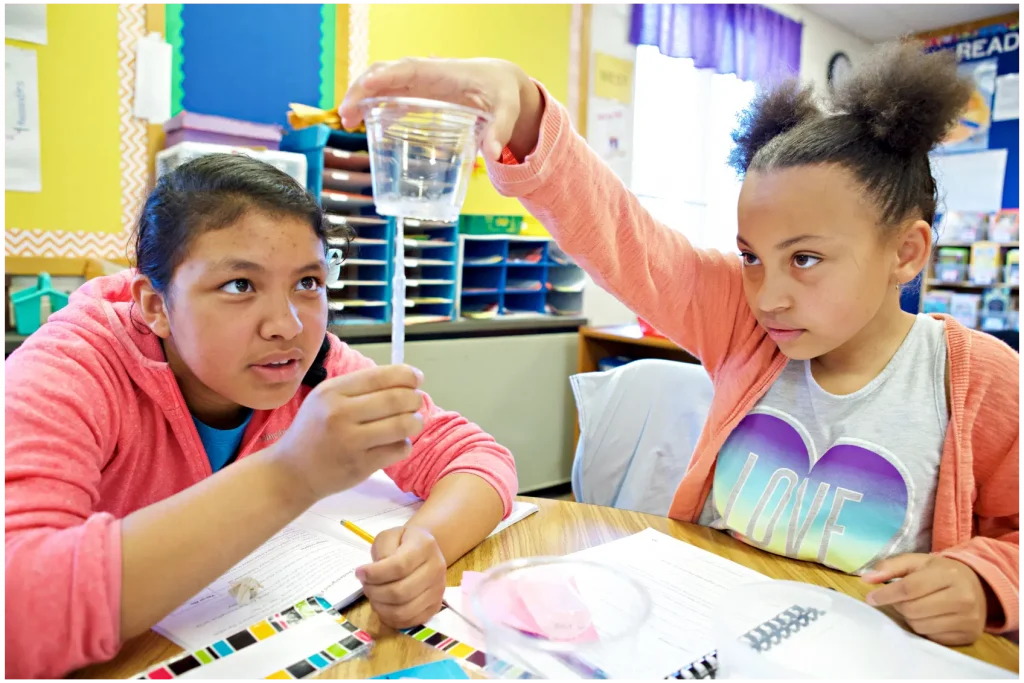
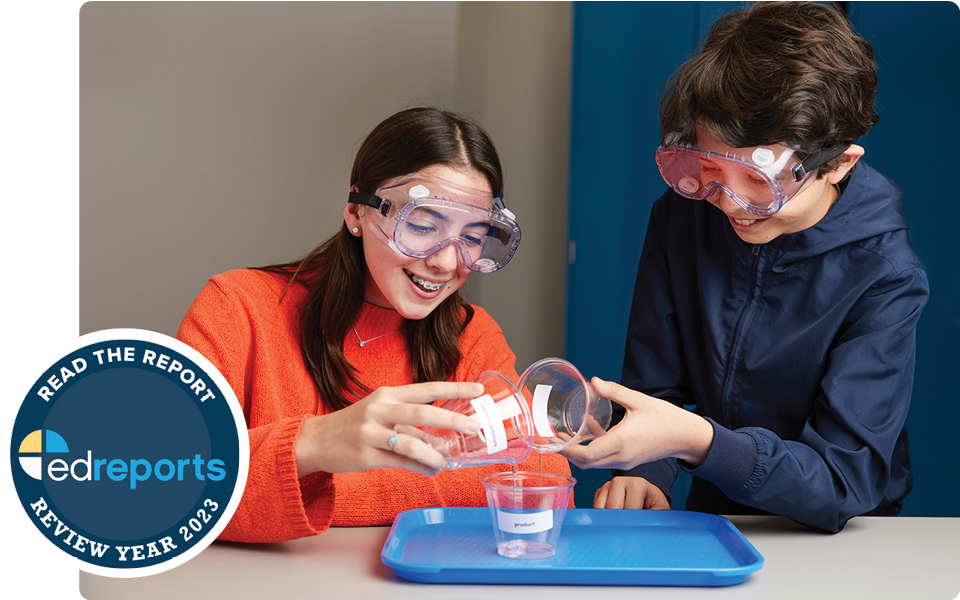
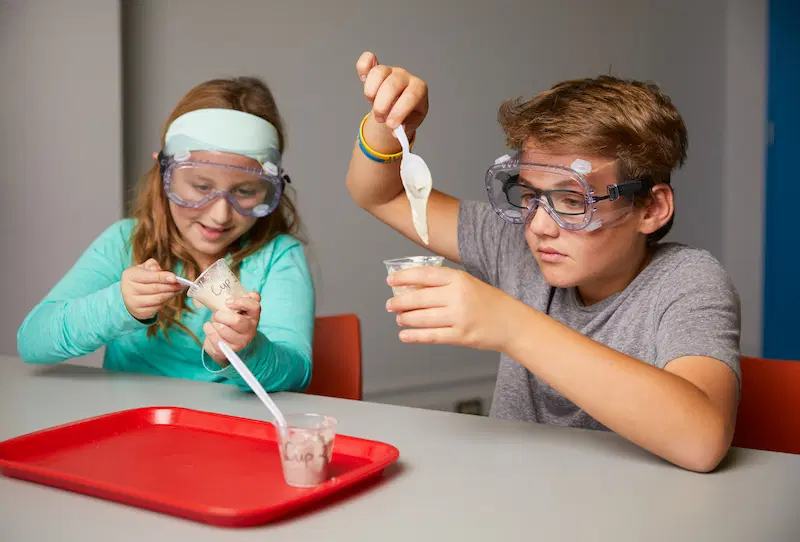
      Two middle school girls conduct a science experiment

      A powerful partnership

      Amplify Science was developed by the science education experts at the University of California, Berkeley’s Lawrence Hall of Science and the digital learning team at Amplify.

      The Lawrence Hall of Science
      The University of California, Berkeley’s Lawrence Hall of Science is a recognized leader in PreK-12 science education, producing groundbreaking curriculum products for more than 40 years, including the international award-winning Seeds of Science/Roots of Reading®. The Hall’s curriculum materials are used in one in four classrooms across the nation.

      Amplify
      Amplify has been pioneering digital education products for more than 15 years, empowering teachers across the country to offer more personalized instruction and accelerate the potential of their students to become more active, engaged learners. Amplify has supported more than 200,000 educators and three million students in all 50 states.

      Elementary school curriculum

      Grade K

      • Needs of Plants and Animals
      • Pushes and Pulls
      • Sunlight and Water

      Grade 1

      • Animal and Plant Defenses
      • Light and Sound
      • Spinning Earth

      Grade 2

      • Plant and Animal Relationships
      • Properties of Materials
      • Changing Landforms

      Grade 3

      • Balancing Forces
      • Inheritance and Traits
      • Environments and Survival
      • Weather and Climate

      Grade 4

      • Energy Conversions
      • Vision and Light
      • Earth’s Features
      • Waves, Energy, and Information

      Grade 5

      • Patterns of Earth and Sky
      • Modeling Matter
      • The Earth System
      • Ecosystem Restoration

      Middle school curriculum – Domain Model

      Earth and Space Science

      • Launch:
        Geology on Mars
      • Plate Motion
      • Engineering Internship:
        Plate Motion
      • Rock Transformations
      • Earth, Moon, and Sun
      • Ocean, Atmosphere, and Climate
      • Weather Patterns
      • Earth’s Changing Climate
      • Engineering Internship:
        Earth’s Changing Climate

      Life Science

      • Launch:
        Microbiome
      • Metabolism
      • Engineering Internship:
        Metabolism
      • Traits and Reproduction
      • Populations and Resources
      • Matter and Energy in Ecosystems
      • Natural Selection
      • Engineering Internship: Natural Selection
      • Evolutionary History

      Physical Science

      • Light Waves
      • Launch:
        Harnessing Human Energy
      • Force and Motion
      • Engineering Internship:
        Force and Motion
      • Magnetic Fields
      • Thermal Energy
      • Phase Change
      • Engineering Internship: Phase Change
      • Chemical Reactions

      Middle school curriculum – Integrated Model

      Grade 6

      • Launch:
        Microbiome
      • Metabolism
      • Engineering Internship:
        Metabolism
      • Traits and Reproduction
      • Thermal Energy
      • Ocean, Atmosphere, and Climate
      • Weather Patterns
      • Earth’s Changing Climate
      • Engineering Internship:
        Earth’s Changing Climate

      Grade 7

      • Launch:
        Geology on Mars
      • Plate Motion
      • Engineering Internship:
        Plate Motion
      • Rock Transformations
      • Phase Change
      • Engineering Internship: Phase Change
      • Chemical Reactions
      • Populations and Resources
      • Matter and Energy in Ecosystems

      Grade 8

      • Evolutionary History
      • Launch:
        Harnessing Human Energy
      • Force and Motion
      • Engineering Internship:
        Force and Motion
      • Magnetic Fields
      • Light Waves
      • Earth, Moon, and Sun
      • Natural Selection
      • Engineering Internship: Natural Selection

      Standards correlations

      Download a full correlation to the Arizona Science Standards.

      Spanish-language support

      Amplify Science is committed to providing support to meet the needs of all learners, including multiple access points for Spanish-speaking students. Developed in conjunction with Spanish-language experts and classroom teachers, multiple components are available in Spanish across the Amplify Science curriculum.

      Spanish-language materials include:

      Components
      Teacher / Student
      • Student Investigation Notebooks (K–8)
      • Student
      • Student Books (K–5)
      • Student
      • Science articles (6–8)
      • Student
      • Video transcripts (6–8)
      • Student
      • Digital simulation translation key (6–8)
      • Student
      • Printed classroom materials (K–8)
        (i.e., Unit and chapter questions, key concepts, vocabulary cards, etc.)
      • Teacher / Student
      • Copymasters (K–8)
      • Teacher
      • Assessments (K–8)
      • Teacher

      Program Guide

      For more information about the program, see our
      Amplify Science Digital Program Guide.

      Watch the video walkthroughs

      Elementary school

      Middle school

      Demo access and your Arizona representative

      To request demo access, please contact your Account Executive.

      Thomas Gearhart
      Senior Account Executive

      Western, Eastern, and Southern AZ
      Email: tgearhart@amplify.com
      Phone: (505) 206-7661

      Yvonne Rohde
      Senior Account Executive

      Northern AZ
      Email: yrohde@amplify.com
      Phone: (480) 673-0019

      Laina Armbuster
      Account Executive
      Accounts 3,500 and below
      Email: larmbuster@amplify.com
      Phone: (602) 791-4135

      Welcome, Arizona educators!

      Dear Arizona educator,

      Thank you for your interest in Amplify’s core, assessment, intervention, and supplemental programs. Amplify’s resources are different to make a difference—and the results are undeniable. Explore our unique, research-based approaches built right into our high-quality instructional materials. If you have any questions, please don’t hesitate to reach out.

      With great respect for what you do,

      The Arizona Amplify team

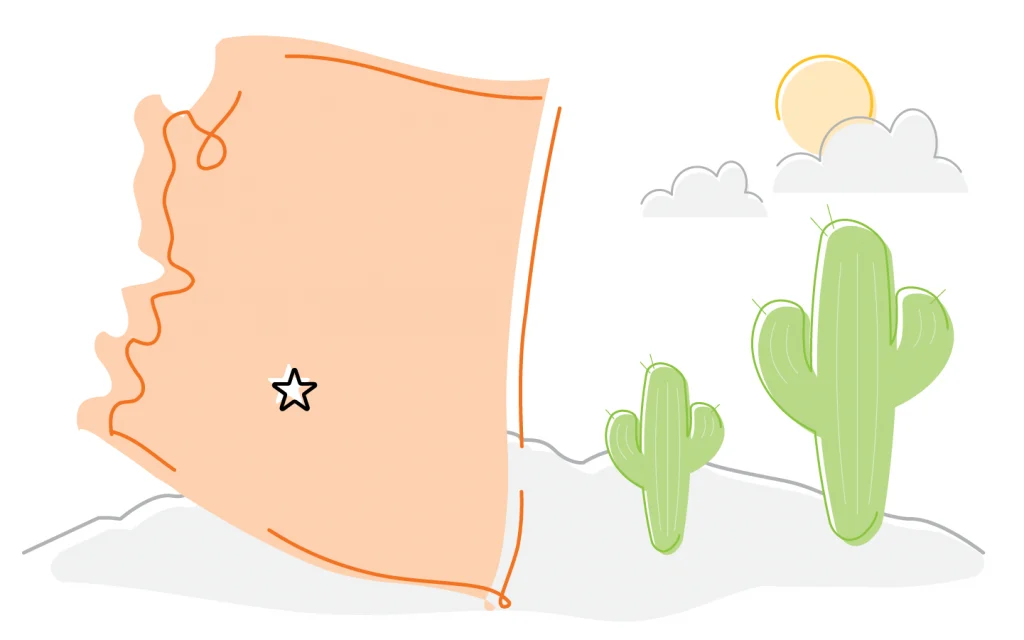
      Simple illustration of Arizona with a star marking a location, two green cacti, sun, and clouds in the background.

      Early Literacy Suite

      Based on 20 years of experience with the Science of Reading, Amplify’s early literacy suite combines the crucial elements of core curriculum, intervention, and personalized learning. Our programs ensure that all educators have what they need to support every student within an aligned system based on research and effective practices. Amplify CKLA received all-green ratings from EdReports. Read the review on EdReports.

      Illustration of a bear on a rock overlooking a campsite in a valley with mountains, trees, tents, and people; includes an EdReports review badge in the lower right corner.
      Collage image featuring a girl with a crown looking at a sunset, a boy reading about the Amplify ELA program, and the "read the report review year 2020 edreports" logo

      Amplify ELA

      Amplify ELA is a blended curriculum designed specifically for grades 6–8. At the heart of every lesson is the text. We enable teachers to teach skills texts and develop their students’ muscles for building meaning through reading. With Amplify ELA, students learn to attack any complex text and make observations, grapple with interesting ideas, and find relevance for themselves. Rated all green by EdReports, Amplify ELA earned perfect scores across all gateways. Read the review on EdReports.

      Amplify Science

      Amplify Science empowers students to think, read, and write like real scientists and engineers. Amplify Science K–8 received all-green ratings in EdReports’ review of national middle-school science curricula. Read the review on EdReports.

      Two students wearing safety goggles conduct a science experiment together, pouring liquid between plastic cups over a blue tray on a classroom table.
      A laptop displaying a graph on a webpage labeled "Robots" sits next to two textbooks titled "Amplify Desmos Math," one being the teacher edition and the other for grade 6, exemplifying student-centered instruction through math technology.

      Amplify Desmos Math

      Meet Amplify Desmos Math. Our structured approach to problem-based learning systematically builds on students’ curiosity to develop lasting grade-level understanding.

      Contact us

      Support is always available. Our team is dedicated to helping you and can be reached at any time by emailing or calling us directly.

      A man with a beard and short hair, wearing a striped suit, blue shirt, and orange tie, poses against a plain white background.

      Tommy Gearhart

      Senior Account Executive

      (505) 206-7661

      tgearhart@amplify.com

      A woman with long, wavy brown hair, wearing a dark blazer and a bright pink blouse, smiles at the camera against a plain gray background.

      Yvonne Rohde

      Senior Account Executive

      (480) 673-0019

      yrohde@amplify.com

      A woman with straight dark brown hair and light skin smiles at the camera, wearing a black top and gold earrings, in front of a white brick wall.

      Laina Armbruster

      Account Executive

      (602) 791-4135

      larmbruster@amplify.com

      Welcome, Arizona educators!

      Thank you for taking the time to review Amplify’s complete early literacy system for PreK–5.

      Our curriculum, assessment, practice, and intervention solutions work in tandem to ensure classroom teachers have what they need to provide multi-tiered literacy support to every student.

      On this site, you’ll find a variety of resources designed to support your review and evaluation.  If you have any questions, please don’t hesitate to contact us.  Contact information is at the bottom of the page.

      Illustration of diverse children and animated creatures, with a large friendly robot, engaged in playful activities in a vibrant, imaginative setting.

      Complete literacy
      system

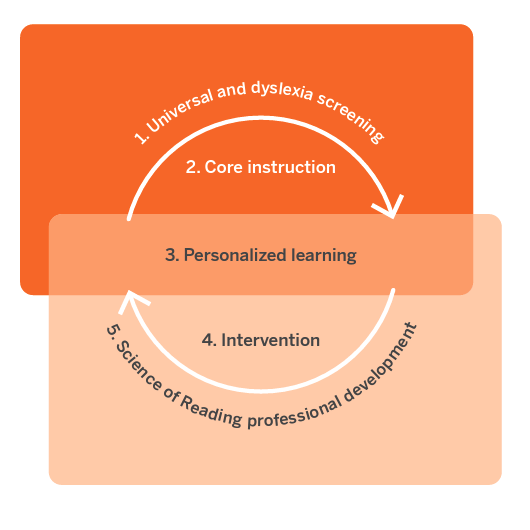
      Strong core instruction is crucial–but in isolation, even that’s not enough. A truly effective literacy system needs to bring together assessment, core instruction, personalized practice, targeted intervention, and ongoing professional development.

      Together with leading experts in reading instruction, Amplify has built a proven early literacy system grounded in the latest reading research and designed to ensure every student receives the multi-tiered support they need to grow as a reader. Our partners include:

      • The University of Oregon
      • Core Knowledge Foundation
      • Recognized language, literacy, and biliteracy experts such as Dr. Lillian Durán, Dr. Desiree Pallais, Dr. Catherine Snow, and others.
      Flowchart showing a five-step educational process: 1. universal screening, 2. core instruction, 3. personalized learning, 4. intervention, 5. science of reading professional development.

      Assessment

      Not only should an assessment systems include universal screening, dyslexia screening, diagnostic assessments, and progress monitoring, it must also be easy and efficient to administer, and provide classroom teachers with actionable data that guides instruction.

      The mCLASS® Assessment System delivers all that and more!

      When the DIBELS® 8th Edition assessment is paired with:

      • The Text Reading and Comprehension (TRC) assessment, teachers unlock the ability to record reading behaviors through running digital records.
      • The Vocabulary, Encoding, and Rapid Automatized Naming (RAN) measures, teachers are empowered to screen for dyslexia risk.
      • mCLASS Lectura, teachers gain a holistic view of their students with biliteracy insights that support students in both English and Spanish.

      Ready to learn more? Click the buttons below to review mCLASS with DIBELS 8th Edition with TRC and mCLASS Lectura.

      Core instruction

      Core instruction should include explicit, systematic lessons in foundational skills and a coherent approach to building background knowledge, developing vocabulary, and reading complex text with confidence.

      With Amplify Core Knowledge Language Arts® (CKLA) and Amplify Caminos, all students have the opportunity to become strong readers, writers, speakers, and thinkers. Through a powerful combination of proven, evidence-based practices and engaging, interactive content, these core curricula enable students to develop a deep mastery of foundational skills as well as a robust knowledge base–both of which are necessary for accessing and comprehending complex texts.

      Ready to learn more? Click the buttons below to review Amplify CKLA and Amplify Caminos.

      Personalized practice

      Student needs are multidimensional, which is precisely why practice must be personalized and provide opportunities for remediation and acceleration across multiple dimensions.

      Through its integration with mCLASS and Amplify CKLA, Boost Reading’s adaptive personalized pathway makes practice more purposeful and productive. mCLASS automatically places students on an adaptive path within Boost Reading, which provides them the exact practice they need. That very practice follows the same approach and scope and sequence as Amplify CKLA, which further reinforces the core instruction.

      Ready to learn more? Click the button below to review Boost Reading.

      Targeted intervention

      Getting students caught up on reading skills requires more than just “extra help” in small groups. It requires data-informed instruction focused directly on the specific skills each group needs to learn next.

      mCLASS® Intervention is a staff-led reading intervention that does the heavy lifting of data analysis and lesson sequencing, freeing up teachers to teach the reading skills each student needs. mCLASS Intervention connects directly to mCLASS data, automatically groups students with similar needs, follows a research-based skills progression, includes ready-to-teach engaging lessons, and updates skill profiles and groups every ten days.

      Ready to learn more? Click the button below to review mCLASS Intervention.

      Your Arizona team

      Looking to speak directly with your local representative? Get in touch with an Arizona team member to learn more about our early literacy suite or request a demo account.

      Tommy Gearhart

      Senior Account Executive

      (505) 206-7661

      tgearhart@amplify.com

      Yvonne Rohde

      Senior Account Executive

      (480) 673-0019

      yrohde@amplify.com

      Laina Armbruster

      Account Executive

      (602) 791-4135

      larmbruster@amplify.com

      A powerful partnership

      Amplify Science was developed by the science education experts at the University of California, Berkeley’s Lawrence Hall of Science and the digital learning team at Amplify.

      The Lawrence Hall of Science
      The University of California, Berkeley’s Lawrence Hall of Science is a recognized leader in PreK-12 science education, producing groundbreaking curriculum products for more than 40 years, including the international award-winning Seeds of Science/Roots of Reading®. The Hall’s curriculum materials are used in one in four classrooms across the nation.

      Amplify
      Amplify has been pioneering digital education products for more than 15 years, empowering teachers across the country to offer more personalized instruction and accelerate the potential of their students to become more active, engaged learners. Amplify has supported more than 200,000 educators and three million students in all 50 states.

      Elementary school curriculum

      Grade K

      • Needs of Plants and Animals
      • Pushes and Pulls
      • Sunlight and Water

      Grade 1

      • Animal and Plant Defenses
      • Light and Sound
      • Spinning Earth

      Grade 2

      • Plant and Animal Relationships
      • Properties of Materials
      • Changing Landforms

      Grade 3

      • Balancing Forces
      • Inheritance and Traits
      • Environments and Survival
      • Weather and Climate

      Grade 4

      • Energy Conversions
      • Vision and Light
      • Earth’s Features
      • Waves, Energy, and Information

      Grade 5

      • Patterns of Earth and Sky
      • Modeling Matter
      • The Earth System
      • Ecosystem Restoration

      Middle school curriculum – Domain Model

      Earth and Space Science

      • Launch:
        Geology on Mars
      • Plate Motion
      • Engineering Internship:
        Plate Motion
      • Rock Transformations
      • Earth, Moon, and Sun
      • Ocean, Atmosphere, and Climate
      • Weather Patterns
      • Earth’s Changing Climate
      • Engineering Internship:
        Earth’s Changing Climate

      Life Science

      • Launch:
        Microbiome
      • Metabolism
      • Engineering Internship:
        Metabolism
      • Traits and Reproduction
      • Populations and Resources
      • Matter and Energy in Ecosystems
      • Natural Selection
      • Engineering Internship: Natural Selection
      • Evolutionary History

      Physical Science

      • Launch:
        Harnessing Human Energy
      • Force and Motion
      • Engineering Internship:
        Force and Motion
      • Magnetic Fields
      • Thermal Energy
      • Phase Change
      • Engineering Internship: Phase Change
      • Chemical Reactions
      • Light Waves

      Middle school curriculum – Integrated Model

      Grade 6

      • Launch:
        Microbiome
      • Metabolism
      • Engineering Internship:
        Metabolism
      • Traits and Reproduction
      • Thermal Energy
      • Ocean, Atmosphere, and Climate
      • Weather Patterns
      • Earth’s Changing Climate
      • Engineering Internship:
        Earth’s Changing Climate

      Grade 7

      • Launch:
        Geology on Mars
      • Plate Motion
      • Engineering Internship:
        Plate Motion
      • Rock Transformations
      • Phase Change
      • Engineering Internship: Phase Change
      • Chemical Reactions
      • Populations and Resources
      • Matter and Energy in Ecosystems

      Grade 8

      • Launch:
        Harnessing Human Energy
      • Force and Motion
      • Engineering Internship:
        Force and Motion
      • Magnetic Fields
      • Light Waves
      • Earth, Moon, and Sun
      • Natural Selection
      • Engineering Internship: Natural Selection
      • Evolutionary History

      Standards correlations

      Download a full correlation to the Arizona Science Standards.

      Spanish-language support

      Amplify Science is committed to providing support to meet the needs of all learners, including multiple access points for Spanish-speaking students. Developed in conjunction with Spanish-language experts and classroom teachers, multiple components are available in Spanish across the Amplify Science curriculum.

      Spanish-language materials include:

      COMPONENTTEACHER/STUDENT
      Student Investigation Notebooks (K–8)Student
      Science articles (6–8)Student
      Student Books (K–5)Student
      Video transcripts (6–8)Student
      Digital simulation translation key (6–8)Student
      Printed classroom materials (K–8)
      (Unit and chapter questions, key concepts, vocabulary cards, etc.)
      Teacher and student
      Copymasters (K–8)Teacher
      Assessments (K–8)Teacher

      Contact your Arizona representative directly

      Thomas Gearhart
      Account Executive, Southwest

      Email: tgearhart@amplify.com
      Phone: (505) 206-7661

      Access curriculum now

      To begin your review, click the button to access the online digital curriculum.

      Review the Program Guide.

      Watch the video walkthroughs

      Elementary school

      Middle school

      Welcome, Arizona educators!

      The Arizona Department of Education just released its first-ever list of approved universal literacy screeners. According to the state, these screeners “shall be used by schools in the 2020-2021 school year to meet the requirements of both the Move On When Reading (MOWR) legislation and the dyslexia screening legislation.”
       
      We’re excited to announce that mCLASS® with DIBELS® 8th Edition and mCLASS RAN is on that list.

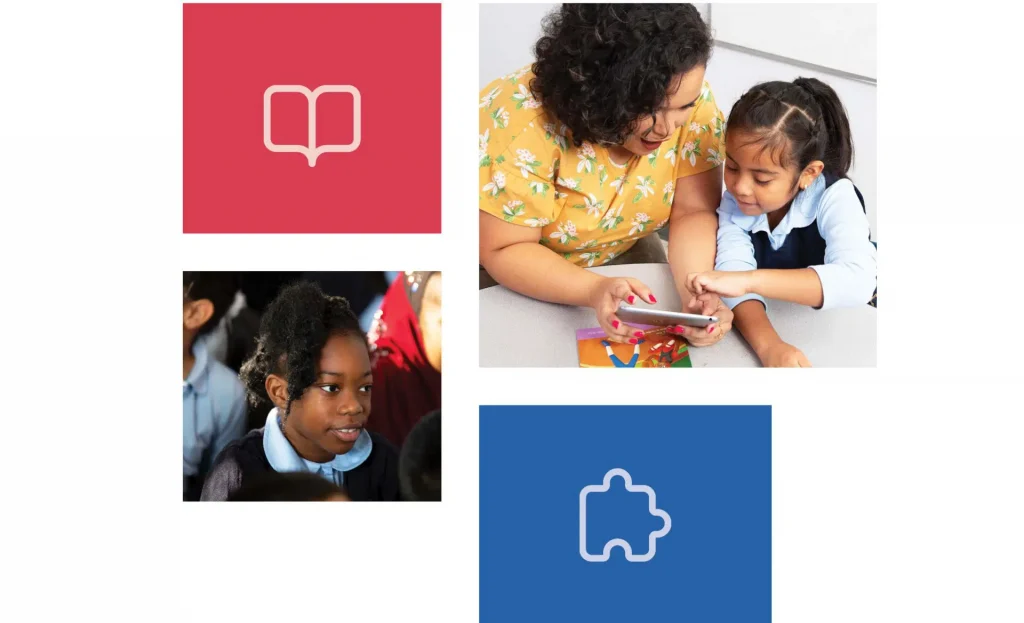
      A teacher shows a tablet to a young student at a table; below, a girl listens in class. Two squares feature icons of a book and a puzzle piece on colored backgrounds.

      Why mCLASS?

      mCLASS® with DIBELS® 8th Edition and mCLASS RAN is a single solution that meets all of the requirements of the law.

      • It’s a universal early literacy screenerdyslexia screener, and diagnostic tool in one.
      • It includes immediate and actionable literacy instruction and intervention strategies based on student performance.
      • It’s flexible and can be implemented in a variety of scenarios, including in-person, remote, and hybrid learning environments.
      • It allows for non-paper assessment and scoring as well as offline assessment capabilities.
      • It includes a variety of parent notification resources and at-home reading strategies.
      A timeline with milestones from 2000 to 2018 shows Amplify’s focus on literacy, with a large play button in the center and the text: "We have been laser-focused on literacy for two decades.

      Funding

      Schools may utilize Move On When Reading (MOWR)Early Literacy Grants, or federal CARES Act funds to purchase assessments to meet both MOWR legislation and the dyslexia screening legislation (A.R.S §15-701 and A.R.S. §15-4704).
       
      Visit our CARES Act resource hub or download this CARES Act flyer to learn more.

      Young girl with curly hair sits indoors, looking at a tablet device with a focused expression.

      More than a test

      mCLASS is an integrated, gold standard literacy system that closes the knowing-doing gap. By combining assessment, reporting, and instruction in one, it eliminates the need for cobbled together tools.

      • Data gathered through efficient one-minute measures is made available to teachers instantly.
      • Easy-to-read reports make teachers aware of potential reading difficulties as well as observed patterns.
      • Ready-to-teach literacy instruction and intervention strategies help teachers target specific skill deficits immediately.

      Remote learning

      mCLASS has created a collection of resources to help you plan for a variety of scenarios for the 2020–2021 school year.
       
      Whether your school is engaged in in-person, hybrid, or remote instruction, we know how important it is for teachers and administrators to have a full picture of every student’s literacy development.
       
      Download our Remote and Hybrid Learning Guide to learn more.

      A person sitting at a desk using a laptop, with a bookshelf containing books, a fish tank, and a soccer ball nearby.

      Personalized practice

      Amplify Reading is the practice and remediation companion to mCLASS.
       
      At its heart, there are three main areas that make Amplify Reading a unique and essential supplemental learning program for the 2020-2021 school year.

      • The program meets all students where they are with powerful individualized instruction and practice.
      • Age-appropriate narratives create a learning experience that leaps off the screen.
      • Research shows Amplify Reading improves student performance–particularly among English Learners–reducing the overall percentage of students at risk of reading difficulty.

      Get in touch

      Ready to discuss how mCLASS can support your specific needs? A brief 30-minute call is all we need to determine if mCLASS with DIBELS 8th Edition is the right fit for you.
       
      Simply fill out the form below and we’ll be in touch.

      Man with a trimmed beard and shaved head, wearing a dark suit, blue shirt, and orange tie, posing against a plain white background.

      Tommy Gearhart

      Senior Account Executive

      A woman with shoulder-length brown hair smiles in front of a brick wall.

      Laina Armbruster

      Account Executive

      A smiling man in a jacket is shown in a black-and-white portrait with a blurred outdoor background.

      Laina Armbruster

      Field Manager

      Request a meeting

      Kyrene, welcome to Amplify ELA!

      Welcome to the Amplify ELA review site for Kyrene School District. This site is designed to help you learn about Amplify ELA—a core English Language Arts curriculum for Grades 6–8 and the middle school counterpart to Amplify CKLA. Like K-5, Amplify ELA is built on the same Science of Reading instructional strategies to help middle schoolers grow as readers, writers, and thinkers. Additionally, here are a few important documents so you can rest assured that Amplify ELA is aligned to Arizona’s English Language Arts standards.

      Amplify ELA’s alignment to Arizona standards

      Amplify ELA’s correlations to Arizona standards

      Illustration of a woman's profile with floral hair decorations, a group of diverse children reading, and an astronaut, with text "read the report: edreports review year 2019.

      Overview Presentation

      After watching the video to the right, scroll down to learn even more, download resources, and access a demo.

      What is Amplify ELA?

      Amplify ELA is a core program for grades 6–8 that delivers:

      • A unique research-based approach designed to get all students reading grade-level text together.
      • An instructional design that inspires students to read more deeply, write more vividly, and think more critically.
      • A rich combination of dynamic texts, lively discussions, and interactive Quests that truly engages middle schoolers and inspires them to participate in learning.

      Interested in learning more about the research behind the program?

      Click the link to access the Amplify ELA Research Hub.

      How does it work?

      Amplify ELA provides everything you need to deliver a full year’s worth of high-quality instruction.

      Looking for a more flexible version of the curriculum? Check out our abridged lesson pathways ensure full coverage of the standards in just 100 days.

      What do students explore?

      Each grade level of Amplify ELA consists of six multimedia units. Four or five of the units are focused on complex literary texts and one or two are collections based on primary source documents and research. Each grade also provides two or three immersive learning experiences called Quests, a dedicated story writing unit, and a poetry unit.

      students collaborating and using laptops

      How does it engage all students?

      Watching students mature into adolescents: inspiring. Knowing how to engage and motivate their changing brains: science.

      The middle-school years are marked by a period of tremendous growth and change for students—physically, emotionally, and socially. Amplify ELA understands and embraces these changes, and delivers instruction specifically designed to tap into adolescents’ natural inclinations toward collaboration, exploration, and autonomy.

      Differentiation

      Amplify believes all students are capable of reading grade-level text together.

      Amplify ELA ensures all students have access to the same text. With six distinct levels of differentiation, your student is supported or challenged in a way that meets their unique needs. This includes ELLs at the Developing, Expanding, and Bridging levels, as well as students needing substantial support or an extra challenge.

      Multiple overlapping open documents on a computer screen, featuring text editing interfaces with prompts for feedback and responses.

      Assessment

      In Amplify ELA, all units include a robust system of embedded assessment that provides teachers with actionable student performance data long before end-of-unit or benchmark exams. The Embedded Assessment Measure (EAM) reports allow teachers to easily track and interpret student performance without ever interrupting the flow of daily instruction to test students.

      Clear and actionable student performance data
      With intelligent feedback tools and embedded assessments, Amplify ELA makes it easy to monitor student progress and intervene where needed—no matter where teaching and learning is taking place.

      Automated Writing Assessment
      Amplify’s Automated Writing Evaluation assesses student writing for Focus, Use of Evidence, and Conventions, providing critical feedback for teachers and data for Amplify’s writing reports.

      Reporting
      Amplify ELA Reporting provides teachers with clear data to understand patterns of student performance and deliver scaffolds and supports as students need them.

      Click this link for more information on assessments in Amplify ELA.

      Access demo

      Ready to explore on your own? Follow the instructions below to access your demo account.

      Explore as a teacher

      To access the teacher digital platform, first watch the quick navigation video to the right. Then login using the directions below.

      • Click the ELA Teacher Platform button below.
      • Select Log in with Amplify.
      • Enter this username: t1.kyrenerfp@demo.tryamplify.net
      • Enter this password: Amplify1-kyrenerfp

      Explore as a student

      To access the student digital platform, follow the login directions below.

      • Click the ELA Student Platform button below.
      • Select Log in with Amplify.
      • Enter this username: s1.kyrenerfp@demo.tryamplify.net
      • Enter this password: Amplify1-kyrenerfp

      Contact Us

      If you have any questions about Amplify ELA, please don’t hesitate to contact:

      Tommy Gearhart

      Senior Account Executive

      505-206-7661

      tgearhart@amplify.com

      CKLA Review for Scottsdale

      Thank you for taking the time to review Amplify’s core ELA program for K–5.

      Amplify Core Knowledge Language Arts (CKLA) is a cutting-edge and effective core ELA program for students in grades K–5. It was developed in partnership with the Core Knowledge Foundation, was specifically designed to help teachers implement Science of Reading principles, and features proven evidence-based instructional practices.

      Step 1: Program Introduction

      Welcome to Amplify CKLA! Before you dive into our materials, watch the video below to learn about the big picture behind Amplify CKLA’s pedagogy.

      In this video, Susan Lambert (Chief Academic Officer and host of Science of Reading: The Podocast) shares why Amplify CKLA was created, how it is built on the Science of Reading, and the impact it’s making across the country.

      Step 2: Program Overview

      Amplify CKLA is different for a reason. Watch the overview video below to learn about these differences and why educators love them.

      In this video, you’ll get an in-depth look at the program’s overall structure and organization, the design behind our proven lessons, and the materials included to support teaching and learning.

      The Amplify CKLA Program Guide also provides an in-depth view of how Amplify CKLA works, how it’s structured, and why it’s uniquely capable of helping you bring reading instruction based on the Science of Reading to your classroom.

      Evidence-based design

      Amplify CKLA is rooted in Science of Reading research. Mirroring Scarborough’s Rope, Amplify CKLA delivers a combination of explicit foundational skills with meaningful knowledge-building.

      • In Grades PK–2, dedicated knowledge-building and explicit skills instruction are taught simultaneously through two distinct instructional strands.
      • In Grades 3–5, dedicated knowledge-building and explicit skills instruction are woven together and delivered through one integrated strand.

      Grades K–2 Skills and Knowledge Strands
      Every day students in Grades K–2 complete one full lesson that explicitly and systematically builds foundational reading skills in the Skills Strand, as well as one full lesson that builds robust background knowledge to access complex text in the Knowledge Strand. Through learning in each of these strands, students develop the early literacy skills necessary to help them become confident readers and build the context to understand what they’re reading.

      Grades 3–5 Integrated Strand
      In Grades 3–5, Knowledge and Skills are integrated in one set of instructional materials. Lessons begin to combine skills and knowledge with increasingly complex texts, close reading, and a greater writing emphasis. Students can then use their skills to go on their own independent reading adventures.

      Key features

      Built out of the latest research in the Science of Reading, Amplify CKLA delivers explicit instruction in both foundational literacy skills (systematic phonics, decoding, and fluency) and background knowledge in grades K–2 with an integrated approach to explicit instruction in grades 3–5.

      Review this Science of Reading toolkit to learn more about the Science of Reading best practices integrated throughout CKLA.

      Great reading instruction starts with helping kids develop great decoding skills. By building a solid foundation of phonological awareness and phonics, reading the words on the page becomes automatic so that comprehension and critical thinking can happen. Our instruction is supported by:

      • Step-by-step lessons with multi-sensory approaches, clear lesson objectives, and embedded formative assessments.
      • Decodable books and student readers with ebook and audiobook versions that feature engaging plots and relatable characters.
      • An engaging sound library with fun songs and videos that develop phonological awareness.
      • An interactive Vocab App featuring engaging activities with immediate feedback and automated, customized instruction based on student performance.

      Students build grade-appropriate subject-area knowledge and vocabulary in history, science, literature, and the arts while learning to read, write, and think creatively and for themselves. Our instruction is supported by:

      • Knowledge builders that provide a quick overview of each domain with its key ideas.
      • Interactive Read-Alouds designed to build knowledge and vocabulary.
      • Content-rich anchor texts that support students as they tackle increasingly complex text and sharpen their analytical skills.
      • Social and emotional learning paired with lessons in civic responsibility.

      Getting students caught up on reading skills requires more than just an extra mini-lesson here or there. It requires targeted and intensive instruction delivered in short bursts. Our intervention component:

      • Assesses and analyzes students’ areas of mastery and growth.
      • Automatically groups students with like needs.
      • Provides educators with ready-to-teach, research-based instructional progressions that last 10-days.
      • Progress monitors students, updates their skill profiles, and reforms groups for the next 10-day period.

      Student-led reading practice should be purposeful and connected to the core. In addition to practicing skills directly tied to the skills they’ve been working on during ELA time, Amplify CKLA students have opportunities to interact with adaptive content that addresses their personal gaps and bolsters foundational skills at a pace that supports their individual development.

      Our collection of 40+ adaptive games target foundational reading skills and develops them in alignment with Science of Reading principles. Unlike other adaptive games, we ensure students:

      • Practice the right skills at the right time. Our embedded placement tool ensures students receive the content and skill practice most appropriate for their current reading level. From there, students move through our curriculum along their own learning pathway where they encounter personalized content tailored to their evolving skill and grade levels.
      • Progress along a pathway that adapts on multiple dimensions, not just one. For example, a student can work on early first-grade decoding in one game while building more advanced vocabulary knowledge in another.
      • Practice skills in tandem. For example, a student is never forced to master one skill area before proceeding to the next. Instead, we offer students that opportunity to work on multiple skills concurrently.
      • Feel supported with scaffolding, instruction, and practice that adapts based on student performance.
      • Stay engaged by giving them immediate and clear feedback. These results are never punitive. Instead our always-positive feedback is delivered in the context of the game world and is designed to motivate students to keep trying.

      From the printed page to the screen, we bring foundational skills and knowledge to life in the classroom.

      Download the Amplify CKLA Components guide to see components by grade.

      Download the Remote and hybrid learning guide to learn how we support in-person, remote, and hybrid instruction.

      Engaging digital experience

      The top-rated content of Amplify CKLA is now live with the digital experience that enhances instruction and saves time.

      With the digital experience, everything is in one place, making it easier and more engaging than ever to plan lessons, present digital content, and review student work. Click the arrows below to learn more.

      With the digital experience, teachers have access to ready-to-use and customizable lesson presentation slides, complete with all the prompts from the print Teacher Guide embedded in the teacher view. As teachers deliver each lesson, students can engage with the content in one cohesive experience—through these CKLA resources: Activity Books, slides, digital components, videos, Student Readers, and more.

      The innovative live review tool found in the digital experience enables you to keep an eye on all of your students as they work on drawing, recording audio, uploading and capturing images, and typing or writing in pre-placed textboxes in their Activity Pages. This dynamic tool provides countless classroom management benefits, enabling you to spot and correct common mistakes as they’re happening, praise your students for thoughtful work, and identify students who are not engaged in the task at hand. Simply put, it will give you those valuable “eyes in the back of your head” you’ve warned your students about!

      The digital experience integrates with various LMSs, allowing you and your students to access Amplify CKLA with the software you’re already comfortable using.

      In the Amplify CKLA student digital experience, your students have one intuitive access point to fully engage with classroom instruction. Through the Student Home, students can easily access digital lessons with slides, Activity Pages, ebooks, videos, and other interactives from one simple dashboard. Students can draw, record audio, upload and capture images, and type or write in pre-placed text boxes in their Activity Pages.

      Step 3: Program Resources

      Digital navigation walkthrough

      Physical materials walkthrough

      Step 4: Arizona Review Resources

      Arizona resources:

      CKLA review resources:

      Step 5: Demo Program Access

      Explore as a teacher

      Before logging in, watch this brief video on navigating the CKLA Teacher Platform.

      Ready to explore as a teacher? Follow these instructions:

      • Click the Amplify CKLA Teacher Platform button below.
      • Select Log in with Amplify.
      • Enter the teacher username: t1.scottsdaleunified@demo.tryamplify.net
      • Enter the password: Amplify1-scottsdaleunified
      • Click the CKLA icon.
      • Select a grade level from the drop-down menu at the top of the page.

      Explore as a student

      Before logging in, watch this brief video on navigating the CKLA Student Hub.

      Ready to explore as a student? Follow these instructions:

      • Click the CKLA Student Hub button below.
      • Select Log in with Amplify.
      • Enter the student username: s1.scottsdaleunified@demo.tryamplify.net
      • Enter the password: Amplify1-scottsdaleunified
      • Click the Hub icon
      • Select a grade level.

      Amplify ELA for Prescott School District

      Amplify ELA is the only ELA curriculum truly built for the needs of middle school teachers and students.

      Not only that, it helps all teachers implement Arizona’s English Language Arts Standards by delivering an instructional approach based on the Science of Engagement.

      Illustration of a woman's profile with floral hair decorations, a group of diverse children reading, and an astronaut, with text "read the report: edreports review year 2019.

      Overview

      After watching the 6–8 video to the right, scroll down to learn even more, download resources, and access a demo.

      What it is

      Amplify ELA is a core program for grades 6–8 that delivers:

      • A unique research-based approach designed to get all students reading grade-level text together.
      • An instructional design that inspires students to read more deeply, write more vividly, and think more critically.
      • A rich combination of dynamic texts, lively discussions, and interactive Quests that truly engages middle schoolers and inspires them to participate in learning.

      How it works

      Amplify ELA lessons follow a structure grounded in regular routines, but that is flexible enough to allow for a variety of learning experiences.

      Need an abridged version of the curriculum? Our abridged lesson pathways ensure full coverage of the standards in just 100 days.

      What students explore

      Amplify ELA provides everything you need to deliver a full year’s worth of instruction.

      Each grade level of Amplify ELA consists of six multimedia units. Four or five of the units are focused on complex literary texts and one or two are collections based on primary source documents and research. Each grade also provides two or three immersive learning experiences called Quests, a dedicated story writing unit, and a poetry unit.

      Download the unit overviews below to learn more.

      Three educational book covers from amplify ela series, featuring illustrations of an astronaut, diverse children with books, and a poet surrounded by symbolic imagery.

      Built on the Science of Engagement

      Watching students mature into adolescents: inspiring. Knowing how to engage and motivate their changing brains: science.

      The middle school years are marked by a period of tremendous growth and change – physically, emotionally, and socially. Amplify ELA understands and embraces these changes, and delivers instruction specifically designed to tap into adolescents’ natural inclinations toward collaboration, exploration, and autonomy.

      Six levels of differentiation

      We believe all students are capable of reading grade level text together.

      Amplify ELA ensures all students have access to the same text. With six distinct levels of differentiation, every student is supported or challenged in a way that meets their unique needs. This includes ELLs at the Developing, Expanding, and Bridging levels as well as students needing substantial support or an extra challenge.

      Multiple overlapping open documents on a computer screen, featuring text editing interfaces with prompts for feedback and responses.

      Assessment

      Not only does Amplify ELA include captivating content. It also provides clear and actionable measurement data about student performance.

      Our embedded formative and summative assessment tools maximize teaching time, while allowing teachers to make confident, data driven decisions about the instruction and supports students need to grow continually as readers and writers.

      Access demo

      Ready to explore on your own? Follow the instructions below to log into our live demo account.

      Explore as a teacher

      First, watch the quick teacher navigation video to the right. Then, follow the instructions below to access your demo account.

      • Click the ELA Learning Platform button
      • Select Log in with Amplify
      • Enter this username: t1.prescottelag58@demo.tryamplify.net
      • Enter this password: Amplify1-prescottelag58
      • Select the desired grade level

      Explore as a student

      First, watch the quick teacher navigation video to the right. Then, follow the instructions below to access your demo account.

      • Click the ELA Learning Platform button
      • Select Log in with Amplify
      • Enter this username: s1.prescottelag58@demo.tryamplify.net
      • Enter this password: Amplify1-prescottelag58
      • Select the desired grade level

      Contact us

      Looking to speak directly with your Arizona representative? Your dedicated Account Executive, Tommy Gearhart, is standing by and ready to help.

      Tommy Gearhart

      Senior Account Executive

      (505) 206-7661

      tgearhart@amplify.com

      Alestra Menéndez

      Literacy Curriculum Specialist

      (925) 698-8083

      amenendez@amplify.com

      Amplify ELA for Prescott School District

      Amplify ELA is the only ELA curriculum truly built for the needs of middle school teachers and students.

      Not only that, it helps all teachers implement Arizona’s English Language Arts Standards by delivering an instructional approach based on the Science of Engagement.

      Illustration of a woman's profile with floral hair decorations, a group of diverse children reading, and an astronaut, with text "read the report: edreports review year 2019.

      Overview

      After watching the 6–8 video to the right, scroll down to learn even more, download resources, and access a demo.

      What it is

      Amplify ELA is a core program for grades 6–8 that delivers:

      • A unique research-based approach designed to get all students reading grade-level text together.
      • An instructional design that inspires students to read more deeply, write more vividly, and think more critically.
      • A rich combination of dynamic texts, lively discussions, and interactive Quests that truly engages middle schoolers and inspires them to participate in learning.

      How it works

      Amplify ELA lessons follow a structure grounded in regular routines, but that is flexible enough to allow for a variety of learning experiences.

      Need an abridged version of the curriculum? Our abridged lesson pathways ensure full coverage of the standards in just 100 days.

      What students explore

      Amplify ELA provides everything you need to deliver a full year’s worth of instruction.

      Each grade level of Amplify ELA consists of six multimedia units. Four or five of the units are focused on complex literary texts and one or two are collections based on primary source documents and research. Each grade also provides two or three immersive learning experiences called Quests, a dedicated story writing unit, and a poetry unit.

      Download the unit overviews below to learn more.

      Three educational book covers from amplify ela series, featuring illustrations of an astronaut, diverse children with books, and a poet surrounded by symbolic imagery.

      Built on the Science of Engagement

      Watching students mature into adolescents: inspiring. Knowing how to engage and motivate their changing brains: science.

      The middle school years are marked by a period of tremendous growth and change – physically, emotionally, and socially. Amplify ELA understands and embraces these changes, and delivers instruction specifically designed to tap into adolescents’ natural inclinations toward collaboration, exploration, and autonomy.

      Six levels of differentiation

      We believe all students are capable of reading grade level text together.

      Amplify ELA ensures all students have access to the same text. With six distinct levels of differentiation, every student is supported or challenged in a way that meets their unique needs. This includes ELLs at the Developing, Expanding, and Bridging levels as well as students needing substantial support or an extra challenge.

      Multiple overlapping open documents on a computer screen, featuring text editing interfaces with prompts for feedback and responses.

      Assessment

      Not only does Amplify ELA include captivating content. It also provides clear and actionable measurement data about student performance.

      Our embedded formative and summative assessment tools maximize teaching time, while allowing teachers to make confident, data driven decisions about the instruction and supports students need to grow continually as readers and writers.

      Access demo

      Ready to explore on your own? Follow the instructions below to log into our live demo account.

      Explore as a teacher

      First, watch the quick teacher navigation video to the right. Then, follow the instructions below to access your demo account.

      • Click the ELA Learning Platform button
      • Select Log in with Amplify
      • Enter this username: t1.prescottelag58@demo.tryamplify.net
      • Enter this password: Amplify1-prescottelag58
      • Select the desired grade level

      Explore as a student

      First, watch the quick teacher navigation video to the right. Then, follow the instructions below to access your demo account.

      • Click the ELA Learning Platform button
      • Select Log in with Amplify
      • Enter this username: s1.prescottelag58@demo.tryamplify.net
      • Enter this password: Amplify1-prescottelag58
      • Select the desired grade level

      Contact us

      Looking to speak directly with your Arizona representative? Your dedicated Account Executive, Tommy Gearhart, is standing by and ready to help.

      Tommy Gearhart

      Senior Account Executive

      (505) 206-7661

      tgearhart@amplify.com

      Alestra Menéndez

      Literacy Curriculum Specialist

      (925) 698-8083

      amenendez@amplify.com

      research hub line art for desmos math

      Our research

      Amplify Desmos Math

      Amplify Desmos Math is a curiosity-driven K–12 program that builds students’ lifelong math proficiency. Our structured, problem-based approach builds on students’ curiosity while strategically developing math fluency and lasting grade-level understanding.

      Efficacy

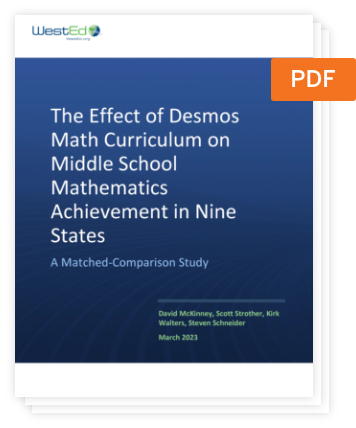
      Pdf cover with title "The Effect of Desmos Middle School on Mathematics Achievement in Nine States," labeled as an education research study from March 2023 by WestEd.

      The Effect of Desmos Math Curriculum on Middle School Mathematics Achievement in Nine States

      Read more

      Research base

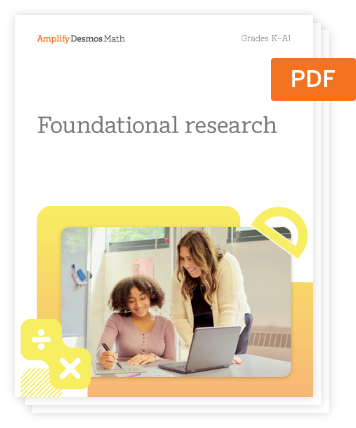
      A cover page for an Amplify Desmos Math PDF titled "Foundational research," featuring two women working together at a desk with a laptop and papers.

      Amplify Desmos Math: The research behind the K–12 math program

      Read more

      District success stories

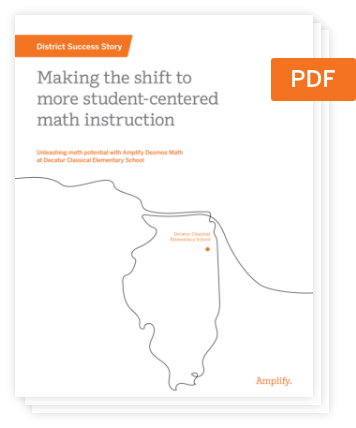
      Cover page of a PDF titled "Making the shift to more student-centered math instruction" with an outline of Illinois and a marked location for Decatur Classical Elementary School.

      Decatur Classical Elementary School, Illinois: Kindergarten through grade 2 proficiency grows 34% with Amplify Desmos Math in one year.

      Read more

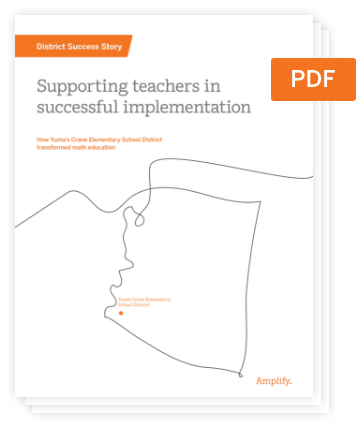
      Cover page of a PDF document titled "Supporting teachers in successful implementation" by Amplify, focused on a school district's approach to math education.

      Crane Elementary School District, Arizona: 5 schools earn all possible math growth points using Amplify Desmos Math.

      Read more

      Cover page of a PDF titled "Anchoring math instruction in shared values" by Amplify Desmos Math, featuring a simple outline map with a location marker and an orange label reading "District Success Story.

      Superior School District, Wisconsin: Achieving 5.2% growth in middle school with Amplify Desmos Math

      Read more

      Ready to learn more?

      Fill out this form, and we’ll be in touch shortly.

      A line drawing of a spilled liquid with a smartphone partially submerged in it.

      Explore more of our research.

      Learn more about the research behind our programs.

      Core Principles:

      These core principles guide our operations, employee behavior and product development:

      • Customer Control: We help school districts securely manage their personally identifiable student information. The districts direct our use of the data, and control who has access to that data and with whom it is shared.
      • Educational Purpose: Personal student information can only be used for customer-authorized purposes to support student learning through the secure and effective operation of our educational tools. 
      • Transparency: School districts, teachers, parents and students have the right to know what information is collected by school technology, how it is used and by whom, as clearly described in our privacy policy.
      • Commitment: Privacy and security are thoroughly embedded into our organizational practices. We dedicate substantial resources to systems, processes and personnel required to protect student information.

      Amplify Data Privacy and Security Practices:

      Amplify maintains a customer data privacy policy that explains our data collection, handling and use practices. 

      Amplify also maintains a data security policy that explains how student data is protected from unauthorized access.  Data security practices at Amplify are developed and maintained in accordance with the internationally recognized ISO27002 security standards.  In addition, Amplify has successfully completed the SOC 2 Type 2 examination of controls relevant to security and conducts such examination on an annual basis. 

      For more information, please review our customer privacy policy and security practices. If you have additional questions, please contact us at privacy@amplify.com.  

      State Law Compliance

      Amplify has entered into Data Privacy Agreements (DPAs) with districts across the country to facilitate compliance with applicable laws governing student data privacy. These DPAs can be applied to any Amplify product.

      Unless otherwise noted, the DPAs are based on the Student Data Privacy Consortium’s (SDPC) model agreement which was created to simplify the contracting process between providers and local education agencies (LEAs) while ensuring LEAs have the necessary data protection obligations in place with providers. For additional information please visit the SDPC website and select your state.

      General Offer of Privacy Terms:
      To expedite your district’s need for a DPA and streamline the contracting process, we have compiled the following DPAs, listed by state.

      By executing the General Offer of Privacy Terms, your LEA can “piggy back” off an existing DPA that other LEAs in your state have already agreed to. If you do not see your state below, please contact privacy@amplify.com.

      Instructions: 
      (i) Please download the General Offer of Privacy Terms, (ii) sign and send the executed copy to your Amplify account representative, and (iii) retain a copy for your records. If you have any questions please reach out to privacy@amplify.com.

      *Please note, states marked with an asterisk do not have a General Offer of Privacy Terms; however, please review the instructions below on how to quickly implement a DPA in compliance with your LEA’s state law.

      Arizona: To enter into Amplify’s AZ-NDPA-V1, please sign the General Offer of Privacy Terms

      Arkansas: To enter into Amplify’s AR-NDPA-V1, please sign the and General Offer of Privacy Terms

      California: To enter into Amplify’s CA-NDPA, Version 1.5, please sign the General Offer of Privacy Terms

      Connecticut*
      To facilitate your district’s compliance with the requirements of Connecticut’s student data privacy law (Connecticut General Statutes §§ 10-234aa through 10-234dd), Amplify is proud to offer our “Connecticut Terms of Service Addendum” linked below. This Addendum supplements Amplify’s Terms and Conditions for use of Amplify products licensed by the district available at https://amplify.com/customer-terms.
      Addendum: Connecticut Terms of Service Addendum
      Instructions: Please retain a copy for your records – no further action is required.

      Florida: To enter into Amplify’s FL-NDPA, Version 1.0, please sign the General Offer of Privacy Terms

      Hawaii*
      Amplify has entered into a Data Sharing Agreement with the Hawaii State Department of Education (HIDOE) which applies to any LEA associated with HIDOE. If your LEA is not a part of the HIDOE and you require a data privacy agreement, please reach out to privacy@amplify.com.

      Illinois: To enter into Amplify’s IL-NDPA (which includes the IL State Supplemental Terms), please sign the General Offer of Privacy Terms

      Iowa: To enter into Amplify’s IA-NDPA (which includes the IA State Supplemental Terms), please sign the General Offer of Privacy Terms

      Maine: To enter into Amplify’s MA-ME-MO-NH-NY-OH-RI-VT DPA, Version 1 (which includes the ME State Supplemental Terms), please sign the General Offer of Privacy Terms 

      Massachusetts: To enter into Amplify’s MA-ME-MO-NH-NY-OH-RI-VT DPA, Version 1 (which includes the MA State Supplemental Terms), please sign the General Offer of Privacy Terms

      Missouri: To enter into Amplify’s MO-NDPA, Version 1.0, please sign the General Offer of Privacy Terms

      Montana: To enter into Amplify’s MT DPA, Version 3, please sign the General Offer of Privacy Terms

      Nebraska: To enter into Amplify’s NE NDPA (which includes the NE State Supplemental Terms), please sign the General Offer of Privacy Terms

      New York*
      Option 1:
      To facilitate your district’s compliance with the requirements of New York State Education Law § 2-D and regulations promulgated thereunder, Amplify is proud to offer our “New York Data Privacy and Security Addendum” linked below. This Addendum supplements Amplify’s Terms and Conditions for use of Amplify products licensed by the educational agency available at https://amplify.com/customer-terms.
      Addendum: New York Data Privacy and Security Addendum
      Instructions: Please retain a copy for your records- no further action is required.
      Option 2:
      To enter into Amplify’s MA-ME-MO-NH-NY-OH-RI-VT DPA, Version 1 (which includes the NY State Supplemental Terms), please sign the General Offer of Privacy Terms

      New Hampshire: To enter into Amplify’s MA-ME-MO-NH-NY-OH-RI-VT DPA, Version 1 (which includes the NH State Supplemental Terms), please sign the General Offer of Privacy Terms

      North Carolina*
      The Data Confidentiality and Security Agreement issued by the North Carolina Department of Public Instruction (NCDPI) is not applicable to Amplify’s services given Amplify does not have a direct integration to any state system via API/plugin. You can review the NCDPI guidance here: https://www.dpi.nc.gov/about-dpi/technology-services/third-party-data-integration. However, Amplify can sign this form with some revisions. As such, we have prepared an Addendum which supplements the Data Confidentiality and Security Agreement.
      Instructions: Please download a copy of the Data Confidentiality and Security Agreement with Amplify Addendum, return an executed copy to your account executive, and retain a copy for your records.

      Ohio: To enter into Amplify’s OH-NDPA Version 1.0, please sign the General Offer of Privacy Terms

      Oregon: To enter into Amplify’s OR-NDPA-V1, please sign the General Offer of Privacy Terms

      Rhode Island: To enter into Amplify’s MA-ME-MO-NH-NY-OH-RI-VT DPA, Version 1 (which includes the RI State Supplemental Terms), please sign the General Offer of Privacy Terms

      Tennessee: To enter into Amplify’s TN-NDPA-V1, please sign the General Offer of Privacy Terms

      Texas: To enter into Amplify’s TX-NDPA-V1R6, please sign the General Offer of Privacy Terms

      Utah: To enter into Amplify’s UT-NDPA, Version 1, please sign the General Offer of Privacy Terms

      Vermont: To enter into Amplify’s MA-ME-MO-NH-NY-OH-RI-VT DPA, Version 1 (which includes the VT State Supplemental Terms), please sign the General Offer of Privacy Terms

      Virginia: To enter into Amplify’s VA-DPA, please sign the General Offer of Privacy Terms

      Washington: To enter into Amplify’s WA-NDPA, Version 1, please sign the General Offer of Privacy Terms

      Wisconsin: To enter into Amplify’s WI SDPA, Version 1, please sign the General Offer of Privacy Terms

      Wyoming: To enter into Amplify’s WY-NDPA-V1, please sign the General Offer of Privacy Terms

      Welcome, Prescott ELA review committees!

      Dear Prescott educator,

      We’re extremely excited to be part of your English language arts adoption process.

      Amplify CKLA and Amplify ELA aren’t your traditional core ELA programs. They’re different to make a difference – and the results are simply undeniable. Watch theoverview presentations belowto learn more.

      I look forward to visiting with you soon and sharing more about the unique research-based approaches built right into these high-quality solutions.

      With great respect for what you do,

      Tommy Gearhart
      Arizona Account Executive

      A miniature yellow van with luggage on top is parked next to a small stop sign, with a blurred, colorful vehicle in the background. Text reads: "Your literacy journey stops here!.

      About our programs

      Amplify CKLA for Grades 3–5

      Watch the video to the right to learn how Amplify CKLA brings Science of Reading best practices to life and addresses the specific needs of students in grades 3–5.

      Ready for more? Visit our review site to download resources and access a demo.

      Amplify ELA for Grades 6–8

      Watch the video to the right to learn how Amplify ELA takes the Science of Reading to the next level, engages and empowers learners, and addresses the specific and very unique needs of students in grades 6–8.

      Ready for more? Visit our review site to download resources and access a demo.

      Contact us

      Looking to speak directly with your Arizona representative? Your dedicated Account Executive, Tommy Gearhart, is standing by and ready to help.

      Tommy Gearhart

      Senior Account Executive

      (505) 206-7661

      tgearhart@amplify.com

      Alestra Menéndez

      Literacy Curriculum Specialist

      (925) 698-8083

      amenendez@amplify.com

      Overview

      With Amplify Science, students don’t just passively learn about science concepts. Instead, they take on the role of scientists and engineers to actively investigate and figure out real-world phenomena. They do this through a blend of cohesive and compelling storylines, hands-on investigations, collaborative discussions, literacy-rich activities, and interactive digital tools.

      Watch the videos below to learn how our program empowers students to think, read, write, and argue like real scientists and engineers every day.

      Overview

      What Educators Say

      The NGSS classroom

      EdReports

      Amplify Science for grades K–8 has been rated all-green by EdReports..

      Read the review on Edreports.

      Program structure

      Our cyclical lesson design ensures students receive multiple exposures to concepts through a variety of modalities. As they progress through the lessons within a unit, students build and deepen their understanding, increasing their ability to develop and refine complex explanations of the unit’s phenomenon.

      It’s this proven program structure and lesson design that enables Amplify Science to teach less, but achieve more. We designed our program to address 100% of the NGSS in just 66 days for grades K–2 and 88 days for grades 3–5.

      Unit sequence

      Our lessons follow a structure that is grounded in regular routines while still being flexible enough to allow for a variety of learning experiences.

      In fact, our multi-modal instruction offers more opportunities for students to construct meaning, and practice and apply concepts than any other program. What’s more, our modular design means our units can be flexibly arranged to support your instructional goals.

      Unit sequence
      Mariposa en vuelo sobre plantas en macetas sobre una mesa, con una oruga en un tallo frondoso cerca, una regadera roja a la izquierda y un paisaje brillante al fondo.

      Needs of Plants and Animals

      Domains: Life Science, Earth and Space Science, Engineering Design

      Unit type: Investigation

      Student role: Scientists

      Phenomenon: There are no monarch caterpillars in the Mariposa Grove community garden since vegetables were planted. 
      Una mano tirando de una cuerda atada a una bola blanca, que interactúa con un tablero de madera con varias clavijas y bandas elásticas.

      Pushes and Pulls

      Domains: Physical Science, Engineering Design

      Unit type: Engineering design

      Student role: Pinball engineers

      Phenomenon: Pinball machines allow people to control the direction and strength of forces on a ball. 
      An illustration from the Sunlight and Weather unit

      Sunlight and Weather

      Domains: Earth and Space Science, Life Science, Engineering Design

      Unit type: Modeling

      Student role: Weather scientists

      Phenomenon: Students at Carver Elementary School are too cold during morning recess, while students at Woodland Elementary School are too hot during afternoon recess. 
      Una ilustración de una tortuga marina nadando bajo el agua, acompañada por una tortuga más pequeña, una tortuga más grande y un tiburón distante. Al fondo se ven algas.

      Animal and Plant Defenses

      Domain: Life Science

      Unit type: Modeling

      Student role: Marine scientists

      Phenomenon: Spruce the Sea Turtle lives in an aquarium and will soon be released back into the ocean, where she will survive despite ocean predators. 
      An illustration from the Light and Sound unit

      Light and Sound

      Domains: Physical Science, Engineering Design

      Unit type: Engineering design

      Student role: Light and sound engineers

      Phenomenon: A puppet show company uses light and sound to depict realistic scenes in puppet shows. 
      Ilustración que muestra un paisaje urbano dividido en noche a la izquierda con una luna y estrellas, y día a la derecha con un sol, nubes y un avión.

      Spinning Earth

      Domain: Earth and Space Science

      Unit type: Investigation

      Student role: Sky scientists

      Phenomenon: The sky looks different to Sai and his grandma when they talk on the phone. 
      Un elefante se encuentra debajo de un árbol y usa su trompa para arrancar un trozo de fruta.

      Plant and Animal Relationships

      Domains: Life Science, Engineering Design

      Unit type: Investigation

      Student role: Plant scientists

      Phenomenon: No new chalta trees are growing in the fictional Bengal Tiger Reserve in India. 
      A hand holds a red bean on a table, while a wooden stick spreads white glue and scattered beans. Also on the table are a white cup and a yellow pen.

      Properties of Materials

      Domains: Physical Science, Engineering Design

      Unit type: Engineering design

      Student role: Glue engineers

      Phenomenon: Different glue recipes result in glues that have different properties. 
      An illustration from the Changing Landforms unit

      Changing Landforms

      Domain: Earth and Space Science

      Unit type: Modeling

      Student role: Geologists

      Phenomenon: The cliff that Oceanside Recreation Center is situated on appears to be receding over time. 
      An illustration from the Balancing Forces unit

      Balancing Forces

      Domain: Physical Science

      Unit type: Modeling

      Student role: Engineers

      Phenomenon: The town of Faraday is getting a new train that floats above its tracks. 
      An illustration from the Inheritance and Traits unit

      Inheritance and Traits

      strong>Domain: Life Science

      Unit type: Investigation

      Student role: Wildlife biologists

      Phenomenon: An adopted wolf in Graystone National Park (Wolf 44) has some traits that appear similar to one wolf pack in the park and other traits that appear to be similar to a different wolf pack. 
      An illustration from the Environments and Survival unit

      Environments and Survival

      Domains: Life Science, Engineering Design

      Unit type: Engineering design

      Student role: Biomimicry engineers

      Phenomenon: Over the last 10 years, a population of grove snails has changed: The number of grove snails with yellow shells has decreased, while the number of snails with banded shells has increased. 
      Un orangután con un pelaje naranja cuelga de una enredadera en una densa y verde jungla con árboles y plantas, mientras el sol brilla de fondo.

      Weather and Climate

      Domains: Earth and Space Science, Engineering Design

      Unit type: Argumentation

      Student role: Meteorologists

      Phenomenon: Three different islands, each a contender for becoming an Orangutan reserve, experience different weather patterns. 
      An illustration from the Energy Conversions unit

      Energy Conversions

      Domains: Physical Science, Earth and Space Science, Engineering Design

      Unit type: Engineering design

      Student role: System engineers

      Phenomenon: The fictional town of Ergstown experiences frequent blackouts. 
      An illustration from the Vision and Light unit

      Vision and Light

      Domain: Physical Science, Life Science, Engineering Design

      Unit type: Investigation

      Student role: Conservation biologists

      Phenomenon: The population of Tokay geckos in a rain forest in the Philippines has decreased since the installation of new highway lights. 
      Ilustración de una costa rocosa con acantilados angulares en tonos rojizos a la izquierda y una masa de agua azul debajo.

      Earth's Features

      Domain: Earth and Space Science

      Unit type: Argumentation

      Student role: Geologists

      Phenomenon: A mysterious fossil is discovered in a canyon within the fictional Desert Rocks National Park. 
      An illustration from the Waves, Energy, and Information unit

      Waves, Energy, and Information

      Domains: Physical Science, Life Science, Earth and Space Science, Engineering Design

      Unit type: Modeling

      Student role: Marine scientists

      Phenomenon: Mother dolphins in the fictional Blue Bay National Park seem to be communicating with their calves when they are separated at a distance underwater. 
      An illustration from the Patterns of Earth and Sky unit

      Patterns of Earth and Sky

      Domains: Physical Science, Earth and Space Science

      Unit type: Investigation

      Student role: Astronomers

      Phenomenon: An ancient artifact depicts what we see in the sky at different times — the sun during the daytime and different stars during the nighttime — but it is missing a piece. 
      An illustration from the Modeling Matter unit

      Modeling Matter

      Domain: Physical Science

      Unit type: Modeling

      Student role: Food scientists

      Phenomenon: Chromatography is a process for separating mixtures. Some solids dissolve in a salad dressing while others do not. Oil and vinegar appear to separate when mixed in a salad dressing. 
      An illustration from the Earth System unit

      The Earth System

      Domains: Earth and Space Science, Physical Science, Engineering Design

      Unit type: Engineering Design

      Student role: Water resource engineers

      Phenomenon: East Ferris, a city on one side of the fictional Ferris Island, is experiencing a water shortage, while West Ferris is not. 
      An illustration from the Ecosystem Restoration unit

      Ecosystem Restoration

      Domains:Physical Science, Life Science, Earth and Space Science, Engineering Design

      Unit type: Argumentation

      Student role: Ecologists

      Phenomenon: The jaguars, sloths, and cecropia trees in a reforested section of a Costa Rican rain forest are not growing and thriving. 

      Access program

      Watch the video to the right showing you how to navigate our digital platform. When you’re ready, follow the instructions below to log into your live demo account.

      • Click the orange button below to access the platform.
      • Explore as a teacher with this username (t1.cartwrightsd@demo.tryamplify.net) and this password (Amplify1-cartwrightsd).
      • Explore as a student with this username (s1.cartwrightsd@demo.tryamplify.net) and this password (Amplify1-cartwrightsd).
      • Choose your grade level from the drop-down menu.


      Access the digital platform now

      Resources

      S1-04: Connecting with students and caregivers in the science classroom: Ryan Rudkin

      Promotional graphic for "science connections", season 1, episode 4, featuring a smiling woman named Ryan Rudkin, themed with science illustrations like atoms and a globe, highlighting how to engage students

      In this special episode, our host Eric Cross sits down with veteran middle school teacher Ryan Rudkin. Ryan shares her expertise after almost two decades in the classroom, discussing ways to incorporate aspects of problem-based learning into the K–8 science classroom. Eric and Ryan talk about how to increase parent engagement, involve community members, and add excitement to lessons.

      Explore more from Science Connections by visiting our main page.

      Download Transcript

      Ryan Renee Rudkin (00:00):

      I know there’s other goals in mind, you know, standards and test scores. But at the end of the day, I wanna come back and I want them to come back.

      Eric Cross (00:35):

      My name’s Eric Cross, host of our science podcast, and I am with Ryan Rudkin, middle-school teacher out here in California just to the north up near Sacramento? El Dorado Hills?

      Ryan Renee Rudkin (00:46):

      Yeah. 20 miles east of Sacramento.

      Eric Cross (00:49):

      Nice. And I am down here in San Diego. And so Ryan, to start off, what I wanna do is ask you about your origin story, like a superhero. So how did you become a middle-school science teacher to become part of this elite profession of science folks that get to do awesome things with kids?

      Ryan Renee Rudkin (01:08):

      I would agree with you that it is definitely an elite profession. I got my credential and I thought I was gonna teach third or fourth grade elementary school. And the second day I got called for a sub job for middle school. And I just thought, “We’ll take it,” you know? And by second period, I knew: This is where I belong. The kids, middle school, students are just a species of their own. And you have to appreciate them. And if you do appreciate them, then you’re in the right spot. And I quickly looked at my coursework and I was able to get authorizations in science, history, and English, and I love science. So I chose science. And the rest is history. It’s been a wild ride and I wouldn’t have changed or asked for anything different. I love it.

      Eric Cross (02:02):

      I definitely agree with you. So, your history—you’ve been in various middle-school classrooms. Can you tell us a little bit about that? What classrooms have you been in? What disciplines of science have you taught or are currently teaching?

      Ryan Renee Rudkin (02:14):

      I was hired for seventh grade life science, and then I did that for a few years and then I got moved into eighth physical science, and I was there for 12 years. Love eighth grade science. I love eighth graders. Chemistry and physics are my favorite. There’s just so much opportunity for just awesome labs, great conversations, student discourse, all of that. And then the past three years I’ve been in sixth grade and now we’re integrated. So,a sixth grade integrated science and I also teach social studies and a technology design class.

      Eric Cross (02:52):

      Oh, nice. What do you do in your technology design class? That sounds cool.

      Ryan Renee Rudkin (02:56):

      Right now it’s mostly internet media and we use WeVideo, it’s an editing-video program, and we produce and put on our school weekly news bulletin. And then we weave in other projects. We do some interdisciplinary projects. Right now my students are working on a mythology God, Goddess, and Monster project that relates to our social studies curriculum. And we’re learning about Greece. So yeah, we just try to give them added projects and they’re using the WeVideo platform. By sixth grade, they’re coming to us now with wonderful skills with all the tech. I mean, if I need help, I ask them like, “How do you do something on Google Docs?” Or, “How do you do something on Drive?” The kids are definitely tech-savvy.

      Eric Cross (03:49):

      They must love being the teacher in the classroom. They get to—it kind of switches power roles, where they get to teach the teacher something.

      Ryan Renee Rudkin (03:56):

      Yes. And especially WeVideo, sometimes we’ve had some hiccups, and the kids show everybody, and that’s part of the design class. They’re trying to solve—we’re teaching them how to solve their own problems. So if there’s any kind of issue with anything with the technology, honestly, I usually tell them, “Go ask a friend,” or we kind of shout out, “Hey, who knows how to troubleshoot this?” And the kids are eager to help each other, which is nice.

      Eric Cross (04:21):

      And they have this authentic experience where they’re actually doing real problem-solving, as opposed to something that we manufactured. Like, those are real things that we have to deal with in life. And that’s exactly like how we solve it, right? We just go ask people! We look it up, and the ahas are genuine too. Throughout!

      Ryan Renee Rudkin (04:36):

      Yes, especially thinking on the fly. Especially yesterday, I was in the middle of teaching and my laptop froze, and it’s like, “OK, everybodytake a couple minutes, you know, work on this, this, or that while I switch out laptops!” And so I’m modeling, too, how to solve my own problems. And I think it teaches the kids how to do that too.

      Eric Cross (04:59):

      I’ve always thought it was interesting that when teachers get to teach in real time, how do we handle stress and frustration when it’s really happening? And I think the tech—at times, failure is the real one where you feel this chill or this sweat that kind of comes over you and you’re trying to present or cast or the video won’t play and things like that. I think I’ve done enough times in my years of teaching where now my students know what to do, or they want to come up and help, and we’re good with it. But I remember in the beginning when those things would kind of glitch or go wrong or the wifi goes down, and you’re like, OK, what do we need now?

      Ryan Renee Rudkin (05:33):

      I think it’s honestly, after the fact, when I think in the moment, I’m not thinking of feeling stressed, but just afterwards, then I’m like, “Oh my gosh, this has just been a wild day.” But yeah, you just have to kind of go with it. And that’s just the beast of middle school. I just added to the list of why we love it.

      Eric Cross (05:53):

      You said something about interdisciplinary work, and I wanna kind of ask about that. Because it sounds like you’ve had your hand in several different areas of science and grade levels. Working, doing design courses, working with tech. Are there certain lessons that are your favorites to teach? The ones that you really enjoy, or that no matter what, you’re like, “We need to do this; this is such a rich experience for students”?

      Ryan Renee Rudkin (06:17):

      Yeah. I definitely try to do lessons or activities along the way. I like to do projects at the end of my units. When I taught physics, we did a project and it was mainly an assessment tool called the Wheeling and Dealing. The kids, they would all get a different car. And then they to sell their car. And so they had to pretend to be a car salesman, and they did that with their knowledge of the physics unit. So everything we did on forces and speed and motion. So I like doing culminating projects like that. And you’re kind of tricking them into assessing them.

      Eric Cross (06:57):

      When I think about your car salesman project, I’m thinking of a bunch of students, but they’re like on Shark Tank, but they’re just littler versions. And they’re doing these sales pitches, but they’re speaking in scientific terms as they’re trying to do it. Do you record these or do they just exist in the classroom?

      Ryan Renee Rudkin (07:12):

      No…And that was a long time ago, when I taught eighth grade. I wish I had; I wish I had recorded. That was definitely—it was fun, ’cause the kids, they would get their little piece of paper and they—some of ’em didn’t know what car it was. And so they’re like “A Boo… A Boo-gatti? What’s a Boo-gatti?” And then someone from across the room would be like, “Ooh, I want it! Here, I’ll trade you my Ford Focus!” And <laugh> so they would kind of wheel-and-deal which car they would…and then once they got their choice, then they would do the project.

      Eric Cross (07:44):

      So they’re really embodying this persona of a car salesman. The wheeling and doing back-and-forth and trying to trade a Bugatti for a Ford Focus. <Laugh>

      Ryan Renee Rudkin (07:53):

      I know. <Laugh> I like to make my class, my learning environment, enjoyable. You know, I gotta be there; they gotta be there. So I know there’s other goals in mind—you know, standards and test scores—but at the end of the day, I wanna come back, and I want them to come back. And I just have that as a priority.

      Eric Cross (08:18):

      Well, based on the projects that you’re doing and the way that you approach education with students, I can see why middle-school students would want to come back, even if they had the option not to. Just because of the cool things that you’re doing. Now we’re on this—hopefully, fingers crossed—tail end of COVID in the classroom and schools, and I know it’s impacted all of us differently. Has student engagement changed since COVID and if so, how, and what have you done in these last two years to maybe adjust your approach, to continue that engagement and that richness that you provide for your kids?

      Ryan Renee Rudkin (08:57):

      I definitely—I think for me, I recognize that when the students are in my classroom, I want them to, I dunno, for lack of a better word, just escape the noise at home. And I know we’ve always had students that are going through divorce situations or their dog died, other things, but I think with COVID, it’s definitely been compounded. And just creating a safe place for the kids to want to be and…it’s hard. We’ve had a lot of students that have been out, absent, for various reasons and on quarantine. And they’re struggling with doing work from home, ’cause their parents are stressed and their parents are dealing with their work issues. And so I think just having grace for the kids and just keeping…I don’t know, I guess like I said, I’ve always had student engagement as top of my list.

      Eric Cross (10:06):

      It sounds like—the things I hear you say really have to do with who these students are as people.

      Ryan Renee Rudkin (10:12):

      Yeah.

      Eric Cross (10:13):

      And then as a second, who they are as students. How do relationships fit into your engagement? ‘Cause I’m hearing this connection that you seem to be making with kids as you’re talking about things that are beyond academics: their home life, how they’re impacted.

      Ryan Renee Rudkin (10:28):

      Yes.

      Eric Cross (10:28):

      Is there anything that you do to build these relationships, or to connect with your students, to make them feel wanted or feel connected to the classroom or to you?

      Ryan Renee Rudkin (10:37):

      Yeah, I do. I do a few things to build those connections. And again, this timeframe in their life is so out of their control, their peer relationships, relationships with their parents. And when they’re in my classroom, I want them to feel loved and appreciated. Something I do it’s called Phone Fridays. And in one of the social media groups, someone posted about it, and I’ve been doing it for over a year now, actually. So on Fridays I call parents and give good news. And so I’ll pick maybe one or two students. And it could be academic reasons. It could be behavior, I’ve seen a slight improvement of behavior. Maybe a role model in the classroom. And my goal is to get everybody every trimester. So everybody gets a phone call by the end of the trimester. And it’s funny ’cause sometimes the parents are a little like “Uh-oh”! When they pick up, they see the caller ID, and their school’s calling. ‘Cause Some kids don’t get good calls. So it’s a really—I would say every single parent that I’ve called, I usually get a follow-up email, either to me or my admin, just saying it’s such a cool idea I do this; thank you so much. And yeah, I just call and give good news and just put ’em on the spot. And usually the kids are a little embarrassed, but you can tell, even though they’re kind of—I think they’re faking it, that they’re embarrassed! ‘Cause You know that they got the Phone Friday, and everybody’s like, “Who’s gonna get the phone Friday?!” And so it’s a very big deal in my class.

      Eric Cross (12:07):

      What a great way to—I mean, it seems like that hits on so many levels. You’re making these positive calls home. You’re praising publicly, which a lot of times can happen where students can get criticized or redirected publicly and then praised privately, which is a lot of times the reverse what we should be doing. But here you are praising them publicly. And then you’re not only building a relationship with yourself, but you’re also connecting them with their parent or whoever is caring for them, because now when they go home, there’s this, “Hey, your teacher called; you’re doing awesome!” So it’s this kind of triangle that’s forming there. I think that’s super-cool and a great thing for teachers to do.

      Ryan Renee Rudkin (12:45):

      It takes, you know, the last five minutes of my class. I do it every class. And then I have a system. Like I said, I keep track of all the kids. That way, by the end of the trimester I’ve gotten everybody. Sometimes I let the students, whoever I call first, then I let them pick a peer and I tell them, “OK, we have to have a solid reason. Why are we calling?” And a couple times they’ll have a student, like one of my energized ones, they’ll raise their hand. “How About me? How about me?” And I and the kids kind of laugh a little and I said, “Well, how about this? Let’s make a goal. How about next week we’re gonna make a goal and we’re gonna have a reason to call home.” So just working on the kids that need a little push in the right direction. That’s other reasoning to it. But yeah, it’s fun. I love it.

      Eric Cross (13:33):

      And you have the community. You have this goal setting. We were talking a little earlier about this transition—so you’re becoming this…your school’s going through the IB process, is that right?

      Ryan Renee Rudkin (13:44):

      Yes.

      Eric Cross (13:44):

      And we were talking about the ATL skills and one of them is goal-setting management. You already kind of organically do this in your classroom, which is really neat. I know being an IB teacher, a lot of times I find the things that I’ve already been doing and find, “Oh, this is actually an approach to learning!” or “This is something that has a title!” I just thought it was just being helpful! Ah…So the kids are connected. You have this process where you’re calling parents; it’s working; students are involved, so it’s building this community. Now you’re engaging students. Do you have any favorite student engagement tools that you use in your classroom or when you’re teaching that you feel like you get a lot of bang for your buck? There’s so many things out there these days. And so many approaches, tools, web apps. Do you have any favorites that you use?

      Ryan Renee Rudkin (14:40):

      No. Nothing comes up top of my mind right now. Mostly just projects, like I said. And being excited. I think having my students see me excited about something…and I’m honest when we’re doing something that’s not quite my favorite, then I’m honest about that too. But just having my—like, we just started thermal energy this week and I told my students, I said, “OK guys, I’m gonna weave in some chemistry in there. I’m gonna weave in some particle motion,” and they’re like, “Oh! That’s when you taught eighth grade, huh!” Cause I talk a lot about when I taught eighth grade before. I don’t know, just showing my own enthusiasm, I think, is a good payoff to me. That’s a bang for your buck. Other things…I try to give ’em cool videos and Mark Grober, he’s definitely a favorite of mine I like to show my students. I like to bring in guest speakers from our community. When I taught eighth grade for physics, I always brought in a local CHP officer and they would bring in the radar and lidar guns and the kids would mark off the parking lot and they would calculate their speed. And then they would verify it with the radar gun. Two years ago when I taught math, I brought in a local landscaper company, a father-and-son outfit, and they showed the kids how they would do bids on jobs. And so, relate it to our chapter on volume and area. So just making that connection with real life. Plus it’s just a nice opportunity, too, for the community to come in. With our design class, put on our newscast. And then one of our units in our sixth grade curriculum is weather. And so I brought in a local weatheruh, chief meteorologist. And he actually talked to the students about his job as a meteorologist and then also being on the news and putting on a newscast. So we got him on our green screen and did a little like Mark Finan, you know, little cameo on our newscast for the week for school. So that was kind of cool.

      Eric Cross (16:45):

      They must have been excited.

      Ryan Renee Rudkin (16:47):

      Yeah. They’re pretty starstruck by him. So that was pretty fun.

      Eric Cross (16:51):

      This person was on their local news? So they would know him?

      Ryan Renee Rudkin (16:56):

      Yeah, he’s on Channel 3 out of Sacramento. Yeah. KCRA Channel 3, Mark Finan.

      Eric Cross (17:00):

      So all these guest speakers that you have…how do you reach out to these people? And you sound like you get a lot of success. Do you ever get nos? Like if I’m sitting here listening and that inspires me, but you’re getting celebrities and you see a few people…like, how do you reach out to them? And does everybody say yes? How does it go?

      Ryan Renee Rudkin (17:21):

      Well, usually at my back-to-school night, I always ask the parents if they have a career or hobby that could lend itself to the curriculum. And so sometimes I’ll hear about—students will talk about, like, “My mom’s a doctor.” And so I’ll reach out to parents and just say, “Hey, you know, your kiddo said, you’re a doctor. May I ask what type?” And most of the time the nos that I’ve received are just because of schedule conflicts. You just have to get creative! Look in your community and see what you have. People want to come and talk to kids. I’ve had some presentations that the person is so intelligent and amazing, but they just, weren’t very kid-friendly. I mean, that happens. Butsomeone knows someone. And just ask! I mean, it doesn’t hurt to ask to have ’em come out, come hang out for the day, with my students. Andone time I had a nurse practitioner she was in the cardiac unit. And so she brought in hearts and led a heart dissection with my students. And we did a station set-up. I’ve had elaborate ones like that, or just a mom come in to tell my students about her job as a nutritionist and relate it to our unit on metabolism. And so just did like a little 15-minute Q&A with the kids on nutrition. And I would just say, look at your community and/or post on social media. I always do that. Post in your school’s PTA groups. So the parents know someone, that’s for sure. Or someone’s retired. One time I had—I think he was a grandfather of one of the kids—he was into rocks. And he had a bunch of meteorites <laugh> and brought in his meteorites.

      Eric Cross (19:15):

      Bring in your rocks!

      Ryan Renee Rudkin (19:15):

      I know! Right? And he <laugh> just brought in his meteorite collection! I was like, sure, come on in!

      Eric Cross (19:23):

      That’s one of the things I love about being a middle-school teacher is that my students have such varied interests and I’ll get the Rock Kid every once in a while and he’ll come in and he’ll have all these rocks and crystals. And a lot of times there’s a grandfather that’s responsible for this inherited geologic treasure that they have.

      Ryan Renee Rudkin (19:45):

      Yeah, something like that—I mean rocks are not my favorites, but I don’t really tell the kids that. I was like, “Sure, yeah, come on in! We can have a whole-day lesson on rocks!”

      Eric Cross (19:55):

      <Weakly> “This is great!”

      Ryan Renee Rudkin (19:58):

      Just utilizing your resources. That’s all it’s about.

      Eric Cross (20:02):

      Well, I think the back-to-school night was really helpful. That’s something that’s super doable. You have a bunch of parents and you just simply ask, “Who do you know? What do you do?” And then just collecting that and then just asking people to come in. I’ve I’ve been reluctant to do it more often than I’ve wanted to, because I haven’t figured out—and maybe you can help me with this—I have three class periods a day plus other class periods that are not necessarily science. And I don’t want to dominate a person’s schedule. Do they tend to be willing to stay all day? Or do you do, one class gets it, and you record it? Like, how do you balance out the speakers with your school schedule?

      Ryan Renee Rudkin (20:39):

      Mostly they’ll they’ll just come for the whole day. When I taught eighth grade, I had five classes, so that was easy. That was an all-day thing. And then usually I’ll offer to call lunch, have lunch delivered, or snacks during the day. I mean—

      Eric Cross (20:53):

      Feeding them is key.

      Ryan Renee Rudkin (20:54):

      Yeah. Just something kind of nice. Donuts in the morning. I mean, you’d be very surprised. Most people that are in the field or retired, like I said, they’re more than willing to come. And even if they have to wait an hour, while you teach another class that doesn’t pertain to it, then they’ll either leave or come back or just hang out in the back and pretend to be a student during that history class that you have.

      Eric Cross (21:20):

      It’s my own limiting belief where I feel guilty. I don’t think about it. I need to think about it through the perspective that you do, that these people WANT to talk. I just assume everybody’s so busy. But I do know, the times I’ve had speakers come out, at the end of the day, they’re so energized or they’re so happy or they’re so grateful. ‘Cause They’re like, “This is what it’s like to teach every day?” I’m like, “Yeah, this is what it’s like.”

      Ryan Renee Rudkin (21:42):

      I think too, a lot of parents…usually being being in the stops at elementary. A Lot of parents don’t get the opportunity to come help out in the classroom, because the middle school kids, you know, it’s not very cool or it’s just not needed like in the elementary classes. So a lot of times, like I said, you’d be surprised. A lot of the parents they’re more than happy to come and hang out. And again, some students, they don’t want their mom or dad to be there, but then I talk it up. I’m like, “Everyone’s gonna be so like impressed that your dad’s a doctor,” or “your mom’s a doctor” or —so then I kind of like downplay it. Like, “Oh, whatever, you’re you’re faking it. It’ll be fine. Don’t be embarrassed.” Leading up to their parent coming into the classroom.

      Eric Cross (22:36):

      Right. Kind of redirect that energy toward something positive. With guest speakers, projects, pacing, all these awesome things that you have going on, how do you find balance as a teacher, as a person? And what encouragement would you give to new or aspiring teachers? We work in a profession that will take as much as you give it. And you fall asleep at night worrying about other people’s kids and we love it. And teachers by personality can just give and give and give and give. But in order for us to last—I’m thinking about those new teachers who are going into it, who are gonna go in and be there before the sun gets up and stay after the sun gets down. How do you maintain balance, taking care of yourself? You’ve been in education for—how long have you been teaching for?

      Ryan Renee Rudkin (23:29):

      Sixteen. This is my 16th year.

      Eric Cross (23:31):

      Enough to be that veteran. So how do you find balance? And then, what encouragement would you give to new or aspiring teachers?

      Ryan Renee Rudkin (23:39):

      I would say each year, pick one or two things to add on. You can’t add on 10 things, even though you’re gonna find 10 things that are awesome. But just make a little list, put ’em in a file, and every year, just get good at what you do and then just add on one or two things. And reflect on what’s not going well that you can get rid of to make room to add something else. Try to be patient with yourself. And don’t reinvent the wheel. There’s so many things out there that you can borrow and make it your own. Again, I think that’s a time-saver, just leaning on your colleagues. And take lots of notes, because then when you do it again next year, you can refresh yourself and, “Oh yeah, this lesson, wasn’t the best…” What can you add in to make it a little bit better? And yeah, I would say just take on one or two things each year. And then by the time you get to, you know, being a veteran, you can do all these awesome things and it’ll feel natural ’cause you’ve been practicing and just adding in one thing at a time. I coached Science Olympiad a bunch of years ago, and Science Olympiad is so rewarding. It’s just so amazing.

      Eric Cross (24:59):

      What is Science Olympiad, for the people who’ve never heard of it?

      Ryan Renee Rudkin (25:03):

      Oh, Science Olympiad is so awesome. Google it. I think it’s just ScienceOlympiad.org. It’s 23 different events across all disciplines of science, different topics. And then you have a team of 15 students. And so your 15 students have to cover the 23 events. So for example, if the student’s on the anatomy team, usually there’s a team of two kids they’re gonna study and learn. They provide all the rules and the guidelines. So the students learn and study whatever the parameters are for that year. And then they take a test. And then they compete against other schools. And there’s build events, the engineering events, they can build things like trebuchets matchbox cars or mousetrap cars. Oh gosh, there’s all kinds of things. There’s like a Rube Goldberg device. It changes every year. And it’s so rewarding to see the kids; they pick their area of science that they love. And sometimes you have to put them on an event that they don’t know, and then they end up loving it. It’s so rewarding as a teacher to see these kids that are just on fire and you know that one day they’re gonna go off and do amazing things. They just commit. They commit to their event. And then they blow it outta the water and they win medals and just the recognition…it’s super, it’s just an amazing program.

      Eric Cross (26:42):

      One of the competitions that’s really low-tech that I’ve taken into my classroom is Write It, Do It. Have you done that one before?

      Ryan Renee Rudkin (26:50):

      Oh, yes. Yeah. That’s one. Yep.

      Eric Cross (26:52):

      It’s such a low-tech, simple one to do, but it teaches such great skills. And for those people who haven’t heard of the Write It, Do It project, you create kinda some abstract art out of random crafts. That’s very difficult to describe. You have pipe cleaners and foam and balls and you know, all these different things. And you make it. And then one person on the team is the writer, and they look at it and they write the procedures, and then their teammate, who’s in a different room and doesn’t get to see it, gets all the materials to build it and the procedures, and they have to rebuild it as closely as possible to the actual original. Even though they don’t get to see the original. So they have to rely on their partner’s ability to write procedures step-by-step. And it was fun to watch my students become teammates in that. And they learned how to communicate in a really fun competition. So I expanded it to do it with all of my students as an activity, just to teach them how write descriptively, to write procedurally, to be technical writers. And it’s, it’s fun! It’s fun to see what they build based on what the students say. <Laugh> And it’s also fun to watch them interact with each other, which for seventh graders, usually it’s conflict. <Laugh> But, like, playful conflict. <Laugh> It’s pretty funny to see what they build.

      Ryan Renee Rudkin (28:11):

      They’re like, “Man, what are you talking about? That doesn’t mean this; it means this!”

      Eric Cross (28:16):

      <Laugh> I know part of me feels guilty, but not enough to stop the project. ‘Cause I know for some of ’em, it’s gonna be a really trial by fire being able to practice their skills with writing procedures.

      Ryan Renee Rudkin (28:27):

      But they’re learning among themselves how to provide more details and to be more thorough with their writing and and their thoughts, put their thoughts onto paper. So yeah, that’s a funny event. Definitely.

      Eric Cross (28:41):

      Earlier you had mentioned something about connecting your kids with kids and students outside of your classroom. What is it that you do with that? Because I thought that was a really cool project. Can you speak to that a little bit?

      Ryan Renee Rudkin (28:57):

      Yes, I’ve done—they haven’t had it in a few years, but there’s something called the Pringles Challenge. And if you Google that, I’m sure it’s on the Internet still. So you sign your class up, or your classes, and you get partnered with another school somewhere in the U.S., someplace else. And you decide individually teams, whatever they build. And they make a package to ship a single Pringle chip through the mail. And then you actually mail a Pringle chip through the mail. And then your partner team or partner school, they send their chips to you and then you open everything and then you can take pictures and video. And then there was a whole scoring process where you would score when you receive the chips. And then you input all the data on the website so you can see like how your—and most schools would trade pictures, so that the kids found out how their chip survived. March Mammal Madness is so much fun. Again, Google that.

      Eric Cross (30:01):

      Did you say March Mammal Madness?

      Ryan Renee Rudkin (30:02):

      Yes.

      Eric Cross (30:03):

      Like March Madness, with mammals?

      Ryan Renee Rudkin (30:05):

      Yes.

      Eric Cross (30:05):

      1. What is this?

      Ryan Renee Rudkin (30:06):

      It starts up in March. And you can sign your students up. And that one—it’s not too interactive with other schools, but this is opportunity to get the kids interacting within your site or within your district. Or if you have teacher friends at other schools. There’s like 60…I think it’s 64 animals? And they have this massive bracket that they post. And then you can have the students, I did it—it would be very time-consuming to have the kids individually research each animal. So I just gave one animal per student and so as a class we researched all the animals and then, I think it’s every three days or so, they have these bouts. And it’s all posted on YouTube. Google it. It’s kind of fun.

      Eric Cross (30:56):

      I’ve already got the website up, ready to go! Folks, everybody who needs to Google this: <articulates carefully> March Mammal Madness. And is it Arizona State University? Is that the main site, ASU?

      Ryan Renee Rudkin (31:04):

      Yes.

      Eric Cross (31:04):

      So people, listen to this. Check it out. March Mammal Madness. Look, I’m doing this! I’m already,—you’ve already sold me on this.

      Ryan Renee Rudkin (31:14):

      It is so much fun, oh my gosh. And then, then the kids—each round, they pick their pick, just like basketball. They do their picks and then you wait for the video. And they do it live on—I think it’s live on Instagram, or the next day on YouTube. And then the kids get all excited. And then usually the kids, whatever animal they got as their research animal, they’re rooting for that one to win, the whole thing.

      Eric Cross (31:42):

      But we still have time; we still have time to—

      Ryan Renee Rudkin (31:45):

      You can jump in anytime. Even if it’s already started, you can jump into it. It usually lasts—I believe it’s a two-week from beginning to end. When they do the first round, the wild card, and then all the way to the winner, I believe it’s a two-week process. Oh, maybe three, actually.

      Eric Cross (31:59):

      I’m already seeing this lead-up to the video being watched in class to see…I’m already thinking about like, “How do I prevent my students from finding the video?” Or like, “When does it go live so that I could be the one to show them so they didn’t go find it early?”

      Ryan Renee Rudkin (32:13):

      It takes time out of the class, but I believe it’s one of those things where you have to just…it takes 10 minutes out of the class, but it’s important. So when they each round and then the next day, they release the YouTube video. Last year, when it got down to the final round, we were on spring break. And so I told my students, “You guys, let’s do some optional Zooms. And so I had a bunch of kids log on and we all watched the videos together. So that was kind of fun. And then this year, the other thing, the first time I’ve ever done this and it’s going really well is—on social media, I was talking with one of the teachers from Ohio who teaches science and she and I decided we’re gonna do penpals for our students this year. Paper-And-Pen penpals. So that’s been a lot of fun. We just partnered up all the students, her students and my students, and once a month we send and receive the letters to each other. So that’s been a really cool experience.

      Eric Cross (33:14):

      If you keep doing that, and you need more teachers to be involved, can my students be penpals with your students?

      Ryan Renee Rudkin (33:20):

      Yeah!

      Eric Cross (33:20):

      If you open it up to more people? I think that, to get a letter, old-school? Letter in the mail? It would be so exciting.

      Ryan Renee Rudkin (33:28):

      It is. We mail them, the teacher and I, we just put them all together in one package. But yeah, it’s an actual handwritten letter.

      Eric Cross (33:37):

      The only letters I feel like I get in the mail now are bills.

      Ryan Renee Rudkin (33:42):

      Right? Exactly.

      Eric Cross (33:42):

      But I feel like the digital version of that is if someone calls me, it’s probably bad news. I don’t know if I’m the only one that’s like that, but I’m like, “Who’s calling me? Why aren’t you texting me? What’s going on? Text me first, then call! I need to know who’s going on, and if you’re unknown, you’re going to voicemail.

      Ryan Renee Rudkin (34:00):

      Exactly. The penpals has been a lot of fun.

      Eric Cross (34:03):

      You’ve been in education for a while. You’re on the other side of what it’s like to be a student in the classroom. Which can be surreal in itself, when we think about our own experiences as being a student. Is there a teacher or a learning experience that’s had an impact on you while you were a student in school that really stands out to you? And you can interpret the question however you want. But is there someone that’s memorable or an experience that’s memorable that you still carry with you today?

      Ryan Renee Rudkin (34:32):

      Definitely. My favorite teacher, and we actually still keep in contact on social media is Mrs. Sheldon. She was my fifth and sixth grade teacher. I had the pleasure when I was in elementary school, I was in an all-day contained GATE class—Gifted and Talented Education class. I vividly remember doing so many amazing projects. We built this big, giant—she brought in a big ol’, like, TV box. It was big, big, big. And you could stick like three kids inside there, standing up shoulder-to-shoulder. And we built this big dragon. The head, and we had the whole rest of the class in a big sheet behind us, and we would do a little parade around the school. And she had that thing for years after. They had to repair it every year, and they would do the little parade around school. She did a lot of traveling and when we would go on vacation and then come back, that was always the big deal: “Where did Mrs Sheldon go?” And she had sand from Egypt and pictures from the rainforest. And later when I became a teacher and then I looked her up and we reconnected I did ask her, “Did you go to those places? Or did you, like, lie about it? <Laugh> To get us engaged?

      Eric Cross (35:52):

      You went for the real questions!

      Ryan Renee Rudkin (35:54):

      I did. And she laughed and thought that was funny. And she did travel for real. But yeah, she’s an amazing woman. We still keep in contact. And I remember, you know, little things…like we would be out there doing our PE time and she’d have her long skirt, you know, dress on, with her tennies, and she’s out there playing kickball with us. Just a very kindhearted, smart, amazing woman. I’m very fortunate and I’m grateful that we are able to keep in contact. Love social media for that reason. So.

      Eric Cross (36:33):

      Yeah. And that’s Miss Sheldon?

      Ryan Renee Rudkin (36:35):

      Mrs. Sheldon. Marlene Sheldon. Yeah.

      Eric Cross (36:37):

      Shout-Out to Marlene Sheldon influencing the next generation of teachers, with engagement with your world travels and all those different things.

      Eric Cross (37:04):

      Ryan, thank you so much for one, serving our students. And in the classroom, our middle-school students who need us. I think that middle school especially, elementary school, those years are when students are really starting to decide, “What am I good at?” And the experiences that we create for our students really shape what they believe they can do. These really cool, engaging experiences, these projects that you’re giving them, whether they’re doing these car sales, Shark Tanks, or they’re doing penpals, or you have guest speakers, or they’re designing planets. These are things that students don’t forget. And then when they move on to higher grades, they remember more than anything, I think, how they felt about something. And it sounds like you’re crafting these awesome experiences. And so I just wanna thank you for your time. I know as a teacher it’s very short. And I thank you for being on the podcast with us.

      Ryan Renee Rudkin (38:04):

      Thank you. This has been a great experience. I just—I really enjoy my students. And I feel very, very grateful and very blessed for finding where I belong.

      Stay connected!

      Join our community and get new episodes every other Tuesday!

      We’ll also share new and exciting free resources for your classroom every month.

      What Ryan Rudkin says about science

      “I like to make my class and my learning environment enjoyable. I know there’s other goals in mind… but at the end of the day, I want to come back and I want [students] to come back. It’s so rewarding as a teacher to see these kids that are just on fire… and you know that one day they’re going to go off and do amazing things. ”

      – Ryan Renee Rudkin

      Middle school science teacher

      Meet the guest

      Ryan Rudkin is a middle school science educator near Sacremento, California. Although she originally thought she would teach elementary students, Ryan connected with middle school and never looked back. Now in her 16th year in the classroom, Ryan also supports teachers in her district with professional development. Ryan’s favorite part of teaching science is seeing students grapple with concepts and explore phenomena.

      A woman with shoulder-length blonde hair smiles at the camera, wearing earrings and a dark top. The background is blurred green and gray.

      About Science Connections: The podcast

      Welcome to Science Connections: The Podcast! Science is changing before our eyes, now more than ever. So…how do we help kids figure that out? We will bring on educators, scientists, and more to discuss the importance of high-quality science instruction. In this episode, hear from our host Eric Cross about his work engaging students as a K-8 science teacher.

      Literacy Essentials, Episode 1

      Science of Reading Essentials: Writing

      In this special Essentials episode of Science of Reading: The Podcast, Susan Lambert pulls from past episodes of the podcast to give you everything you need to know about science-based writing instruction. Experts include Steve Graham, Ed.D.; Young-Suk Grace Kim, Ed.D.; Natalie Wexler; and Judith Hochman, Ed.D. Listeners will walk away from this episode with a solid foundation for creating a classroom of confident and capable writers, and gain a better understanding of the connection between reading and writing, the role of handwriting and spelling, the power of sentences, and the importance of applying cognitive load theory to writing. Download our discussion guide to fuel a professional learning session!
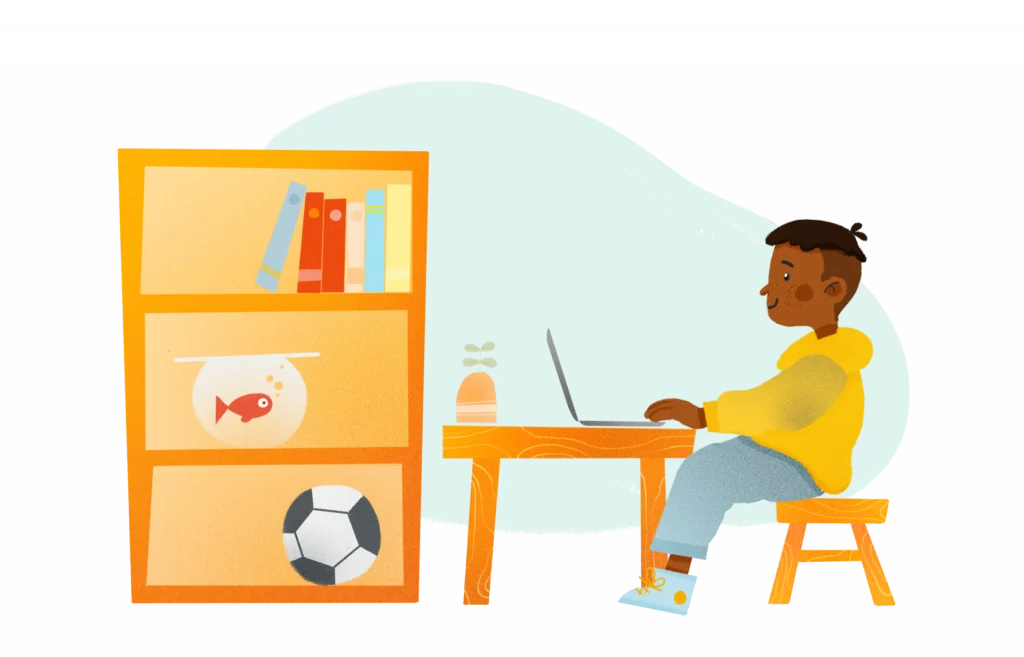
      Meet Our Guest(s):

      Smiling older woman with short white hair, wearing a dark jacket, posed against a plain light background.

      Judith Hochman, Ed.D.

      Judith C. Hochman is the former head of The Windward School and the founder of the Windward Teacher Training Institute in White Plains, New York, as well as the former superintendent of the Greenburgh Graham Free School District in Hastings-on-Hudson, New York. She is the founder of The Writing Revolution, a not-for-profit organization which disseminates evidence-based strategies for writing instruction. Hochman is the author of Basic Writing Skills: A Manual for Teachers and co-author of The Writing Revolution: A Guide to Advancing Thinking Through Writing in All Subjects and Grades (2017, 2024).

      A woman with short, curly blonde hair and light skin wears a white top and earrings, smiling softly at the camera against a neutral background.

      Natalie Wexler

      Natalie Wexler is the author of Beyond the Science of Reading: Connecting Literacy Instruction to the Science of Learning. She is also the author of The Knowledge Gap: The Hidden Cause of America’s Broken Education System—and How to Fix It and the co-author, with Judith C. Hochman, of The Writing Revolution: A Guide to Advancing Thinking Through Writing in All Subjects and Grades. She has a free Substack newsletter called Minding the Gap, and she was the host of Season One of the Reading Comprehension Revisited podcast from the Knowledge Matters Campaign. More information is available at her website, www.nataliewexler.com.
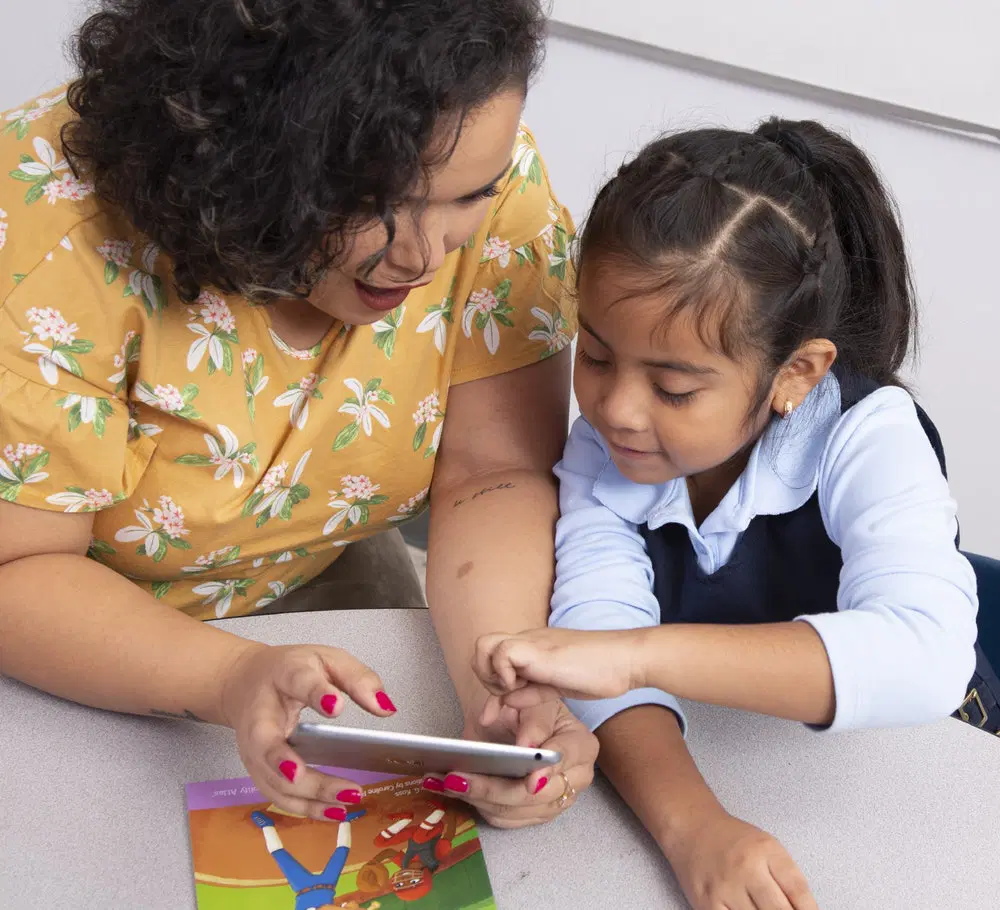
      A woman with short dark hair and glasses, wearing a dark blazer and white shirt, smiles at the camera with a blurred green background.

      Young-Suk Grace Kim, Ed.D.

      Young-Suk Grace Kim, Ed.D., (Harvard University) is a professor at the School of Education, University of California at Irvine. She was a former classroom teacher in San Francisco. Her scholarship focuses on understanding language and literacy development and effective instruction for children from diverse backgrounds. Her areas of research include reading comprehension, reading fluency, listening comprehension and oral language, dyslexia, higher-order cognitive skills, written composition, and reading-writing relations. She has worked extensively with monolingual children and multilingual children from various linguistic backgrounds including English, Korean, Chinese, Spanish, and Kiswahili. Her research has been supported by over $60 million in grants from the Institute of Education Sciences, the U.S. Department of Education, the National Institute of Child Health and Human Development, and the National Science Foundation. Her work was recognized by several awards, including the 2012 Presidential Early Career Award for Scientists and Engineers (PECASE) by former President Barack Obama, the Developing Scholar Award, and the Robert M. Gagne Outstanding Student Research Award. She is an American Educational Research Association (AERA) Fellow, and serves as the editor-in-chief for Scientific Studies of Reading and the chair of the California Reading Difficulties Risk Screener Selection Panel (RDRSSP), appointed by the California State Board of Education.

      A smiling older man with light skin, gray hair, and blue eyes is wearing a blue collared shirt. The background is blurred with autumn leaves visible.

      Steve Graham, Ed.D.

      Steve Graham is a Regents’ and Warner Professor at Arizona State University’s Mary Lou Fulton College for Teaching and Learning Innovation. For 47 years, he has studied how writing develops, how to teach it effectively, and how it can be used to support reading and learning. In recent years, he has been involved in the development and testing of digital tools for supporting writing and reading through a series of grants from the Institute of Educational Sciences and the Office of Special Education Programs in the U.S. Department of Education. His research involves the development of writers with special needs in both elementary and secondary schools, much of which occurs in urban schools. Graham has received many awards for his contributions to literacy and was selected to the Reading Hall of Fame in 2018. He is a fellow of the American Educational Research Association, Division 15 of the American Psychological Association, and of the International Academy for Research in Learning Disabilities.

      Meet our host, Susan Lambert

      Susan Lambert is chief academic officer of literacy at Amplify and host of Science of Reading: The Podcast. Throughout her career, she has focused on creating high-quality learning environments using evidence-based practices. Lambert is a mom of four, a grandma of four, a world traveler, and a collector of stories.

      As the host of Science of Reading: The Podcast, Lambert explores the increasing body of scientific research around how reading is best taught. As a former classroom teacher, administrator, and curriculum developer, Lambert is dedicated to turning theory into best practices that educators can put right to use in the classroom, and to showcasing national models of reading instruction excellence.

      A woman with short, light blonde hair, wearing clear glasses, a black top, and a beaded necklace, smiles at the camera in front of a blurred outdoor background.

      Quotes

      “The Science of Reading encapsulates decades of research about both reading and writing—because if writing was never invented, we would not have to teach kids how to read.”

      —Susan Lambert

      "What we see with exceptional teachers is they have their kids write."

      —Steve Graham, Ed.D.

      “This is not learned by osmosis. And it's not learned by vague feedback like, 'Make it better,' or 'Add more details.' You've got to be very granular.”

      —Judith Hochman, Ed.D.

      Season 7, Episode 8

      Writing your way to better reading, with Steve Graham

      When it comes to literacy education and cross-domain learning, it’s critical to understand the relationship between reading and writing. In this episode, Susan talks to Steve Graham all about writing—and how it can be used to strengthen literacy. Graham served as chair of the What Works Clearinghouse Practice Guides on elementary and secondary writing, and is the current Regents and Warner Professor at Arizona State University. Together, he and Susan discuss ways to support student writing, hindrances to writing development, the importance of teaching handwriting skills, and why writing is essential to any literacy program.

      Meet Our Guest(s):

      Steve Graham

      Steve Graham

      Steve Graham is the Regents and Warner Professor in the division of Leadership and Innovation at Arizona State University’s Mary Lou Fulton Teachers College. For 42 years, he has studied how writing develops, how to teach it effectively, and how it can be used to support reading and learning. In recent years, he has been involved in the development and testing of digital tools for supporting writing and reading through a series of grants from the Institute of Educational Sciences and the Office of Special Education Programs in the U.S. Department of Education. His research involves the development of writers with special needs in both elementary and secondary schools, much of which occurs in urban schools. 

      He has received many awards for his contributions to literacy and was selected to the Reading Hall of Fame in 2018. He is a fellow of the American Educational Research Association, Division 15 of the American Psychological Association, and of the International Academy for Research in Learning Disabilities.

      Meet our host, Susan Lambert

      Susan Lambert is the Chief Academic Officer of Elementary Humanities at Amplify, and the host of Science of Reading: The Podcast. Her career has been focused on creating high-quality learning environments using evidence-based practices. Susan is a mom of four, a grandma of four, a world traveler, and a collector of stories.

      As the host of Science of Reading: The Podcast, Susan explores the increasing body of scientific research around how reading is best taught. As a former classroom teacher, administrator, and curriculum developer, Susan is dedicated to turning theory into best practices that educators can put right to use in the classroom, and to showcasing national models of reading instruction excellence.

      Retrato de una mujer caucásica sonriente con cabello rubio corto, involucrada en un podcast sobre la ciencia de la lectura, con gafas, lápiz labial rojo y un collar de perlas.

      Quotes

      "Kids need to write, they need to write for a variety of purposes. And they also need to write for real reasons, for real audiences."

      —Steve Graham