S2-01: How teachers are really feeling this school year
In this special solo episode, Eric Cross starts the season by sharing his personal journey as an educator, and how the difficulties of the last few years have shaped his mindset going into the upcoming school year. Eric also addresses teacher burnout and what inspires him to continue working as a classroom educator. Explore more from Science Connections by visiting our main page.
Eric Cross (00:02):
Welcome to Science Connection, Season Two. As we begin the next season, I thought it would be a good time to share my story. As the host, I get to ask people questions about their journey, but I’ve actually never shared much about my own. So I’ve taken some of my most frequently asked questions to guests and asked them to myself. I hope you enjoy.
Eric Cross (00:23):
So the origin story question, I think really gets to the heart of why a person does what they do, because so much of who we are, especially as adults and teachers, is a result of experiences that we had in our lives when we were kids or in school with other teachers. And my life’s no different. I was born to a 19-year-old single mom. And when you’re a young boy growing up, especially with a young single mom, you often look to older men in different positions as kinda like a surrogate or like a mentor. And you may not even tell them that they are that to you. You kind of keep it close to the chest. And that’s what I did growing up. One of the ones that really stood out to me is, in seventh grade, I went to a middle school here in San Diego that was called Keiller Middle School. And we were a magnet program that specialized in science. And they had this program that brought professors from the local universities and they did this high-level enrichment. They would even take us to the college campus and we would work in these labs as seventh graders. It was amazing. And one of the people there, his name was Dr. Tress, and he was a professor. And Dr. Tress took a liking to me. I reminded him of his son. We were doing this great embryology experiment. We would take purple sea urchins. And we would inject them with potassium chloride, which would cause them to spawn. And we would fertilize these eggs, and then we would run different experiments using them. And these were things that I had never done before. I had always loved science. I’d always loved tinkering and building things. But this was my introduction, really, to high-level biology and to higher levels of education. I didn’t—I didn’t have many figures like that in my life growing up. I mean, I’m a first-generation, you know, high school, college graduate. Many of these are first generations for me. So, this was a new experience. And so Dr. Tress really unlocked a core memory and was one of my first mentors, as far as academics are concerned. And during my seventh-grade year, I entered the science fair and won first place, which was a huge deal. They took us out to Balboa Park. We got to miss school for a week. We got to go to all the museums for free. It was the best. And I think at that point in time, it really solidified something in me that would lay dormant until later on in my adult life. High school, I was really fortunate: the high school I went to was Morse High School, not too far from Keiller, and they had an aeronautics program. So I was able to enroll in that aeronautics program. And I learned how to fly before I learned how to drive. And I had this great instructor named Mr. Klon, who was this like 6′ 4″, 250-pound hippie guy. And he—we would get in the plane and we would have these like philosophical conversations. And through that, especially looking back now as a teacher, I realized that he was making connections with me and investing into who I was as a person. And it was something that I so needed at the time. Because at home I didn’t have that. You know, my safe place, a lot of time, was school. It was my only structure. It was where I knew I would get encouragement. It was where I knew things were reliable and consistent. For a lot of people, and a lot of kids, their home life isn’t like that. School was that for me. So Mr. Klon, I mean, he was this authentic, you know, consistent person in my life and made a huge difference at this time.
Eric Cross (03:23):
After I graduated high school, I left home just to get away from a difficult environment. And I was homeless for a little while and that was a huge moment in my life. And around that time, an aunt found out and she said, “You’re gonna come stay with us.” And this was like this three-year process of me living with them in this, like, functional family that ate dinner together. And they went to the zoo. They had family passes. And they took family photos at Christmastime. This was all weird stuff. Like, I didn’t know—I didn’t know who did these things. It was—I felt like a puppy that like lived in a home that was like…it was a home that was just always kind of like violent or like just really toxic. And then it gets put into a healthy home and doesn’t know how to act. That’s how it felt. And this was around like 19, 20 years old. During that time I started putting myself through school. So I went to community college and I was broke as a joke. And so I couldn’t afford the textbooks while I was going. So I would just go to the bookstore, the Barnes and Noble bookstore in Mira Mesa here in San Diego. And I would stay there all night using the textbooks or using the books there for doing my work. And then I would just put the books back on the shelves. Because let’s just face it. Textbooks are expensive, brother wasn’t trying to pay for all that. So I really had to earn that time. So I was working full-time. I was going to school. And, eventually I got a job in working in finance with a really great friend who mentored me during my younger twenties. And I didn’t wanna be broke and finance made sense.
Eric Cross (04:44):
And so I did that for a little while, until I got to a point in my career where I was watching an episode of The Office, the UK version, the Ricky Gervais version, and a character said, “I’d rather be at the bottom of a ladder I want to climb than halfway up one I don’t.” And I realized, working in finance, that I was halfway up a ladder I never wanted to climb. So I wanted to move into something that, if I was gonna spend eight hours a day or 10 hours a day doing something, I wanted it to be something that actually filled me up inside. And this is how I got into teaching. So I had always been working with young people, specifically 12- to 18-year-olds, like a non-profit or volunteering, mentoring, after-school programs. And I’ve always managed to rationalize my job in the finance world as meaningful because it let me do the real work that fulfilled me. So the real work was working with the kids. But my day job, my, like, Clark Kent-type job, was just, you know, doing the finance thing of like helping people that have a lot of money make more money. Which at the end of my life, I look back and I said, “That’s not what I want my legacy to be.”
Eric Cross (05:43):
And when the finance crash happened in 2008, that’s when I think I started looking back on it and said, “If I’m gonna spend all my time doing something and spending 40 or 60 or 80 hours of my day of my week doing things, I want it to matter. And that’s when I decided to pivot and leave that field and go and get my master’s in education and get my teaching credential, teaching science specifically. Now, one of the questions we get asked a lot and I’ve been asked is, is “How has teaching changed as a result of the pandemic?” And I feel like this could be several podcasts in and of itself, and it’s also regional, because everybody’s experienced it differently, And we’re still experiencing it! That’s the crazy thing! It’s like, it’s not over, we’re still in it. And some places have innovated and pivoted and some places just did what they needed to and they are trying to go back to business as usual. But if anything has happened, the pandemic revealed how much more, how much schools are more than places of just content learning. For many students it’s where they have their only community, their structure, their emotional wellness. They get regular meals, access to tech, and adults that care about them that are outside of their family. The schools are so much more than that. I mean, my school, they were a place, like a hub, that was giving out food every single day during the pandemic to families that would kind of drive by. So for a lot of schools, they became places like that. It also…the pandemic revealed the intensity of the educator workload. I mean, being able to manage your family, having the capacity, to be a content expert, you need to be a counselor, a trauma-care specialist, a coach, an encourager, a tech expert.
Eric Cross (07:23):
I mean, the term mental health is now more common and starting to become prioritized. Now we’re focusing so much more on the whole child. And we know from research that how a child feels about themselves and their safety and their security impacts their ability to learn. So the more comfortable and safe a student feels in the classroom with teachers and with friends, the better they’re gonna be able to learn. And ultimately the higher they’re gonna be able to achieve. You can’t, you can’t have one without the other. In addition, I think less teachers, see themselves teaching into retirement. I think that’s a big thing. I read these articles about teacher shortages and I think the reality is it’s actually teacher exodus. It’s teachers leaving. And that’s been really difficult. I’ve had many friends who’ve left for the private sector. And I get it, especially if you’re one that has—if you’re the first in your family to graduate from college, with a STEM degree, to them taking a teaching position can mean walking away from a salary in the private sector that pays two or three times more.
Eric Cross (08:23):
And in many places around the country, in order to be a teacher and maintain a median standard of living, you need either dual income, multiple jobs, or a multi-generational household. For a lot of people it just doesn’t make sense. And even right now, today, as I’m recording this, I’m reading articles and getting text messages…and I received a text message three days ago from a teacher that said, “My goal this year is to just not resign.” And that’s where a lot of teachers are feeling right now: isolated, challenged, and under-appreciated. And Plato said, “What’s honored in a country is cultivated there.” And I’ve been looking at how teachers are honored and one of the ways is just, like, practical. Like, look, I gotta pay my bills. You know, love the Starbucks gift card. Love the CPK, the gift card. The cards, all those other things…but brother got a car payment. And at the end of the day, if we care about our kids, we need to take care of the people that take care of them. And there’s very practical ways for that to happen. And everybody in different sectors around the country is dealing with that in different ways. I think the pandemic also revealed, now the public can see how our kids don’t receive the same quality of education. And once you’re aware of that, you can’t put the genie back in the bottle. So once you see on Zoom or once you see in a meeting, or once you see on the news, that students in different areas, whether it’s the rural South or a suburb in Seattle, are not getting equitable educations, well, ultimately that impacts all of us. Now. It’s not all doom and gloom. Good things have come from, as a result of, the pandemic. Many schools have made progress towards narrowing the technology gap, ’cause they had to! ‘Cause you can’t do Zoom and you can’t do Google Meet and all that stuff with a packet! You gotta get those Chromebooks. And Chromebooks and the internet and access to tech is not a new thing. It’s been out for a long time. The technology gap is not a new thing. It’s been written about extensively, but all of a sudden districts and schools started figuring out how to close that gap. And that’s awesome. We didn’t want a pandemic to be the catalyst for that to happen. But at the end of the day, we started closing it. A lot of schools did an amazing job and districts did an amazing job with deploying the hardware, sending out buses with wifi, putting lessons and videos on USB sticks and dropping them off to parents who live in sparsely populated areas. I mean, there were so many stories that I’ve heard about schools and teachers just doing amazing things, going above and beyond what they needed to on behalf of kids.
Eric Cross (10:51):
I think in addition to that, there’s also been students and families are now having more options to personalize their learning. So we have this in-person model, we have this Zoom or kind of online model, and this hybrid model, and it hasn’t all been perfect, you know, at all. But some families have come out and said, you know what actually doing this hybrid model is better for my son or better for my daughter or better for my student, because they’re able to get the socialization, but also able to focus better at home than they are in a classroom of 36. And that’s legitimate. You know, we talk about personalized learning, but it’s not exactly personalized when everybody has to wake up at the same time, same schedule, go to the same, the same classroom of, you know, up to 40 kids, and do the same lesson. I mean, we have to be honest about our limitations with personalizing learning for students. And when we can provide more options and we give teachers the infrastructure to be able to use different platforms, then we’re able to personalize learning a lot more.
Eric Cross (11:51):
There’s also been an emphasis on the whole-child wellness. I think the spotlight on mental well-being heavily impacts their academic success, but counseling teams, social workers, school psychologists—I think more than ever we’ve realized the value that they bring to the schools. And unfortunately many of them have caseloads of 200 students or more. And they’re seeing students most often that are in crisis. And especially after the pandemic, we’re realizing how valuable they are and how much we need to, one, honor them and give them the support that they need, and also recruit more. Because as we start recognizing how our brains are impacted by the things that we’re dealing with, we’re also gonna see how that’s gonna impact our students’ performance. And we need the specialists in those positions to be able to support our kids. I think, last, I think more innovation and lesson design and how we assess students. And so we’ve been talking about in education just kind of critiquing: how do we assess what a student knows? How do we make what a student actually does at school relevant to real life? I mean, so many times I have students who’ve graduated that are like, “I feel like the things I learned in school, like, they’re not always transferable to real life. It helped me on a test, but like, I don’t know how to do my taxes.” Or “I memorized these facts, but I don’t really apply it in my job.” Or “The facts that I learned I could have actually learned on the fly in my job. I wish I would’ve actually focused on the skills or had an earlier opportunity to get some experience because when I’m trying to apply for a job, <laugh> they ask for experience and I’m 22 years old.”
Eric Cross (13:28):
And so all these things kind of come up. And so I think there’s been some great conversations around “how do we rethink what education looks like?” And there’s different pockets around the country that have been doing that, I think, really well. And I think it’s important for us as teachers to stay connected to those people who are kind of pushing the boundaries and thinking outside the box, because when we get siloed, it’s really easy to get calcified and cynical. I get it. And it impacts me too. But when we’re around those people who have those fresh ideas, who are really pushing the limits, it inspires us. And that’s something I think during the pandemic that I’m grateful that I was intentional about, is staying connected with other teachers. There’s a big question; Why do you continue your work in the classroom and what keeps you motivated? And I was thinking really hard about this question, because depending on <laugh>, depending on my day, I feel like my answer’s gonna be a little bit different. So I’ve had to step back from this 30-foot, thousand-foot perspective and answer the question. And my answer is this: I think because I still feel like I can be effective to influence positive change in my classroom with my students and within the larger education system as a whole. I think if I lost either of those two, then I’d rethink my profession. Look, I’m an innovator. I like asking “why” questions and things like that. And I’m not always the most popular person when you do that. But education is like just a huge ship. It doesn’t pivot on a dime. And asking why questions and pushing for change on behalf of kids isn’t easy, fun, or glamorous, but it’s it’s necessary. And I feel like over the last few years, I’ve been able to see these kind of glimmers of a trajectory change, at least where I am locally. And that’s something that has given me a lot of hope. I’m very fortunate to be connected to educators and people in leadership that are really about making a difference beyond just kind of the cliched platitudes. They actually wanna make systemic change, in a way that’s positive. And that’s been really helpful for me. So as long as I feel like I’m useful in the classroom for students, and as long as I feel like I’m bringing, I think change, on behalf of teachers and students and administrators and our community in a way that moves the ball down the field, that’s what keeps me motivated. And what I like to ask teachers when I close in the podcast is. “What teacher or teachers have inspired you?”
Eric Cross (15:54):
And for me, I think it would start off with the teachers who cared about me when they didn’t have to, in elementary school all the way through college. And there are numerous teachers. My science-teacher community of practice. For the last two years, I’ve been fortunate to spend every month, once a month, meeting with just a core group of science teachers that really care about some of the things that we are impacted by in the classroom. And when the pandemic was going on, we still met regularly. And because we’re not all teaching in the same place, we kind of were able to bring different perspectives to the table. I think the current classroom teachers and former classroom teachers that I have in my community really inspire me. The ones who are dedicated to opening doors for students. The graduate students that I teach at the University of San Diego, they keep me fresh. I love leaving teaching my 12- and 13-year-olds, and then driving down the street to the university and teaching 20somethings who are all about to be in the classroom. They come with new ideas, they’re asking questions, and I get to actually share things that I just did three hours ago. I think that’s one thing that continues to inspire me. And it’s one of the reasons why I love teaching at the University of San Diego. Their energy and enthusiasm is super-refreshing. And then all the teachers that are willing to take risks and fail forward, to try things different, to ask hard questions, to push the envelope. Teaching’s hard. It’s easy to point out the problems in education as a whole. But after we do that, it’s important to figure out the practical ways we can make the changes that we wanna see.
Eric Cross (17:23):
Now, that’s to say that if you have the capacity for it and the resources and the support. Some of us, we don’t. Some of us, we are on an island, and that’s a really, really difficult place to be, especially when you have family and kids to take care of. And you have to make decisions on what’s best for you and for your own students. We do this work on behalf of kids. And it’s one of the most honorable services a person can provide to our community. But one area for growth that I think we have kind of as a society, is teachers spend their lives, daily, on behalf of the future of our country. For other people’s children. They fall asleep at night worrying about other people’s kids. They spend their own money to create opportunities and experiences that students might not otherwise have. And it’s important that we collectively, and I know I’m preaching the choir when I say this, but this is one of my messages, is that we honor them in turn. We create programs that allow them to be able to afford housing. We create opportunities for them to be able to generate wealth. We create ways for them to be able to find rest, to get connection. And then internally we create systems where they can just work on themselves, fill themselves, get trained, and be whole, so they can bring their best self to the kids in front of them. That’s one of my personal platforms. It’s something that I think is vital. We gotta take care of the people that take care of our kids. So there’s a saying that says, “It’s better to light a candle than to curse the darkness.” And it takes one person to blow out a candle, but one candle can light thousands of other candles, without diminishing its own light. And that’s what we have to be. So my encouragement, teachers, as you’re going into this new school year, and you’re thinking about what’s going on, you’re thinking about all the challenges—and they’re there, and they’re real, and trust me, it’s not like some Pollyanna, like, “Hey, just be positive!” mindset and everything’s gonna be great—no, no, no, no, no. It’s not that. But my encouragement…if I can tell you one thing that’s helped me more than anything else, it’s being connected to other people who are candle-lighters. Because there are a lot of places that are gonna blow out the candle. It could be the staff lounge. It could be Twitter, it could be Reddit. It could be Instagram. It could be TikTok. It could be, you know, anybody. Someone next door to you. There’s a lot of folks that are gonna be willing to point out and say, “Look, this is what’s wrong.” But find the helpers. Find the people that are candle-lighters. And stay connected with them. Find that community. I can tell you for me, that’s been the thing that’s been able to help me sojourn through all of this—I couldn’t do this by myself—is being able to share my story with other teachers and knowing that I’m doing this work alongside of other folks who are doing this work, and I can share my story with them and listen to their stories, is something that’s been able to fill my cup. And so I hope I can do the same for you and for other people listening to other people I come in contact with.
Eric Cross (20:08):
Teachers, I wish you a great school year. Hang in there. Be those candle-lighters and bring your best self on behalf of the students. Thanks so much for listening. Now, we wanna hear more about you. If you have any stories you wanna share about the classroom, please email stem@amplify.com. That’s STEM at amplifycom.wpengine.com. And make sure to click subscribe wherever you listen to podcasts. And join our Facebook group, Science Connections: The Community. Until next time.
Stay connected!
Join our community and get new episodes every other Tuesday!
We’ll also share new and exciting free resources for your classroom every month.


Meet the guest
Eric Cross is a 7th grade science/technology teacher, grade level lead, and digital learning innovator for Albert Einstein Academies, International Baccalaureate schools. He is also an adjunct professor of learning and technology at the University of San Diego and a Google certified innovator. Eric earned a bachelor’s degree from Azusa Pacific University and a Master of Education from the University of San Diego. He had 17 years of experience working with at-risk youth and underserved populations before becoming a middle school teacher. By building relationships with students, colleagues, and the community, he has become an empowered leader in and out of the classroom. Through meaningful learning experiences centered around student agency, STEM has become accessible to students through highly engaging lesson design, thoughtful integration of digital tools, and culturally relevant pedagogy.

About Science Connections
Welcome to Science Connections! Science is changing before our eyes, now more than ever. So…how do we help kids figure that out? We will bring on educators, scientists, and more to discuss the importance of high-quality science instruction. In this episode, hear from our host Eric Cross about his work engaging students as a K-8 science teacher. Listen here!



Welcome to your Amplify Science California pilot!
We’re thrilled to welcome you to the Amplify family, and we look forward to making your experience with Amplify Science California successful from day one.
On this site, you’ll find resources, tips, videos, and other helpful information designed to support you throughout your pilot experience.


Tips for getting started successfully
It takes time to learn any new program and get used to its patterns and flow—time that you aren’t always afforded in a pilot situation. Based on our work with thousands of pilot teachers who are now happy users, we can tell you with 100% confidence that it gets easier. In no time, you’ll be preparing and delivering all your lessons with ease.
Until you become comfortable with the organization of each unit and how one lesson flows into the next, the following resources will be key in helping you prepare to teach your first unit.
Unit Guide
These short and sweet guides provide a big picture overview of each unit’s phenomenon and storyline, the key questions that guide learning, and how the storyline develops from chapter to chapter. We even spoil the big reveal at the end by pointing out ahead of time what students figure out throughout the unit.
Ready to download? Navigate to your grade level using the menu bar above, scroll to the Unit Types section, and then download the appropriate Unit Guide(s).

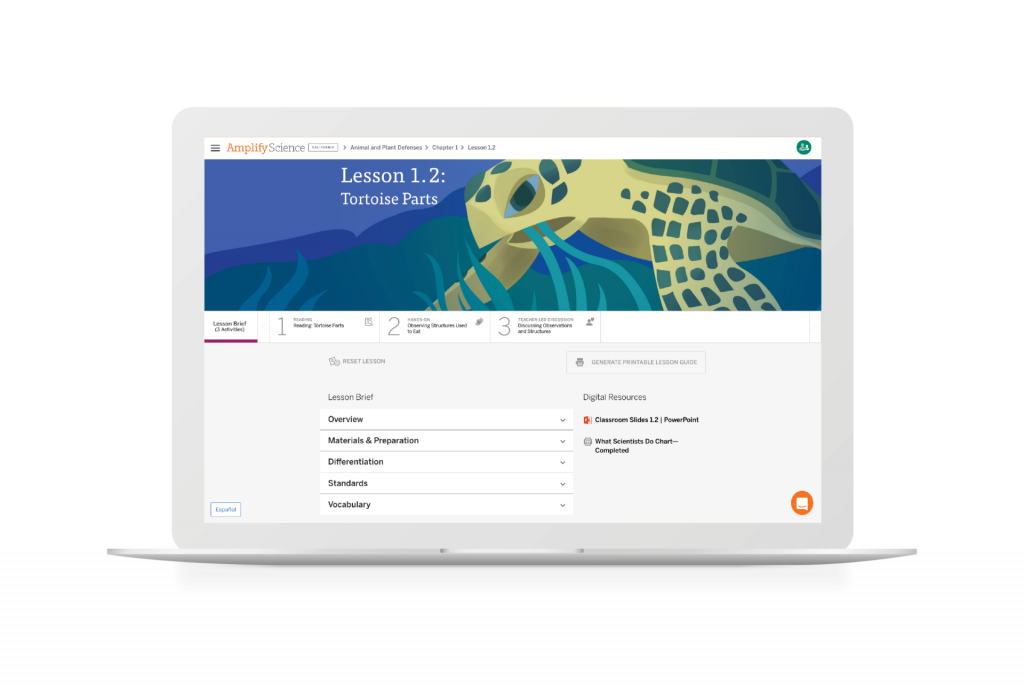
Lesson Overview
Reading this short summary is a great way to get a quick snapshot of the learning that will take place during the day ahead. It includes a short description of the lesson, student learning objectives, and an at-a-glance list of activities.
Where to find it? Log into the digital Teacher’s Guide and navigate to the lesson you want to teach by following this click path: Grade Level > Unit > Chapter > Lesson. Next, scroll to the Lesson Brief section and click Overview. This same information is also found in your printed Teacher’s Reference Guide.
Material and preparation tips
Also found in the Lesson Brief section of your digital Teacher’s Guide and printed Teacher’s Reference Guide is a complete list of materials that you’ll need to gather as well as step-by-step lesson preparation tips organized by:
- Before the Day of the Lesson
- Immediately Before the Lesson
- At the End of the Day


3-D Statements
Color-coded for easy readability and quick scanning, our 3-D Statements can be found at point-of-use for every unit and lesson, making it easy to pinpoint the exact SEPs, DCIs, and CCCs that will be targeted on any given day.
Where to find them? Log into the digital Teacher’s Guide and navigate to any Unit Guide or Lesson Brief and click the expandable box called 3-D Statements. A complete list of 3-D Statements can also be found in the back of any printed Teacher’s Reference Guide.
Coherence Flowcharts
These are another great tool for helping you visualize the flow of a unit and the connections between the questions that drive students’ experiences and:
- The evidence they gather
- The solutions they figure out
- The new questions they generate
Where to find them? Log into the digital Teacher’s Guide, navigate to your desired unit, scroll to the Unit Guide, and look in the Printable Resources section.


Support is always within reach
Your role as a pilot teacher is important. Your district is counting on you not only to evaluate how Amplify Science California works in your classroom, but also to pick a reliable and supportive long-term partner. We feel confident that we’re that partner, and we look forward to proving that to you during your pilot experience.
Just as it will be when you become a customer, support during your pilot will always be within reach through the following channels.
Pilot support coordinator
Your dedicated pilot support coordinator has extensive experience delivering training, rostering students, answering both pedagogical and technical questions, and delivering demonstration lessons. Said another way, he or she is here to help. So, don’t hesitate to reach out.
Who is my pilot support coordinator? Look for his or her contact information in the pilot support brochure that you received during your pilot implementation training.

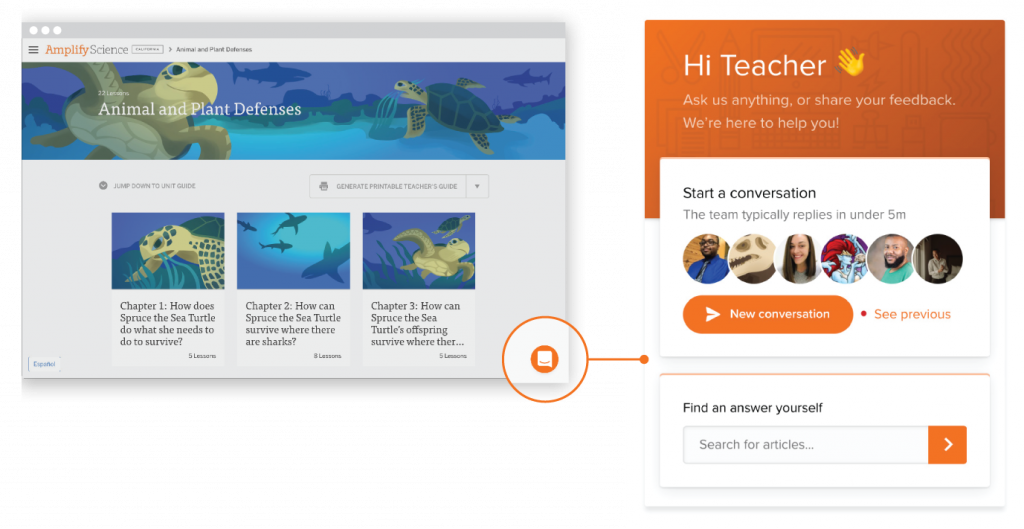
Intercom chat
In addition to traditional lines of communication, our Intercom feature gives you the ability to chat with our customer support, technical support, and pedagogical support teams in real time directly from the digital platform. This ensures that issues that arise in the classroom can be addressed as quickly as possible.
Support teams can be reached from 4 a.m. to 4 p.m. PST, Monday through Friday.
Our customer support, technical support, and pedagogical support teams can also be reached by email at help@amplify.com.
Support teams can be reached from 4 a.m. to 4 p.m. PST, Monday through Friday.

Welcome to your Amplify Desmos Math Pilot!
We’re thrilled to welcome you to the Amplify family, and we look forward to making your experience with Amplify Desmos Math successful from day one.
On this site, you’ll find resources, tips, videos, and other helpful information designed to support you throughout your pilot experience.

Tips for getting started
It takes time to learn any new program and get used to its patterns and flow—time that you aren’t always afforded in a pilot situation. Based on our work with pilot teachers who are now happy users, we can tell you with 100% confidence that it gets easier. In no time, you’ll be preparing and delivering all your lessons with ease.
As you get comfortable with the organization of each unit and the ways one lesson flows into the next, you’ll find the following resources helpful.
Helpful links for getting started
Support resources you may want to use during your pilot

Want to learn more from Amplify experts?
Amplify offers a wide variety of learning opportunities outside our pilot meeting times:
Our math webinar library hosts all our past sessions.
Our Events page is where you can search for and register to attend upcoming math webinars.
The Amplify Blog is a great resource for helpful articles and research-based information.
NYC Solves Regents Prep A1
Hello NYC high school math educators!
Welcome to Amplify Desmos Math NYC Solves Regents Prep A1. This sequence of lessons is specifically designed for students who passed Algebra 1 in eighth grade but did not pass the NYS Regents exam in June. The instructional resources are accessed through the Amplify Desmos Math platform, affording students a highly engaging experience to prepare them for the January administration of the Regents by reinforcing conceptual understanding.
On this site, you’ll find a variety of resources to guide you in learning more about the course and how to get started.
Ready to jump in? This quick start guide will help you take the first steps to get started. Remember to use your NYCDOE email for access.


About Amplify Desmos Math
Amplify Desmos Math 6–A1 is based on the highly rated IM K–12™ curricula from Illustrative Mathematics, with extensive enhancements that include teacher supports, interactivity, assessments, and reporting.
The program is aligned with the expectations outlined in the New York City Department of Education Definition of Culturally Responsive-Sustaining Education and the New York State Culturally Responsive-Sustaining Education Framework.
Your NYC Solves Regents Prep A1 course uses key lessons and activities from Amplify Desmos Math to prepare students for the A1 Regents.
NYC webinar series
Figuring out how to implement a problem-based learning approach to mathematics can be fun—and challenging. Rest assured that you will not be alone on this journey. Amplify will be by your side every step of the way. Our back-to-school math webinar series for K–8 administrators and teachers:
- Introduces the new NYC Solves initiative.
- Establishes the foundation for all educators to effectively understand and implement the NYCPS Shifts in Mathematics in their classrooms.
- Provides an overview of Amplify Desmos Math, the pre-approved NYCPS curriculum chosen to ensure every school can successfully implement these math shifts and is supported with high-level, tailored professional development and coaching throughout the process.
Please see the specific webinars and the recordings below to learn more!
On-demand webinar 1
[Aug. 29 and Sept. 3, 2024]
Would you like to learn more about the NYCPS Shifts in Mathematics and enhance your understanding of each of the five shifts?
Explore how the NYCPS math shifts are transforming mathematics education from a procedural approach to a more engaging, discoverable, and connected learning experience.
Listen to the Understanding the NYCPS Shifts in Mathematics session recording.
On-demand webinar 2
[Sept. 10 and Sept. 12, 2024]
Let’s unpack the why, what, and how to unlock every student’s mathematical mind and build math proficiency for life! In this webinar, we discuss the power of teaching our children to be skilled mathematicians through a structured approach to problem solving
Listen to the Unlocking Mathematical Minds: A Structured Approach to Problem-Based Learning session recording.
On-demand webinar 3
[Sept. 17 and Sept. 19, 2024]
For some educators, transitioning to problem-based learning might seem daunting. There is often concern that its open-ended nature could derail students from achieving mathematical goals. However, by finding the right balance between open-ended opportunities and structured classroom activities, students can be encouraged to share their thinking while meeting key learning targets. Uncover simple shifts that educators can implement to foster open-ended student thinking while maintaining focus on mathematical instructional goals.
Listen to the Making the Shift to Problem-Based Learning session recording.
Live webinar 4
[Oct. 1 and Oct. 3, 2024]
Learn More and Experience Amplify Desmos Math LIVE, an NYCPS Approved Math Curricula.
This is the final session of the series. Amplify Desmos Math New York K–A1 is math that motivates! During this session, you’ll experience a Grade 6 lesson that captures the essence of NYC Solves.
Choose from two convenient times and register below:
- Oct. 1, 2024, 9:15–10:15 a.m. EDT
- Oct. 3, 2024, 3:15–4:15 p.m. EDT
Program features to know

Desmos Classroom digital lessons
Digital lessons should be powerful in their ability to surface student thinking and spark interesting and productive discussions. We’ve joined forces with Desmos Classroom to bring this vision to life with a complete library of interactive, collaborative lessons.

Engaging student experience
Relevant content and interactive math tools create an intuitive and engaging student experience. Plus, working together in real-time allows students to see that communicating their ideas and learning from each other are important parts of math class.

Visibility into student thinking
Imagine having more visibility into your students’ mathematical thinking. Now imagine students have access to this same information. With our collaborative lesson interface and teacher dashboard, students stay engaged. What’s more, they have visibility into the thinking of their peers—exposing them to a wider variety of approaches to solving the same problem.

Ready-to-teach lessons
The two tracks for scope and sequence include ready-to-teach lessons to prepare students for the A1 Regents. Lessons come complete with slides, step-by-step teaching notes, suggested student and teacher responses, tips for incorporating instructional routines, support for developing mathematical language, and links to useful resources. Teachers can also control what slides students see, giving teachers the ability to control the pace of the lesson to suit the needs of the class.
Planning for instruction
To start using the program quickly in your classroom, check out the following onboarding videos, guide, and planning resources. They cover what you need to know to get going fast.
Amplify Desmos Math Regents Prep Course Session I
NYC Solves Regents Prep A1 is customized specifically to meet the needs of students in ninth grade preparing for the Algebra 1 Regents exam. Within each document below, you’ll find the scope and sequence with course structure and lessons.

Logging in to access the program
Login instructions:
- Teachers: Log in with Amplify steps 1–3 and steps 4–6 or TeachHub (district-preferred login method)
- Administrators: Log in with Amplify or TeachHub (district-preferred login method)
- Students: Log in with Amplify steps 1–3 and steps 4–6 or TeachHub (district-preferred login method)
Questions? Check out this Tech FAQ for more information.
Additional support:
- How to navigate the platform
- How to reset student(s) password
- How to log my class out of a shared device
- Clever class logout instructions

Lesson Sampler
Amplify Desmos Math delivers the instructional power of student-centered learning in a lesson format that’s teacher-friendly and manageable.
With easy-to-follow instructional support, implementing a problem-based program is effective and enjoyable for both you and your students. Paired with the Desmos Classroom digital experience, math class becomes fun and dynamic, with plenty of opportunities for students to talk through their reasoning, work with their peers, and gain new understanding.


Additional features
Universal design
Every student is brilliant, and every student has brilliant mathematical ideas worth sharing and cultivating. Incorporating principles of Universal Design for Learning (UDL) into lessons brings students’ brilliance to the forefront. UDL is a research-based framework designed to ensure that all learners can access and participate in meaningful, challenging learning opportunities.

Diversity and representation
Helping students develop strong, healthy, and flexible math identities is a cornerstone of our program. Throughout the curriculum, students are taught that they themselves are mathematicians, that today’s math has been shaped by a diverse range of mathematicians who deserve to be celebrated, and that learning is never finished.

Assessments
Less exciting, but essential for learning: assessments. Amplify Desmos Math features a robust variety of formative and summative assessments, including readiness checks, exit tickets, quizzes, end-of-unit tests, and benchmarks aligned with New York State Next Generation Mathematics Learning Standards.
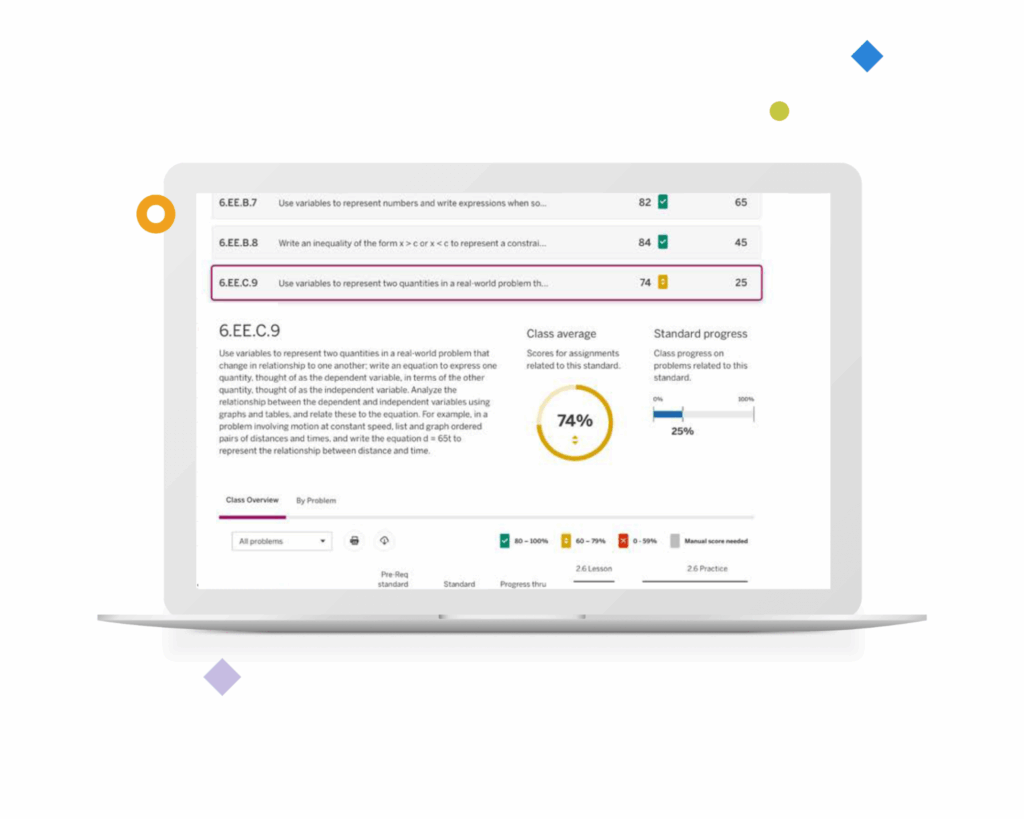
Reporting
Not only do our reports reveal progress toward standard mastery, they also include details on how students performed against the standard in the past and how many encounters are yet to come. This feature alone helps teachers prioritize instruction and intervene with additional resources when necessary.
Looking for help?
Throughout your implementation, you can reach our support team by live chat, phone, or email Monday through Friday,
7 a.m. to 7 p.m. ET.
- Chat: Click the orange icon while logged in to get immediate help.
- Phone: Call our dedicated support line for NYCPS (888) 960-0380.
- Email: Send an email to help@amplify.com. In the message body, please include your name and question. Provide as much detail as possible, so we can help you find a solution.

Welcome to your Amplify Science California pilot!
We’re thrilled to welcome you to the Amplify family, and we look forward to making your experience with Amplify Science California successful from day one.
On this site, you’ll find resources, tips, videos, and other helpful information designed to support you throughout your pilot experience.
Tips for getting started successfully
It takes time to learn any new program and get used to its patterns and flow—time that you aren’t always afforded in a pilot situation. Based on our work with thousands of pilot teachers who are now happy users, we can tell you with 100% confidence that it gets easier. In no time, you’ll be preparing and delivering all your lessons with ease.
Until you become comfortable with the organization of each unit and how one lesson flows into the next, the following resources will be key in helping you prepare to teach your first unit.
Unit Guide
These short and sweet guides provide a big picture overview of each unit’s phenomenon and storyline, the key questions that guide learning, and how the storyline develops from chapter to chapter. We even spoil the big reveal at the end by pointing out ahead of time what students figure out throughout the unit.
Ready to download? Navigate to your grade level using the menu bar above, scroll to the Unit Types section, and then download the appropriate Unit Guide(s).
Lesson Overview
Reading this short summary is a great way to get a quick snapshot of the learning that will take place during the day ahead. It includes a short description of the lesson, student learning objectives, and an at-a-glance list of activities.
Where to find it? Log into the digital Teacher’s Guide and navigate to the lesson you want to teach by following this click path: Grade Level > Unit > Chapter > Lesson. Next, scroll to the Lesson Brief section and click Overview. This same information is also found in your printed Teacher’s Reference Guide.
Material and preparation tips
Also found in the Lesson Brief section of your digital Teacher’s Guide and printed Teacher’s Reference Guide is a complete list of materials that you’ll need to gather as well as step-by-step lesson preparation tips organized by:
- Before the Day of the Lesson
- Immediately Before the Lesson
- At the End of the Day
3-D Statements
Color-coded for easy readability and quick scanning, our 3-D Statements can be found at point-of-use for every unit and lesson, making it easy to pinpoint the exact SEPs, DCIs, and CCCs that will be targeted on any given day.
Where to find them? Log into the digital Teacher’s Guide and navigate to any Unit Guide or Lesson Brief and click the expandable box called 3-D Statements. A complete list of 3-D Statements can also be found in the back of any printed Teacher’s Reference Guide.
Coherence Flowcharts
These are another great tool for helping you visualize the flow of a unit and the connections between the questions that drive students’ experiences and:
- The evidence they gather
- The solutions they figure out
- The new questions they generate
Where to find them? Log into the digital Teacher’s Guide, navigate to your desired unit, scroll to the Unit Guide, and look in the Printable Resources section.
Support is always within reach
Your role as a pilot teacher is important. Your district is counting on you not only to evaluate how Amplify Science California works in your classroom, but also to pick a reliable and supportive long-term partner. We feel confident that we’re that partner, and we look forward to proving that to you during your pilot experience.
Just as it will be when you become a customer, support during your pilot will always be within reach through the following channels.
Pilot support coordinator
Your dedicated pilot support coordinator has extensive experience delivering training, rostering students, answering both pedagogical and technical questions, and delivering demonstration lessons. Said another way, he or she is here to help. So, don’t hesitate to reach out.
Who is my pilot support coordinator? Look for his or her contact information in the pilot support brochure that you received during your pilot implementation training.
Intercom chat
In addition to traditional lines of communication, our Intercom feature gives you the ability to chat with our customer support, technical support, and pedagogical support teams in real time directly from the digital platform. This ensures that issues that arise in the classroom can be addressed as quickly as possible.
Support teams can be reached from 4 a.m. to 4 p.m. PST, Monday through Friday.
Our customer support, technical support, and pedagogical support teams can also be reached by email at help@amplify.com.
Support teams can be reached from 4 a.m. to 4 p.m. PST, Monday through Friday.
Welcome to your Amplify Science pilot!
We’re thrilled to welcome you to the Amplify family, and we look forward to making your experience with Amplify Science successful from day one.
On this site, you’ll find resources, tips, videos, and other helpful information designed to support you throughout your pilot experience.


Tips for getting started successfully
It takes time to learn any new program and get used to its patterns and flow—time that you aren’t always afforded in a pilot situation. Based on our work with thousands of pilot teachers who are now happy users, we can tell you with 100% confidence that it gets easier. In no time, you’ll be preparing and delivering all your lessons with ease.
Until you become comfortable with the organization of each unit and how one lesson flows into the next, the following resources will be key in helping you prepare to teach your first unit.
Lesson Overview
Reading this short summary is a great way to get a quick snapshot of the learning that will take place during the day ahead. It includes a short description of the lesson, student learning objectives, and an at-a-glance list of activities.
Where to find it? Log into the digital Teacher’s Guide and navigate to the lesson you want to teach by following this click path: Grade Level > Unit > Chapter > Lesson. Next, scroll to the Lesson Brief section and click Overview. This same information is also found in your printed Teacher’s Reference Guide.
Material and preparation tips
Also found in the Lesson Brief section of your digital Teacher’s Guide and printed Teacher’s Reference Guide is a complete list of materials that you’ll need to gather as well as step-by-step lesson preparation tips organized by:
- Before the Day of the Lesson
- Immediately Before the Lesson
- At the End of the Day
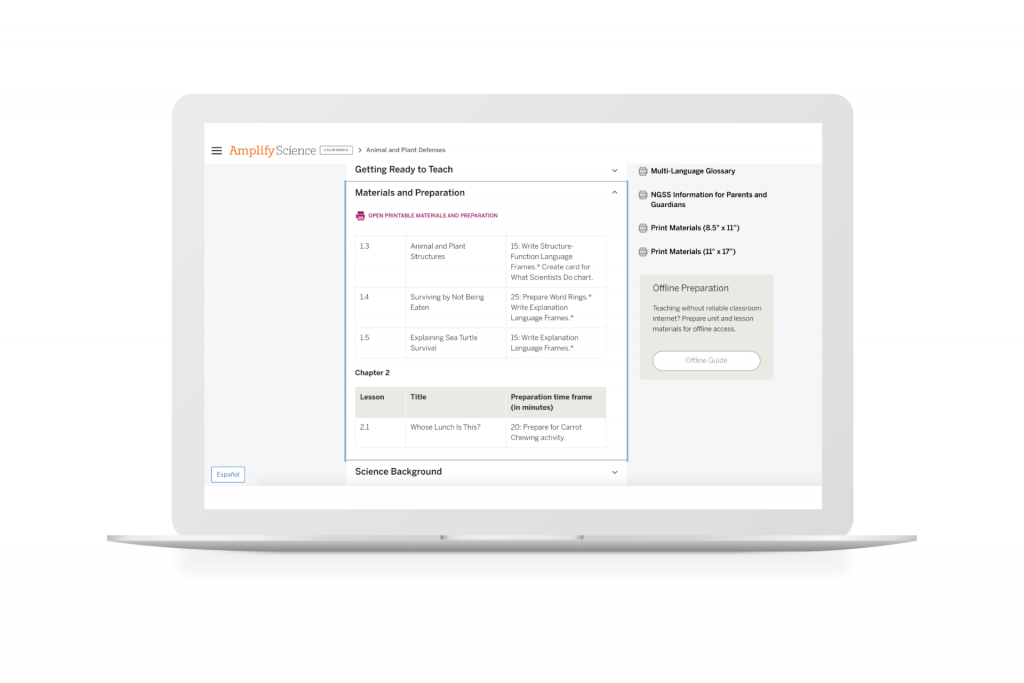

3-D Statements
Color-coded for easy readability and quick scanning, our 3-D Statements can be found at point-of-use for every unit and lesson, making it easy to pinpoint the exact SEPs, DCIs, and CCCs that will be targeted on any given day.
Where to find them? Log into the digital Teacher’s Guide and navigate to any Unit Guide or Lesson Brief and click the expandable box called 3-D Statements. A complete list of 3-D Statements can also be found in the back of any printed Teacher’s Reference Guide.
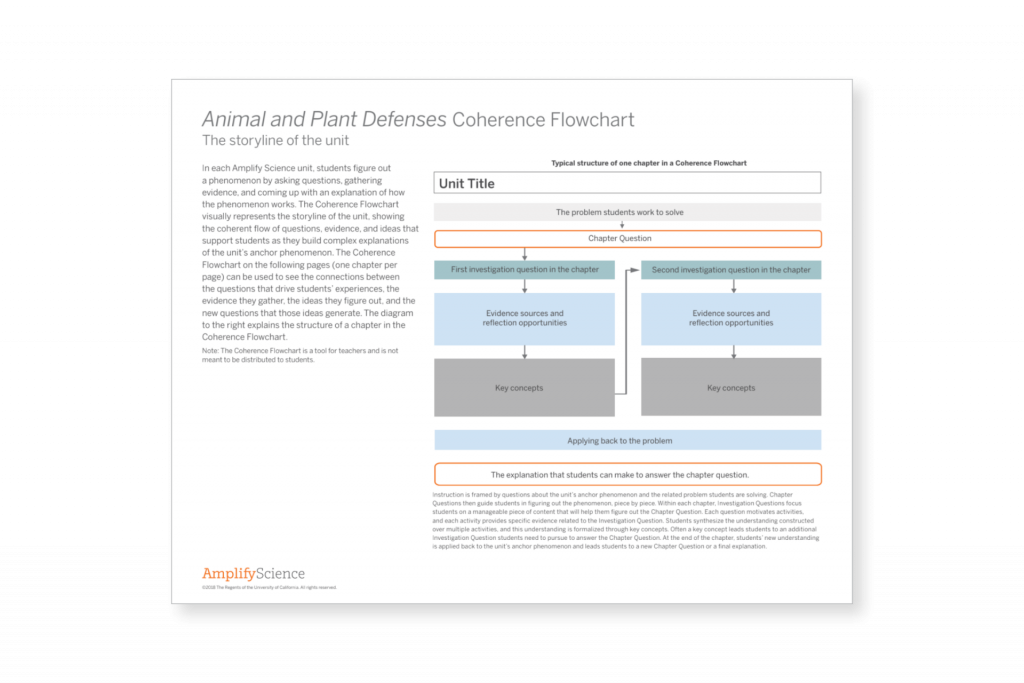
Coherence Flowcharts
These are another great tool for helping you visualize the flow of a unit and the connections between the questions that drive students’ experiences and:
- The evidence they gather
- The solutions they figure out
- The new questions they generate
Where to find them? Log into the digital Teacher’s Guide, navigate to your desired unit, scroll to the Unit Guide, and look in the Printable Resources section.
Support is always within reach
Your role as a pilot teacher is important. Your district is counting on you not only to evaluate how Amplify Science works in your classroom, but also to pick a reliable and supportive long-term partner. We feel confident that we’re that partner, and we look forward to proving that to you during your pilot experience.
Just as it will be when you become a customer, support during your pilot will always be within reach through the following channels.
Pilot support coordinator
Your dedicated pilot support coordinator has extensive experience delivering training, rostering students, answering both pedagogical and technical questions, and delivering demonstration lessons. Said another way, he or she is here to help. So, don’t hesitate to reach out.
Who is my pilot support coordinator? Look for his or her contact information in the pilot support brochure that you received during your pilot implementation training.

Intercom chat
In addition to traditional lines of communication, our Intercom feature gives you the ability to chat with our customer support, technical support, and pedagogical support teams in real time directly from the digital platform. This ensures that issues that arise in the classroom can be addressed as quickly as possible.
Support teams can be reached from 4 a.m. to 4 p.m. PST, Monday through Friday.
Our customer support, technical support, and pedagogical support teams can also be reached by email at help@amplify.com.
Support teams can be reached from 7 a.m. to 7 p.m. EST, Monday through Friday.

Creating lasting change in K–5 math and literacy instruction

Transforming math and literacy education takes more than just tips and tricks—it requires vision, commitment, and the right support. Whether you’re rethinking early literacy skills instruction, refining math core curriculum, or fostering a culture of collaboration, you need strong leadership and proven strategies for real change to occur.
“Sustained, meaningful change doesn’t happen overnight,” said Kymyona Burk, Ed.D., a senior policy fellow at ExcelinEd and the keynote speaker at our recent Leading With Vision symposium. “It requires commitment, collaboration, and a clear vision for supporting both educators and students.”
At the symposium—which included keynotes, panels, and math and literacy tracks—education experts from across the country shared experiences navigating instructional shifts, leading curriculum implementation, and setting schools up for success. From building buy-in to making data-driven decisions, their actionable insights can empower you with the knowledge and tools to create lasting change in your district.
Read on for a recap of the core presentations. You can also watch or listen along—and, for extra credit, download the workbook to deepen your learning.
Opening keynote: Key Factors for Successful Transformation in Literacy and Math
Kymyona Burk, Ed.D.
Senior Policy Fellow, ExcelinEd
In her session, Kymona Burk made the case that real student learning progress in literacy and math doesn’t come from policy alone—it requires systemic, research-based change in classrooms. Too often, schools focus on interventions for struggling students instead of strengthening core instruction to prevent gaps in the first place. She pointed to Mississippi’s success in narrowing achievement gaps as proof that evidence-based teaching, teacher support, and family engagement drive meaningful, lasting improvement.
A key factor in that success, she argued, was a firm commitment to the Science of Reading. “We have decades of research on how children learn to read, and we can’t afford to ignore it,” she said.
Burk also stressed math’s similarities to literacy when it comes to effective teaching methods. Just as students need structured, research-backed reading instruction, they also need math teaching and instructional materials that build deep understanding rather than rely on rote memorization. Achieving this, she said, requires strong materials, better teacher training, and a commitment to using data to refine strategies. The path to better outcomes isn’t a mystery—what’s needed is leadership and persistence.
Key takeaways:
- Tier 1 instruction is the foundation. Schools must prioritize high-quality core instruction to prevent learning gaps.
- Literacy and math both need urgent attention. Math reform has lagged behind literacy efforts, but both require evidence-based teaching and structured support.
- Teachers need more than just training. Professional development must be paired with coaching, collaboration, and access to the right materials.
- Sustained effort leads to results. Mississippi’s success proves that achievement gaps can be closed with consistent investment in people, resources, and accountability.
Leadership Lessons Learned in Baltimore City Schools That Impact Change Everywhere
Janise Lane
VP of Customer Transformation, Amplify; former Executive Director of Teaching and Learning, Baltimore City Schools
Janise Lane’s talk centered on Baltimore City Schools’ multi-year effort to implement a more effective literacy curriculum, highlighting the importance of managing both the logistical and emotional aspects of change. While the district had strong, committed educators, student performance remained stagnant, prompting a curriculum audit and a shift toward evidence-based instruction.
Lane described how to build buy-in and sustainability by ensuring that change is not dictated solely by district leadership. “We had to shift from a system where decisions were made at the top, to one where teachers, families, and community members were true decision-makers,” Lane said.
She also emphasized the need to recognize and address resistance. “Everybody approaches change differently, and it’s our job as leaders to attend to all of those emotions,” Lane said. The key to success, she noted, is creating structured pathways for implementation while remaining adaptable and open to feedback and real classroom experiences.
Key takeaways:
- Balance structure with flexibility. A clear plan is necessary, but it must adapt based on feedback, data, and the realities of implementation.
- Small wins build momentum. Celebrating early progress helps shift mindsets from skepticism to belief in the change.
- Trust and transparency matter. Educators need to see that leadership is engaged, responsive, and committed to making change work for everyone.
Making Math People: Key Shifts in How We Think of Math Assessment
Patrick Callahan, Ph.D.
Educator; Founder, Math ANEX
During his talk, Patrick Callahan emphasized the ways that asset-based assessments measure not just what students don’t know, but the depths of their mathematical thinking. Instead of relying on traditional multiple-choice tests, his approach encourages open-ended responses, allowing teachers to analyze how students arrive at their answers.
Callahan noted that by looking beyond correctness to understand reasoning, teachers can better target instruction. “If all I see is that 37% of my students got an area problem right, I might think I need to reteach area,” Callahan explained. “But if I analyze responses, I see that some kids are correctly multiplying but misunderstanding overlapping rectangles, while others are actually calculating perimeter instead. That tells me exactly where to focus my instruction.”
His research also shows a correlation between students who demonstrated conceptual understanding (such as interpreting remainders in division problems) and higher performance on standardized tests—evidence that fostering deep thinking supports both engagement and achievement.
Key takeaways:
- Assessments should focus on thinking, not just accuracy. Open-ended questions provide deeper learning opportunities.
- Targeted teaching saves time. Knowing why students struggle prevents unnecessary reteaching.
- Classroom discussions boost comprehension. Encouraging students to explain their thinking deepens understanding.
Creating a Supportive Environment for Educators During Times of Instructional Change
Ricky Robertson
Educator; author; consultant
“The number one influence on team effectiveness is psychological safety,” Ricky Robertson said during his symposium session. “Not how talented the individuals are, but how they interact with one another.” His talk focused on how the knowledge that one can speak up without fear of punishment or humiliation affects school culture, educator well-being, and student success, citing research such as Google’s Project Aristotle that demonstrates how high-performing teams thrive not on individual expertise but the quality of interactions among team members.
He also noted that toxic workplace dynamics—such as fear-based leadership, cliques, and bullying—contribute to burnout, disengagement, and resistance to change. Stressing that “strategies don’t transform schools, systems do,” he shared case studies of schools that changed their culture by fostering open communication, restructuring leadership teams, and implementing clear decision-making processes. Creating a safe environment isn’t just about being nice, Robertson said. Robertson noted that creating a safe environment isn’t just about being nice, but about building systems that allow educators to collaborate, support one another, and better serve their students.
Key takeaways:
- Psychological safety boosts performance. Schools that report a high sense of psychological safety see increased collaboration, innovation, and teacher retention.
- Structured collaboration matters. Schools with clear communication protocols and leadership structures create more productive teams.
- Change starts with educators. Supporting teachers’ well-being and professional growth is the foundation for student success.
More to explore
Health benefits

Amplify offers a comprehensive benefits package that meets the health needs of our diverse population and their families. Preventative care, mental health services, fertility benefits, flexible spending and health savings accounts, life insurance, and robust dental and vision coverage are just some of the benefits accessible to all eligible employees. The Transparency in Coverage Final Rule requires health plans and issuers to publicly disclose pricing information via machine readable files (MRFs).
Time off

Our employees and their well-being are our top priority. For that reason, Amplify offers unlimited paid time off to all permanent (salaried) employees. Hourly employees receive a generous PTO bank. This can be used for vacation, sick days, or personal time—whether you need to take your pet to the vet, or care for a sick friend or family member. Paid parental leave, short-term and long-term disability benefits, and paid holidays are also common employee benefits offered at Amplify.
Voluntary benefits

Looking to protect your spouse, partner, children, or pet? Our comprehensive selection of voluntary benefits makes it easier and more affordable to cover those that you care about the most. Supplemental life insurance, pet insurance, and critical illness are just some of the voluntary benefits our employees can take advantage of at any time during their employment with Amplify.
Financial benefits

If saving for retirement is a priority to you, you’re at the right place. Amplify offers traditional (pre-tax) and Roth-based retirement account options with an employer-match benefit, giving you the flexibility and freedom to set and save for your retirement goals. Also, all members of our full-time staff have the opportunity to take advantage of our equity incentive plan, which demonstrates our commitment to our employees and the success of our organization.
Remote work

Remote work isn’t a new trend at Amplify. With more than half our staff based in cities outside the Amplify headquarters, we believe our employees can be productive and make valuable contributions regardless of where they’re located. Fun is also part of the remote work experience at Amplify—from happy hours to talent shows, yoga, and meditation sessions, Amplifiers can enjoy the many virtual employee engagement events that take place all year round.