Familias y cuidadores, ¡bienvenidos a Amplify Desmos Math Texas
K–5!
Bienvenidos al Caregiver Hub de Amplify Desmos Math K–5. Esperamos que su estudiante disfrute explorando las matemáticas, trabajando con amigos para resolver problemas y aprendiendo conceptos nuevos e interesantes. ¡Y esperamos que ustedes disfruten de la experiencia matemática junto con ellos! A continuación, encontrarán algunas sugerencias y recursos para apoyar su aprendizaje en casa.
For the English version, please click here.
Recursos de la unidad para cuidadores
Para cada unidad del programa, hemos creado un Recurso para cuidadores (Caregiver Resource), el cual ofrece un resumen de los conceptos clave, además de un problema del conjunto de práctica de la lección que usted puede resolver con su estudiante. Encontrará un Recurso para cuidadores en cada unidad, disponible tanto en inglés como en español.
- Unidad 1: Conceptos Numéricos Iniciales
- Unidad 2: Números 1 a 10
- Unidad 3: Figuras, Monedas y Conocimiento Financiero
- Unidad 4: Comprensión de la suma y la resta
- Unidad 5: Componer y descomponer números hasta el 10
- Unidad 6: Números del 0 al 20
- Unidad 7: Figuras sólidas a nuestro alrededor
- Unidad 1: Sumar, restar y trabajar con datos
- Unidad 2: Problemas Verbales en 10
- Unidad 3: Suma y resta hasta 20
- Unidad 4: Números al 99 y Conocimiento Financiero
- Unidad 5: Números al 120
- Unidad 6: Unidades de Longitud y Medida hasta 120
- Unidad 7: Geometría y la hora
- Unidad 1: Trabajar con datos y desarrollar comprensión de finanzas
- Unidad 2: Suma y resta hasta 100
- Unidad 3: Medir y resolver problemas de longitud
- Unidad 4: Números al 1,200
- Unidad 5: Geometría y la hora
- Unidad 6: Suma y resta hasta el 1,000
- Unidad 7: Grupos Iguales y Área
- Unidad 1: Introducción a la multiplicación
- Unidad 2: Suma, Resta y Redondeo de Números Grandes
- Unidad 3: Conclusión de la suma y la resta hasta 1,000
- Unidad 4: Fracciones como números
- Unidad 5: Medidas y Conocimiento Financiero
- Unidad 6: Organización y Clasificación de Figuras
- Unidad 1: Factores y múltiplos
- Unidad 2: Equivalencia y comparación de fracciones
- Unidad 3: De Cientos a Mil Millones
- Unidad 4: Relaciones Matemáticas y Conocimiento Financiero
- Unidad 5: Multiplicar y dividir números de varios digitos
- Unidad 6: Ángulos y propiedades de las figuras
- Unidad 1: Volumen, Factores y Expresiones
- Unidad 2: Multiplicar y dividir fracciones
- Unidad 3: Multiplicación y División Multidigital y Conocimiento Financiero
- Unidad 4: Patrones de valor posicional y operaciones con decimales
- Unidad 5: Medidas, Operaciones con Fracciones y Datos
- Unidad 6: Geometría y Razonamiento Algebraico
Ingrese a Amplify Desmos Math en casa.
Además del cuaderno de ejercicios impreso de la Edición del estudiante (Student Edition), su estudiante tendrá acceso digital a todos los materiales de aprendizaje, práctica y evaluación a través de la plataforma de Amplify. Es posible acceder al currículo digital desde la escuela o desde casa siguiendo estas instrucciones:
- Haga clic en el botón Amplify Desmos Math.
- Seleccione Log in with Amplify.
- Ingrese el nombre de usuario y la contraseña de su estudiante que el maestro les haya proporcionado.
- Seleccione el nivel escolar deseado.
Una vez iniciada la sesión, los cuidadores pueden ver el trabajo de los estudiantes abriendo tareas anteriores.
Aprenda a navegar por la página de inicio de los estudiantes (student home page).
Vistazo general a los materiales
Amplify Desmos Math Texas promueve el aprendizaje mixto por medio de materiales impresos de apoyo y una experiencia digital única. Todas las lecciones en los grados K a 5 están disponibles en un cuaderno de trabajo de la Edición del estudiante. Muchas de las lecciones incluyen actividades prácticas con materiales manipulables, herramientas que ayudan a que los estudiantes hagan tangibles conceptos abstractos para poder comprenderlos. Su estudiante también trabajará con dispositivos digitales durante un número de lecciones que es apropiado para su edad.
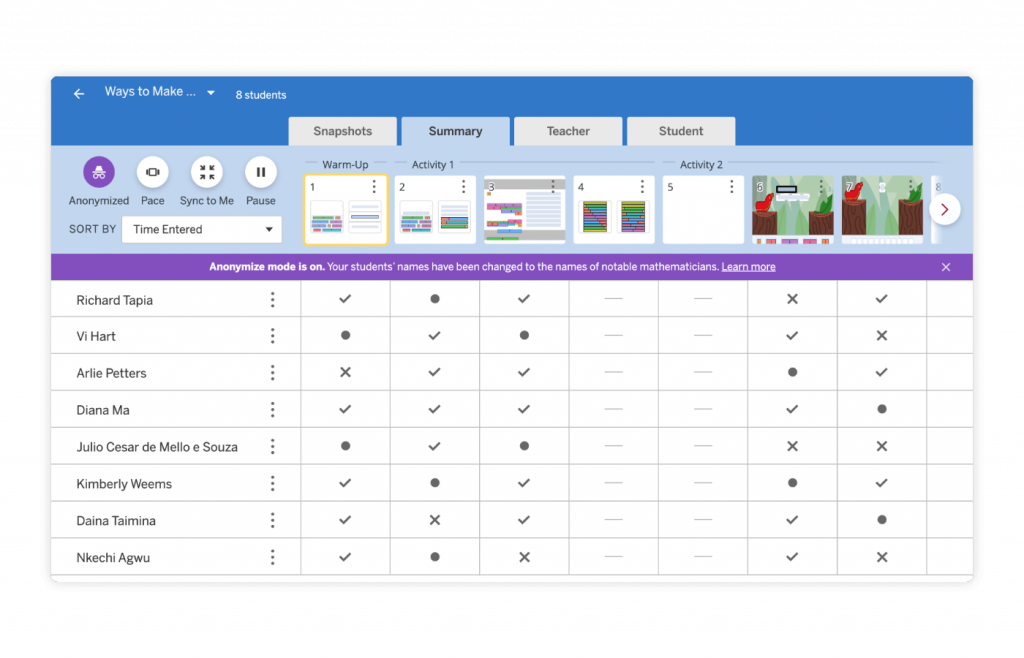
Cuando los estudiantes usan dispositivos, los maestros pueden supervisar su trabajo en tiempo real, asegurándose de que reciban el apoyo exacto que necesitan en cada parte de la lección, dentro y fuera del salón de clase.
Componentes de una lección
A los estudiantes en un aula de Amplify Desmos Math Texas se les ve (¡y se les escucha!) haciendo preguntas, debatiendo respuestas, justificando su razonamiento, enfrentándose a problemas y trabajando juntos o de forma individual.
Una lección típica de Amplify Desmos Math Texas incluye:
- Calentamiento: Un problema breve e interesante para que los estudiantes se sientan atraídos a la lección.
- Actividades: Una o dos actividades cortas que desafíen las destrezas de los estudiantes para resolver problemas.
- Síntesis: Una discusión para revisar y consolidar los conceptos importantes de la lección.
- Demuestra lo que sabes (Show What You Know) y Reflexión (Reflection): Preguntas para que los estudiantes demuestren lo que aprendieron en la lección. (Nota: La evaluación de la lección “Demuestra lo que sabes” es opcional en kindergarten y primer grado).
- Centros (Centers): Estaciones de actividades dirigidas por los estudiantes que refuerzan los conceptos matemáticos que aprendieron durante las actividades de la lección usando formatos interactivos y, a menudo, lúdicos. En kindergarten y primer grado, el tiempo destinado a los Centros se incorpora en los últimos 15 minutos de cada lección.
Para apoyar, fortalecer y ampliar el aprendizaje de los estudiantes después de la lección, Amplify Desmos Math Texas ofrece opciones de:
- Diferenciación: Minilecciones (Mini-Lessons), Centros, Extensiones, Boost Personalized Learning y Fluency Practice (Práctica de la fluidez).
- Práctica: Problemas adicionales que el maestro puede asignar para trabajar en clase o como tarea.
Apoye el aprendizaje de las matemáticas en casa.
Usted puede apoyar el aprendizaje de las matemáticas de su estudiante fuera de la escuela de muchas maneras:
El maestro puede asignar problemas de práctica al final de cada lección como trabajo en clase o como tarea. Si su estudiante ya ha completado los problemas de práctica de la lección, pídale que le explique cómo resolvió cada problema o que comente las partes que le resultaron difíciles. Haga preguntas de seguimiento para fomentar el uso del lenguaje matemático mientras explica su razonamiento, por ejemplo: “¿Cómo lo sabes?”, “¿Cómo puedes demostrar tu razonamiento?” o “¿Cómo describirías eso?”. Si su estudiante no consigue avanzar, hágale preguntas de apoyo, por ejemplo: “¿Qué información de aquí conoces?” o “¿Cómo podrías representar este problema?”.
Los juegos de Centro (Center game) se alinean con las matemáticas de la unidad y se pueden jugar con los estudiantes fuera de clase. Es posible que el maestro les explique a los estudiantes cómo jugar un juego de Centro durante o después de una lección. Si no es así, usted puede enseñarle a jugar usando instrucciones fáciles de seguir.
kindergarten
- Cubos de conexión
1.er grado
- Busca el par Formar 10
2.er grado
- ¿Qué tan cerca? Sumar hasta 100
3.er grado
- Rellenar los cuadrados: Multiplicar por 2, 5 y 10
4.er grado
- ¡Muy pronto!
5.er grado
- La batalla de los rectángulos: Factores 1-5
kindergarten
- Unidad 1: El primer día de clases
- Unidad 2: ¿Qué hay en un restaurante?
- Unidad 3: Figuras en una gran aventura
- Unidad 4: La ciudad de Casey
- Unidad 5: ¿Dónde está Harry?
- Unidad 6: Ganadores
- Unidad 7: Todos necesitamos ayuda
1.er grado
- Unidad 1: La nueva ciudad de Ying
- Unidad 2: ¡A plantar!
- Unidad 3: Imposible
- Unidad 4: Los coleccionistas
- Unidad 5: El día de las coloribazas
- Unidad 6: Uno al lado del otro
- Unidad 7: Un potluck para Pia
2.er grado
- Unidad 1: La nueva mascota de la clase
- Unidad 2: Los héroes de la calle Pineapple
- Unidad 3: Lo que imaginó Orson
- Unidad 4: Conducir por la calle Ricotta 302
- Unidad 5: Arjun, el artista
- Unidad 6: ¿Dónde está Eli?
- Unidad 7: En Clementine Court
3.er grado
- Unidad 1: Mi nombre es Harper
- Unidad 2: La vista desde acá arriba
- Unidad 3: Cocina casera
- Unidad 4: Coen y Obita
- Unidad 5: No te rindas, Sasha
- Unidad 6: A través de los ojos de Piho
4.er grado
- Unidad 1: Paso a paso
- Unidad 2: Finny
- Unidad 3: Myles y las tortugas bobas
- Unidad 4: Solo por diversión
- Unidad 5: Un lei especial para un día especial
- Unidad 6: El tesoro del capitán Bogwart
5.er grado
- Unidad 1: Joyful Green
- Unidad 2: Princess Sweetsocks
- Unidad 3: Andrea
- Unidad 4: Día del mercado
- Unidad 5: Las monarcas
- Unidad 6: Hanan Pacha
Relacione las matemáticas con actividades cotidianas en casa, ya sea ir de compras, preparar la comida o planear una visita a la tienda. Su estudiante puede ayudarle a calcular cuántas manzanas más hay en el carrito que naranjas, dividir un sándwich en cuatro partes o calcular cuánto cambio recibirá si paga con un billete de diez dólares. Anímelo a señalar las maneras en que ustedes usan las matemáticas en sus quehaceres diarios.
Recuerde al estudiante que bloquearse es una parte necesaria (incluso benéfica) del proceso de aprendizaje. Muchos estudiantes (al igual que personas adultas) temen equivocarse, pero las investigaciones demuestran que cometer errores ayuda a que nuestro cerebro se desarrolle. Cuando su estudiante no consiga avanzar en un problema, anímelo a seguir intentando diferentes estrategias, aunque no esté seguro de si son correctas.